

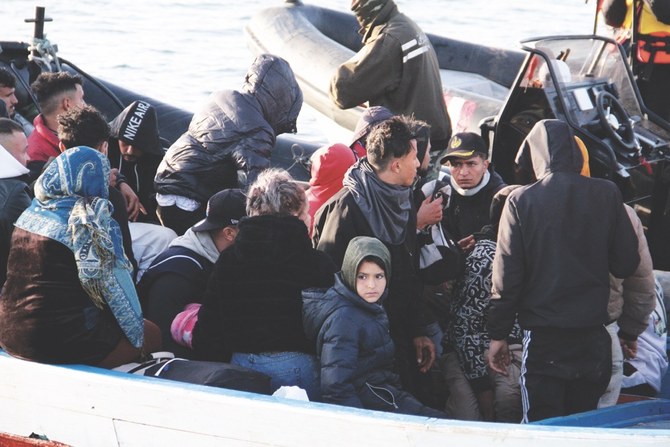

TUNIS: The Coast Guard has retrieved 41 bodies from Tunisian waters, a national guard official said on Friday, raising the number of victims of migrant shipwrecks off the country’s coast to 210 in 10 days.
The bodies were in a decomposed state, suggesting they had been in the water for several days, said Houssem Eddine Jebabli.
The cumulative total of fatalities was unprecedented over such a short period, he said.
Numbers of boats carrying migrants — most from sub-Saharan Africa, Syria and Sudan — trying to reach Italy from Tunisia have risen sharply in recent months, in part due to a crackdown on departures by authorities in Libya.
The country is struggling to contain the surge, and some morgues are running out of space to bury the victims.
Tunisia, whose coastline is less than 150 km from the Italian island of Lampedusa, has long been a favored stepping stone for migrants attempting the perilous sea journey from North Africa to Europe.
So many migrants risking the dangerous sea crossing from Tunisia to Europe have drowned that morgues and hospitals in the key launchpad city of Sfax are full, officials said on Friday.
“On Tuesday, we had more than 200 bodies, well beyond the capacity of the hospital, which creates a health problem,” said Faouzi Masmoudi, justice official in the port city where the central morgue for an area of around a million people is sited.
“There is a problem with large numbers of corpses arriving on the shore. We don’t know who they are or what shipwreck they came from — and the number is increasing.”
Masmoudi said there are funerals “almost every day to reduce the pressure on hospitals.”
On April 20, at least 30 people were buried.
Days later, many more bodies were recovered at sea.
DNA swabs are taken from each body before burial to help their possible identification by relatives, he said.
According to Romdhane Ben Amor of the Tunisian Forum for Economic and Social Rights or FTDES, more than 220 dead and missing have been recorded this year to April 24, mostly from sub-Saharan Africa.
More than three quarters of migrants leaving Tunisia do so from the coast between Sfax and Mahdia, some 90 km north, he added.
The problem of managing the bodies of those drowned in shipwrecks is complicated by the fact that local authorities “have undertaken to create a special cemetery for migrants on the grounds that they are not Muslims,” Ben Amor said.
The number of departures of migrants has intensified after President Kais Saied made a fiery speech on Feb. 21 claiming that illegal immigration was a demographic threat to Tunisia.
The country is also in the grip of a worsening economic crisis that has pushed many of its citizens to take desperate measures in search of better lives abroad.


