

Arab states could resolve Syria crisis, says UN special envoy

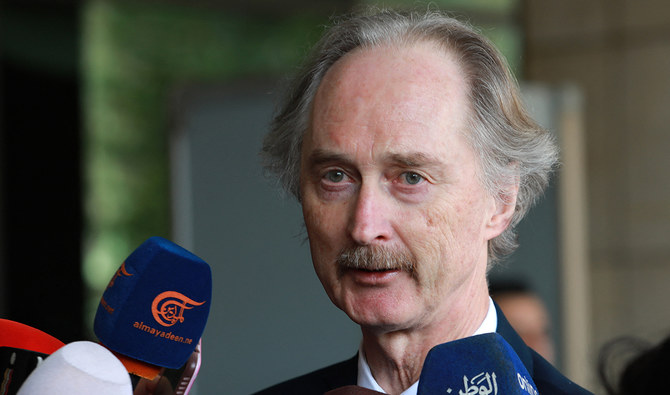
In this file photo, taken on February 13, 2023, United Nations Special Envoy for Syria Geir Pedersen speaks to journalists in Damascus. (Photo courtesy: AFP/File)
Short Url
Updated 28 April 2023
Follow

Arab states could resolve Syria crisis, says UN special envoy

  • Leadership of Saudi Arabia, Egypt, Jordan, UAE highlighted
  • Geir Pedersen remains positive about the possibility of peace

NEW YORK CITY: Arab nations can play a leading role in finding a political solution to the conflict and humanitarian aid crisis in Syria, according to UN Special Envoy for Syria Geir Pedersen.

Speaking at a special briefing of the UN Security Council on Thursday, Pederson said that despite all the challenges — which includes the effect of the recent devastating earthquakes — there were positive signs of a way forward.

Pederson highlighted the roles currently being played by leaders of several Arab states including from Saudi Arabia, Egypt, Jordan and the UAE. 

There have been several high-profile meetings with Syria’s president Bashar Assad to reestablish diplomatic ties, and possibly also see the country regaining its membership of the Arab League.

“I continue to stress that the political solution is the only way to end the suffering of the Syrian people and (find a way) towards stability, security, and peace,” said Pederson.

He said he continues to push for a “Syrian-led” and “Syrian-owned” political process, and that collective effort was needed to find long-lasting solutions.

“I am ready to facilitate the way forward in a step by step reported and verifiable manner consistent with UN Security Council Resolution 2254.”

Resolution 2254 affirmed in 2015 the independence and sovereignty of Syria and called for a Syrian-led process that will end the conflict and meet the legitimate aspirations of its people.

The UAE’s representative Mohamed Issa Abu Shahab emphasized that “Arab diplomacy” remained a key part of a resolution for Syria.

He said the recent consultative meeting of representatives from the GCC, along with Egypt, Jordan and Iraq, highlighted the need for Arab-led efforts.

Pederson noted in his report the continued violence between the regime’s forces and groups that control swaths of Syrian territory in the north and northwest. He added that Israeli airstrikes on targets inside Syria have become more frequent.

He said the Syrian people need urgent support. “After the earthquake and 12 years of war, Syria remains (in) a humanitarian crisis.”

The UN has already collected $384 million to help Syria’s people for its flash appeal, according to Lisa Doughten, resource mobilization director for the UN humanitarian coordination office.

However, the Syrian Humanitarian Response Plan remains severely underfunded because only $363 million has so far been collected out of a total of $4.8 billion needed before the earthquakes — making the Brussels Conference in June vital for the country, said Doughten.


Palestinian NGO condemns Israeli act of ‘revenge’ after prisoner abuse video

Updated 58 min 14 sec ago
Follow

Palestinian NGO condemns Israeli act of ‘revenge’ after prisoner abuse video

  • A Palestinian NGO has denounced what it called an Israeli act of revenge after a video showed far-right National Security Minister Itamar Ben Gvir overseeing the abuse of detainees in a military priso

RAMALLAH: A Palestinian NGO has denounced what it called an Israeli act of revenge after a video showed far-right National Security Minister Itamar Ben Gvir overseeing the abuse of detainees in a military prison.
Just days before the start of the Muslim holy month of Ramadan, Ben Gvir held a tour of Ofer Prison in the occupied West Bank, Israel’s Channel 7 reported.
In footage filmed on Friday and broadcast by the channel, around 20 police officers are seen storming a hallway leading to prison cells, brandishing their weapons and firing stun grenades.
They then pull five detainees from their cells, their hands tied behind their backs, forcing them face-down onto the floor.
The operation took place as a bill proposing the death penalty for Palestinian prisoners convicted of terrorism awaited a final vote in the Israeli parliament.
“This is all part of ongoing displays meant to take revenge on Palestinian detainees,” Abdallah al?Zaghari, head of the Palestinian Prisoners’ Club, told AFP on Saturday.
“Everything Ben Gvir and the far?right government are doing affects not only the Palestinian people and prisoners in detention camps — it also impacts the global legal and human rights system,” he added.
Ben Gvir, known for his inflammatory rhetoric, is considered one of the most hard-line members of Prime Minister Benjamin Netanyahu’s ruling coalition.
“It is simply a source of pride — arriving at a prison like this, a prison for terrorists, the vilest of the vile, seeing them like this,” Ben Gvir said in the video.
“I want one more thing: to execute them — the death penalty for terrorists,” he added.
Palestinian Islamist movement Hamas on Saturday said the remarks were “a new war crime and a blatant challenge to international humanitarian law regarding prisoners.”
International rights groups have repeatedly warned of alleged abuse and mistreatment inflicted in Israeli prisons since Hamas’s October 7, 2023, attack on Israel.
While the death penalty exists for a small number of crimes in Israel, it has become a de facto abolitionist country, with the Nazi Holocaust perpetrator Adolf Eichmann the last person to be executed in 1962.