

‘When will this hell end?’: Sudanese fear for lives as fighting worsens

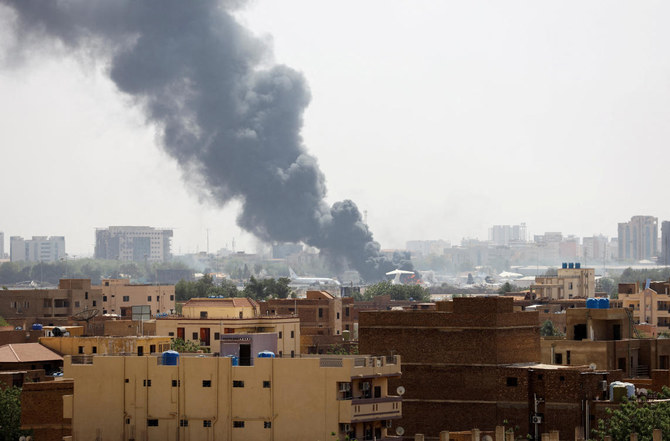
Smoke rises from burning aircraft inside Khartoum Airport during clashes between the paramilitary Rapid Support Forces and the army in Khartoum. (File/Reuters)
Short Url
Updated 29 April 2023
Follow

‘When will this hell end?’: Sudanese fear for lives as fighting worsens

  • Hundreds of people have been killed and tens of thousands have fled
  • The RSF accused the army of violating a ceasefire brokered by the US and Saudi Arabia

KHARTOUM: Strikes by air, tanks and artillery shook Sudan’s capital Khartoum and the adjacent city of Bahri on Friday despite a 72-hour truce extension by the army and the rival paramilitary Rapid Support Forces.
Hundreds of people have been killed and tens of thousands have fled for their lives in a power struggle that erupted on April 15 and disabled an internationally backed transition toward democratic elections.
The fighting has also reawakened a 20-year-old conflict in the western Darfur region where scores have died this week.
In the Khartoum area, heavy gunfire and detonations rattled residential neighbourhoods. Plumes of smoke rose above Bahri. “We hear the sounds of planes and explosions. We don’t know when this hell will end,” said Bahri resident Mahasin Al-Awad, 65. “We’re in a constant state of fear for ourselves and our children.”
The army has been deploying jets or drones on RSF forces spread out in neighborhoods across the capital. Many terrified residents are pinned down by urban warfare with little access to food, fuel, water and electricity.
At least 512 people have been killed and close to 4,200 wounded, according to the UN, but the real toll is thought to be much higher. The Sudan Doctors Union said at least 387 civilians had been killed.
The RSF accused the army of violating a ceasefire brokered by the US and Saudi Arabia with air strikes on its bases in Omdurman, Khartoum's sister city at the confluence of the Blue and White Nile rivers, and Mount Awliya. The army blamed the RSF for violations. The ceasefire is supposed to last until midnight on Sunday.
A Turkish evacuation plane came under fire as it was landing at Wadi Seyidna airport in Omdurman but there were no injuries. Sudan’s army accused the RSF of firing at the plane, damaging its fuel system which was being repaired after the aircraft managed to land safely. The RSF denied that, and accused the army of “spreading lies.”
Lulls in fighting this week allowed some Khartoum residents to leave and foreign evacuations to pick up. Two more evacuation ships arrived in Jeddah on Friday carrying 252 refugees of various nationalities, taking the total number of people brought to safety by Saudi Arabia to about 3,000.

But fighting has otherwise rumbled on through declared ceasefires as both sides appear to have shaky control of their troops.
The violence has sent tens of thousands of refugees across Sudan’s borders and threatens to compound instability across a volatile swath of Africa between the Sahel and the Red Sea.


Lebanon approves financial gap draft law despite opposition from Hezbollah and Lebanese Forces

Lebanon's Prime Minister Nawaf Salam speaking during a press conference after a cabinet session in Beirut on December 26, 2025.
Updated 8 sec ago
Follow

Lebanon approves financial gap draft law despite opposition from Hezbollah and Lebanese Forces

  • Legislation aims to address the fate of billions of dollars in deposits that have been inaccessible to Lebanese citizens during the country’s financial meltdown

BEIRUT: Lebanon’s Cabinet on Friday approved a controversial draft law to regulate financial recovery and return frozen bank deposits to citizens. The move is seen as a key step in long-delayed economic reforms demanded by the International Monetary Fund.

The decision, which passed with 13 ministers voting in favor and nine against, came after marathon discussions over the so-called “financial gap” or deposit recovery bill, stalled for years since the banking crisis erupted in 2019. The ministers of culture and foreign affairs were absent from the session.

The legislation aims to address the fate of billions of dollars in deposits that have been inaccessible to Lebanese citizens during the country’s financial meltdown.

The vote was opposed by three ministers from the Lebanese Forces Party, three ministers from Hezbollah and the Amal Movement, as well as the minister of youth and sports, Nora Bayrakdarian, the minister of communications, Charles Al-Hajj, and the minister of justice, Adel Nassar.

Finance Minister Yassin Jaber broke ranks with his Hezbollah and Amal allies, voting in favor of the bill. He described his decision as being in line with “Lebanon’s supreme financial interest and its obligations to the IMF and the international community.”

The draft law triggered fierce backlash from depositors who reject any suggestion they shoulder responsibility for the financial collapse. It has also drawn strong criticism from the Association of Banks and parliamentary blocs, fueling fears the law will face intense political wrangling in Parliament ahead of elections scheduled in six months.

Prime Minister Nawaf Salam confirmed the Cabinet had approved the bill and referred it to Parliament for debate and amendments before final ratification. Addressing public concerns, he emphasized that the law includes provisions for forensic auditing and accountability.

“Depositors with accounts under $100,000 will be repaid in full with interest and without any deductions,” Salam said. “Large depositors will also receive their first $100,000 in full, and the remainder will be issued as negotiable bonds backed by the assets of the Central Bank, valued at around $50 billion.”

He said further that bondholders will receive an initial 2 percent payout after the first tranche of repayments is completed.

The law also includes a clause requiring criminal accountability. “Anyone who smuggled funds abroad or benefited from unjustified profits will be fined 30 percent,” Salam said.

He emphasized that Lebanon’s gold reserves will remain untouched. “A clear provision reaffirms the 1986 law barring the sale or mortgaging of gold without parliamentary approval,” he said, dismissing speculation about using the reserves to cover financial losses.

Salam admitted that the law was not perfect but called it “a fair step toward restoring rights.”

“The banking sector’s credibility has been severely damaged. This law aims to revive it by valuing assets, recapitalizing banks, and ending Lebanon’s dangerous reliance on a cash economy,” he said. “Each day of delay further erodes people’s rights.”

While the Association of Banks did not release an immediate response after the vote, it previously argued during discussions that the law would destroy remaining deposits. Bank representatives said lenders would struggle to secure more than $20 billion to cover the initial repayment tier and accused the state of absolving itself of responsibility while effectively granting amnesty for decades of financial mismanagement and corruption.

The law’s fate now rests with Parliament, where political competition ahead of the 2025 elections could complicate or delay its passage.

Lebanon’s banking sector has been at the heart of the country’s economic collapse, with informal capital controls locking depositors out of their savings and trust in state institutions plunging. International donors, including the IMF, have made reforms to the sector a key condition for any financial assistance.