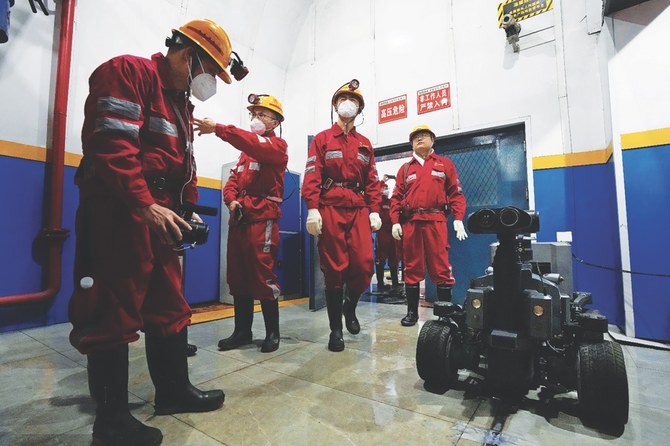

RIYADH: China is using “smart” technology to try to improve its safety record in coal mines, as part of a push by the National Energy Administration to bolster output and stem accidents.
Smart-mine sensors monitor aspects such as gas buildup and flooding or ventilation levels, and set off an alert if any reach a dangerous level. The sensors, located inside the mine and on carts and tools, transfer the data via 5G, allowing for real-time monitoring by a central command.
Huawei Technologies Ltd., better known for telecommunications equipment, teamed up with state-owned Shaanxi Coal Industry Co. to pilot its intelligent coal mine technology in Hongliulin and Xiaobaodang.
The system has allowed Shaanxi to reduce the number of people working underground by 42 percent at the Xiaobaodang mine, while increasing production levels. Miners now work with the help of robots, which monitor equipment while centrally controlled shearers are used to collect coal.
Credit support
China’s banking and insurance regulator said it would enhance credit support and lower the actual financing costs of small and micro enterprises this year to better support economic recovery.
In a statement on Thursday, the China Banking and Insurance Regulatory Commission said financial institutions should provide reasonable credits to small businesses, while preventing the risk of “over-lending.”
The CBIRC said it aims to improve the quality of financial services for small and micro enterprises, to promote market vitality and boost confidence.
FASTFACTS
• The system has allowed Shaanxi to reduce the number of people working underground by 42 percent at the Xiaobaodang mine, while increasing production levels.
• Miners now work with the help of robots, which monitor equipment while centrally-controlled shearers are used to collect coal.
• The sensors, located inside the mine and on carts and tools, transfer the data via 5G, allowing for real-time monitoring by a central command.
Financial institutions should price lending rates reasonably based on the benchmark loan prime rate and the characteristics of small and micro businesses, it said.
The CBIRC added that it would optimize the credit structure for small businesses and meet reasonable financing needs of small businesses with a credit line above 10 million yuan ($1.44 million).
The regulator also said financial institutions should not renew loans for non-business and production purposes, and that financial institutions should not cover up credit risks with loan renewals.
Battery costs
BTR New Material Group sees the price of nickel falling by about two-thirds, an executive from the Chinese battery material supplier said, a prediction that if
fulfilled, points to sharply lower battery costs that could benefit firms like Tesla.
As capacity grows, the price of the metal should fall to $8,000 a ton, down from $24,000 a ton
now, Yang Shunyi, vice general manager of BTR, told the China Automotive Battery Innovation Alliance forum in Changzhou city on Thursday.
This would bring down costs of cathode materials with 90 percent nickel used in batteries powering electric cars by 30 percent, Yang said.
Yang said he visited nickel producers in Indonesia two weeks ago and he estimated its planned nickel refinery capacity could supply about 4 million tons of nickel-based cathode or 3 gigawatt-hours of batteries annually.
“As those projects roll out production this year, the demand and supply is reversed with supply of nickel outweighing demand in 2023. Nickel price is bound to fall downward and in the middle to long term, it will stay at around $8,000,” he said.