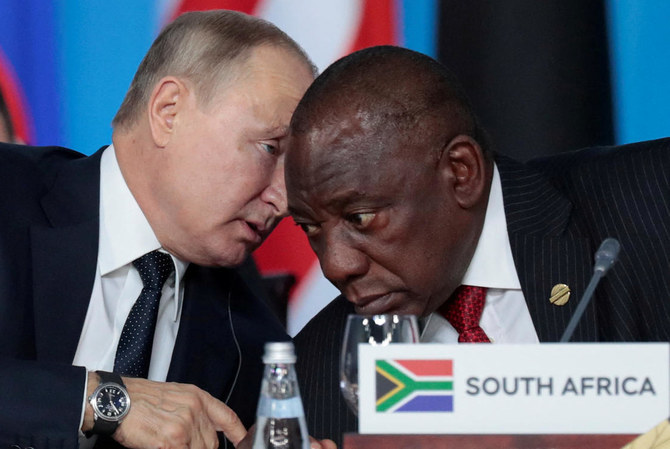
JOHANNESBURG: South African President Cyril Ramaphosa rowed back on Wednesday from a pledge to quit the International Criminal Court, months before he is due to host Russia’s Vladimir Putin who is wanted by the ICC for suspected war crimes.
Ramaphosa had said on Tuesday that the ruling African National Congress would aim to repeal South Africa’s membership of the Hague-based court, which hears cases of genocide, war crimes and crimes against humanity. But on Wednesday, Ramaphosa’s office said he had made a mistake.
“South Africa remains a signatory to the ICC in line with a resolution of the 55th National Conference of the ANC – held in December 2022 – to rescind an earlier decision to withdraw from the ICC,” the presidency said in a statement.
“The December resolution was reaffirmed at a meeting of the National Executive Committee of the ANC during the weekend of 21 to 24 April 2023.”
The ICC issued an arrest warrant in March for Putin, accusing him of the war crime of forcibly deporting children from Russian-occupied territory in Ukraine. Moscow denies committing war crimes including forced deportations of children, and says the ICC has no authority as Russia is not a member.
Putin is due to visit South Africa in August for a summit of the BRICS group of emerging economies comprising Brazil, Russia, India, China and South Africa. As an ICC member, South Africa would be required to detain him.
Putin has not traveled abroad since the ICC warrant was issued. He has made only one trip outside the former Soviet Union — to Iran — since launching the invasion of Ukraine last year.
The ANC decided at its national conference in December that South Africa should abandon a legislative process to pull out of the ICC and try to effect changes to the organization from within.
The presidency said on Wednesday that South Africa would work toward establishing an African continental criminal court that would complement the ICC as a court of last resort.


South Africa, due to host Russia’s Vladimir Putin, rows back from pledge to quit war crimes court
https://arab.news/6sxmx
South Africa, due to host Russia’s Vladimir Putin, rows back from pledge to quit war crimes court

- Ruling African National Congress aims to repeal South Africa’s membership of the Hague-based court
- The International Criminal Court issued an arrest warrant in March for Russian leader


French court slashes jails term for trio over 2020 teacher beheading
- Brahim Chnina, the Moroccan father of a girl who falsely claimed that Paty had asked Muslim students to leave his classroom before showing the caricatures, had his 13-year sentence reduced to 10 years
PARIS, France: A French court on Monday reduced on appeal the jail sentences of three men convicted over the 2020 terrorist beheading of a teacher who showed a class cartoons of the Prophet Muhammad.
Samuel Paty, 47, was murdered in October 2020 by an 18-year-old radical Islamist of Chechen origin in an act that horrified France.
His attacker, Abdoullakh Anzorov, was killed in a shootout with police.
Two friends of Anzorov, French national Naim Boudaoud and Azim Epsirkhanov, a Russian of Chechen origin, had their sentences of 16 years in prison reduced to six and seven years respectively by a Paris court of appeal.
Both were accused of having driven Anzorov and helping him to procure weapons before the beheading.
Brahim Chnina, the Moroccan father of a girl who falsely claimed that Paty had asked Muslim students to leave his classroom before showing the caricatures, had his 13-year sentence reduced to 10 years.
His daughter, then aged 13, was not actually in the classroom at the time and during the first trial apologized to the teacher’s family.
The court however left the 15-year term for French-Moroccan Islamist activist Abdelhakim Sefrioui untouched.
The quartet were among the seven men and one woman found guilty in 2024 of contributing to the climate of hatred that led to the beheading of the history and geography teacher in Conflans-Sainte-Honorine, west of Paris.
Paty, who has become a free-speech icon, used the cartoons as part of an ethics class to discuss freedom of expression laws in France.


