First batch of Pakistani evacuees from Sudan arrives in Jeddah

A Saudi Navy sailor carries a child as a Saudi ship transporting evacuees of different nationalities from Sudan arrive at the King Faisal Naval Base in Jeddah on April 24, 2023. (SPA)
Short Url
Updated 26 April 2023
Follow

First batch of Pakistani evacuees from Sudan arrives in Jeddah

  • There are about 1,300 Pakistanis in Sudan, out of which 900 have so far been moved to safety in Port Sudan
  • Pakistan’s Foreign Office expresses gratitude to Saudi Arabia for its support and hospitality to Pakistani nationals

ISLAMABAD: The first batch of 37 Pakistani nationals from the battle-scarred Sudan arrived in Jeddah on a ship early Wednesday morning, the Foreign Office in Islamabad confirmed, expressing its gratitude to the Saudi authorities for helping with the evacuation process of its citizens.

Pakistan’s diplomatic mission in Sudan has managed to evacuate over 900 of its nationals from the capital city of Khartoum, which has remained embroiled in conflict for the last several days, and brought them to the safety of Port Sudan, which is situated on the eastern coast.

Of these, 200 Pakistani nationals were brought to Port Sudan on Wednesday of which 37 arrived in Jeddah, while the remaining 863 persons are waiting for their transportation arrangements to the kingdom. 

There are more than 1,300 Pakistanis in Sudan, which is witnessing fierce fighting between its army and powerful paramilitary forces. The evacuation process became possible after the initiation of a 72-hour cease-fire between the two warring camps, which was brokered by the United States after 10 days of urban warfare resulting in hundreds of deaths.
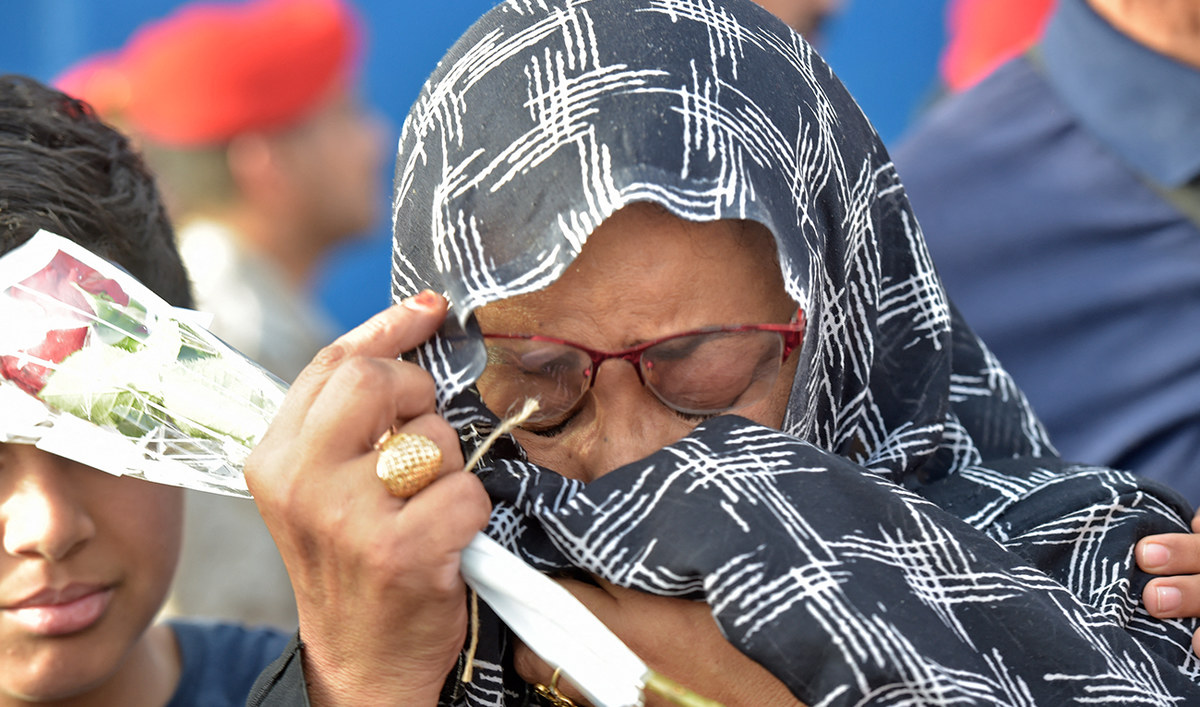


A woman cries as she arrives at King Faisal navy base in Jeddah on April 26, 2023 following a rescue operation from Sudan amid a US-brokered ceasefire between the country's warring generals. (AFP)

The conflict also injured a large number of people before triggering an exodus of foreigners.

“The ship carrying 37 Pakistani nationals from Port Sudan arrives in Jeddah,” the Foreign Office said in a Twitter post, adding the evacuation plan to rescue Pakistani nationals was continuing in Sudan. “They were received by [Consul General] in Jeddah, Khalid Majid, on arrival at Jeddah Port,” it said. “We are grateful to the Government of the Kingdom of Saudi Arabia for its support and hospitality.”

“Another convoy of 200 Pakistanis has arrived safely in Port Sudan and the Embassy of Pakistan in Sudan will continue to facilitate their stay in Port Sudan and arrange their eventual repatriation from Sudan,” it added.

Hamzah Gilani, a spokesperson for the Pakistani consulate in Jeddah, said the Saudi government was taking care of the accommodation and other needs of the evacuees.

“I would like to express my sincere gratitude to the Saudi government for facilitating the evacuation of Pakistani citizens who were stranded in Sudan, and special thanks go to the leadership of King Salman and Crown Prince Mohammed bin Salman for providing logistical support and accommodation,” he told Arab News over the phone from Jeddah.

“This humanitarian effort is a testament to the deep friendship between Pakistan and Saudi Arabia,” he added.

According to a statement issued by the Saudi foreign ministry earlier in the day, the kingdom brought 13 of its citizens along with 1,674 people belonging to other nationalities to its seashore.

So far, Saudi Arabia has evacuated about 2,148 individuals belonging to 62 nationalities since the beginning of the conflict in Sudan.


Pakistan minister calls for integrating ocean awareness into education to preserve ecosystems

Updated 5 sec ago
Follow

Pakistan minister calls for integrating ocean awareness into education to preserve ecosystems

  • Pakistan’s maritime sector posted a record $360 million profit in 2025 following a year of sweeping reforms
  • Junaid Anwar Chaudhry says education equips youth to make informed decisions, contribute to blue economy

KARACHI: Pakistan’s Maritime Affairs Junaid Anwar Chaudhry has urged integrating ocean awareness into formal education systems and empowering youth as active partners in order to preserve marine ecosystems, his ministry said on Saturday.

Chaudhry said this at a meeting with Minister of State for Education and Professional Training, Wajiha Qamar, who called on him and discussed strategies for enhancing marine education, literacy, and youth engagement in sustainable ocean management.

Pakistan’s maritime sector posted a record Rs100 billion ($360 million) profit in 2025 following a year of sweeping reforms aimed at improving port efficiency, cost-cutting, and safeguarding marine ecosystems to boost the blue economy.

“Understanding our oceans is no longer optional, it is essential for climate resilience, sustainable development, and the long-term health of our maritime resources,” Chaudhry said, highlighting the critical role of marine literacy.

The minister said education equips youth to make informed decisions and actively contribute to marine conservation and the blue economy, urging inclusion of marine ecosystems, conservation and human-ocean interactions into curricula, teacher training and global citizenship programs.

“Initiatives like ‘Ocean Literacy for All’ can mainstream these elements in national policies, school programs, and community workshops to build proactive citizenship on marine challenges,” he added.

Ocean Literacy for All is a UNESCO Intergovernmental Oceanographic Commission–coordinated global initiative under the UN Ocean Decade (2021–2030) that promotes ocean awareness, education, and conservation.

Chaudhry announced reforms in maritime education, including granting degree-awarding status to the Pakistan Marine Academy, and the establishment of the Maritime Educational Endowment Fund (MEEF) to provide scholarships for deserving children from coastal communities.

“The scholarship program promotes inclusive development by enabling access to quality education for youth from over 70 coastal and fishing communities, particularly in Sindh and Balochistan,” he said.

The discussions underscored raising awareness about oceans, coastal ecosystems and marine resources, according to the Pakistani maritime affairs ministry. Both ministers stressed the need to integrate climate and marine education from classrooms

to community programs, addressing risks like rising sea temperatures, coastal erosion, biodiversity loss and pollution.

“Incorporating marine science and ocean literacy into curricula can help students connect local challenges with global trends,” Qamar said, underscoring education’s transformative power in building social resilience.

The meeting explored translating complex marine science into accessible public knowledge through sustained, solution-oriented awareness campaigns, according to the maritime affairs ministry.

With coastline facing pressures from climate change, pollution, and overexploitation, the ministers called for a coordinated approach blending formal education, informal learning and youth-led advocacy.

“A joint effort by the Ministries of Maritime Affairs and Education can cultivate an ocean-literate generation, transforming vulnerability into resilience and ensuring the long-term sustainability of coastal and marine ecosystems,” Chaudhry said.