

Amid allegations of meddling in politics, Pakistan’s army says does not support any group or ideology

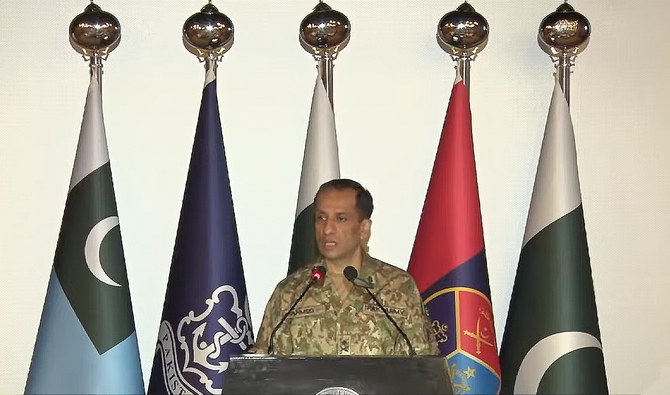
Pakistan's military spokesperson Maj. Gen. Ahmed Sharif Chaudhry is addressing media in Islamabad, Pakistan, on April 25, 2023. (Screengrab taken from PTV News)
Short Url
Updated 25 April 2023
Follow

Amid allegations of meddling in politics, Pakistan’s army says does not support any group or ideology

  • Military’s spokesperson says army cannot be pressurized ‘through coercion and deception’ on social media
  • Maj-Gen Ahmed Sharif Chaudhry says army’s rules, training does not allow it to respond to each and every allegation

ISLAMABAD: Pakistan’s army neither supports any particular political party or ideology nor does it wish to divert its focus from the country’s security by engaging in “useless discussions,” its spokesman said on Tuesday, amid allegations of meddling in the country’s politics. 

Since the ouster of ex-prime minister Imran Khan in a parliamentary no-trust vote in April last year, the Pakistani military establishment, particularly former army chief General Qamar Javed Bajwa, has been widely called out by Khan and his supporters for meddling in political affairs of the country. 

In his farewell speech last year, General Bajwa dismissed Khan’s allegations against him as “fake and false,” but admitted it was the military’s “illegal” and “unconstitutional” interference in politics in the past that had invited criticism. He stressed the army would no longer play any role in national politics moving forward. 

Asked about the army’s political role at a press conference on Tuesday, Maj. Gen. Ahmed Sharif Chaudhry, the new director-general of the military’s media wing, reiterated that Pakistan’s army respected all political parties and it did not support any particular ideology. 

“All political parties are respectable to us because the army of Pakistan is a national army,” Maj. Gen. Chaudhry said. “We do not support any particular political party or ideology”. 

While the constitution of Pakistan granted freedom of expression to every citizen, the same constitution defined some “limits” too, the military spokesman said, when asked about criticism of the army on social media platforms lately. 

“And Pakistan Army also has its rules, training, and discipline in place, which do not allow us to readily respond to all the allegations hurled against the establishment,” he said. 

The office of the army chief is arguably the most powerful position in Pakistan, with the army having ruled the South Asian country for almost half of its 75-year history either through coups or as an invisible guiding hand in politics. 

Khan’s criticism sparked a public debate about the role of the military in Pakistani politics, particularly resonating with young, social-media-savvy Pakistanis, who came out in fierce condemnation of what they deemed military’s meddling in politics. 

Maj. Gen. Chaudhary stressed the army did not want to engage in “useless discussions” that would divert its attention from security operations, saying whatever was being posted online about the Pakistani forces was “unconstitutional.” 

“Pakistan Army cannot be pressurized through coercion and deception,” he added. 

The military spokesman also urged the media and the public to refrain from relying on unverified information about the army on social media and only refer to authentic accounts for news and information. 


Pakistan says 14 suspected militants killed in separate raids in insurgency-hit Balochistan

Updated 4 sec ago
Follow

Pakistan says 14 suspected militants killed in separate raids in insurgency-hit Balochistan

  • Counterterrorism department says eight suspects killed in Quetta operation, six in Barkhan raid
  • Security forces have stepped up anti-militancy operations after last month’s coordinated attacks in Balochistan

QUETTA: Pakistani security forces killed 14 suspected militants in two separate counterterrorism operations in southwestern Balochistan province, police said on Wednesday, as authorities intensify action against insurgent groups after recent large-scale attacks in the region.

Balochistan, Pakistan’s largest but least populated province bordering Iran and Afghanistan, has faced a decades-long separatist insurgency in which militants target security forces, infrastructure and civilians. The violence escalated last month when coordinated attacks across multiple districts in the province killed 36 civilians and 22 security forces. The state says 216 militants were killed in subsequent operations.

Separatist groups such as the Baloch Liberation Army (BLA) accuse the state of exploiting the resource-rich region, a claim Islamabad denies.

“In Quetta’s Darakhshan area, eight suspected terrorists were killed in an exchange of fire during a Counter Terrorism Department operation,” a CTD spokesperson said in a statement, adding that three CTD personnel were also injured and weapons and ammunition were recovered.

The spokesperson said the killed suspects were believed to belong to a banned organization.

In a separate intelligence-based operation in Barkhan district, security forces killed six suspected militants during another firefight.

“During the operation, weapons and explosive material were recovered from the terrorists,” the spokesperson said, adding that the suspects were involved in sabotage activities and their bodies were shifted to Rakhni Hospital.

Security officials say raids and targeted operations will continue as part of broader efforts to dismantle militant networks operating across the province.