

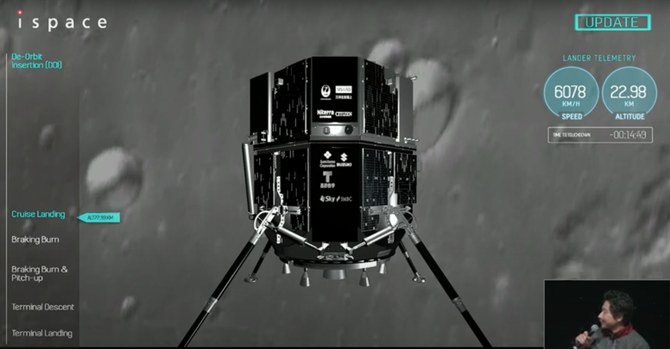

TOKYO: A Japanese company tried to land its own spacecraft on the moon early Wednesday, but its fate was unknown as flight controllers lost contact with it moments before the planned touchdown.
The 7-foot lander (2.3-meter) carried a mini lunar rover for the United Arab Emirates and a toylike robot from Japan designed to roll around in the moon dust. There were also items from private customers on board.
Controllers peered at their screens in Tokyo, expressionless, as the minutes went by with still no word from the lander.
A webcast commentator urged everyone to be patient, as the controllers investigated what might have happened. Contact was lost as the lander descended the final 33 feet (10 meters), traveling around 16 mph (25 kph).
“Everyone, please give us a few minutes to confirm,” he urged.
If successful, the company ispace would be the first private business to pull off a lunar landing.
Only three governments have successfully landed on the moon: Russia, the US and China. An Israeli nonprofit tried to land on the moon in 2019, but its spacecraft was destroyed on impact.
Named Hakuto, Japanese for white rabbit, the spacecraft had targeted Atlas crater in the northeastern section of the moon’s near side, more than 50 miles (87 kilometers) across and just over 1 mile (2 kilometers) deep.
Hakuto took a long, roundabout route to the moon following its December liftoff, beaming back photos of Earth along the way.


