

G7 calls for extension, full implementation and expansion of Black Sea grain deal 

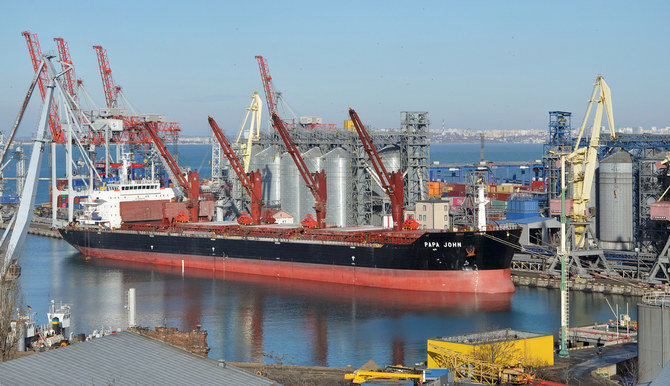
Grain sales are a vital revenue source for Kyiv, and food import bans imposed by four EU member states in Eastern Europe have increased Ukraine's concerns about its food exports. (Shutterstock)
Short Url
Updated 23 April 2023
Follow

G7 calls for extension, full implementation and expansion of Black Sea grain deal 

RIYADH: The Group of Seven economic powers called on Sunday for the "extension, full implementation and expansion" of a critical deal to export Ukrainian grain through the Black Sea, the group's agriculture ministers said in a communique. 

Brokered by the UN and Turkey, the deal was signed in Istanbul last July, allowing Ukraine to export more than 27 million tons of grain from several of its Black Sea ports. 

Russia, which invaded its neighbor in February 2022, has strongly signaled that it will not allow the deal to continue beyond May 18 because a list of demands to facilitate its own grain and fertilizer exports has not been met. 

In the communique after a two-day meeting in Miyazaki, Japan, the G7 agriculture ministers "recognized the importance" of the deal, saying: "We strongly support the extension, full implementation and expansion of (the Black Sea Grain Initiative) BSGI." 

G7 members "stand ready" to support recovery and reconstruction of Ukraine, including by providing expertise in de-mining of agricultural land and reconstruction of agricultural infrastructure, the document said. 

Russian Foreign Minister Sergei Lavrov is scheduled to discuss the Ukraine Black Sea grain export deal with UN Secretary-General Antonio Guterres in New York this week. 

Meanwhile, Ukraine's prospects of unblocking grain shipments to Eastern Europe improved last Friday as Romania opted against a unilateral ban on food imports, but there was no progress on extending a deal on Black Sea exports. 

Grain sales are a vital revenue source for Kyiv, and food import bans imposed by four EU member states in Eastern Europe have increased Ukraine's concerns about its food exports. 

Offering Kyiv some relief, Romania said it would not join Bulgaria, Hungary, Poland and Slovakia in banning food imports from Ukraine to protect local producers hit by an influx of cheaper Ukrainian supplies. 

Instead, Bucharest will wait for the European Commission, the EU executive, to enforce measures to help farmers in central and eastern Europe. 

"I think it is necessary we wait ... to see what the Commission decides, and then we will meet again to establish long-term rules, because Romania and Ukraine are large grain producing countries," Agriculture Minister Petre Daea said. 

A major grain transit hub for Ukraine, Romania's Black Sea port of Constanta shipped some 12 million tons of Ukrainian grains in 2022 and the first quarter of this year. 

Daea said, after talks with Ukrainian Agriculture Minister Mykola Solsky, that Romania and Ukraine would consult weekly on expected grain volumes, as Romania tries to limit imports. 

Solsky told reporters it was obvious the situation required quick decisions, adding: "We understand these decisions must be comfortable for Romanian farmers and ... we wait for the European Commission." 

GRAIN DEAL HANGS IN BALANCE 

The European Commission has announced plans to offer farmers in eastern and central Europe compensation for some products if the unilateral import bans are lifted, but the countries affected want the list of products widened. 

Black Sea grain exports are more significant for Kyiv than exports to Eastern Europe, and talks are under way on the status of the Black Sea Grain Initiative deal agreed last July to create a safe shipping channel. 

The initiative unblocked three Ukrainian Black Sea ports five months after Russia's invasion, and was designed to alleviate a global food crisis as well as to support Ukraine. 

Russia says it has agreed to extend the deal only until May 18 even though Kyiv and its allies say the terms of the agreement stipulate that it should continue beyond that date. 

Worried about its ability to ship grain from its Black Sea ports, Ukraine has stepped up exports via ports on the Danube River that flows though central and southeastern Europe. 


UNCTAD, Social Development Bank launch fellowship to power Saudi entrepreneurs

Updated 23 December 2025
Follow

UNCTAD, Social Development Bank launch fellowship to power Saudi entrepreneurs

RIYADH: The Social Development Bank has signed a memorandum of understanding with UN Trade and Development to launch the “Empretec Saudi Fellowship,” a new initiative aimed at equipping high-potential Saudi entrepreneurs with advanced training and tools to scale their ventures.

The agreement was signed on the sidelines of the second edition of the DeveGo 2025 forum, held on Dec. 21–22 at the King Abdulaziz International Conference Center in Riyadh. The event brought together entrepreneurs, policymakers, and representatives from regional and international organizations, alongside public and private sector leaders.

Featuring more than 150 exhibitors, 85 speakers, and 45 workshops, the forum focused on sharing local and global best practices and strengthening the Kingdom’s entrepreneurial ecosystem.

The Empretec Saudi Fellowship is part of UNCTAD’s flagship capacity-building program to promote entrepreneurship and support micro, small, and medium-sized enterprises and startups. Active in more than 40 countries, the program seeks to develop personal entrepreneurial behaviors through intensive training, access to international experts, and technical tools that help transform promising ideas into scalable, high-impact businesses.

Rebeca Grynspan, UNCTAD secretary-general, said Saudi Arabia offers fertile ground for entrepreneurial growth.

“Saudi Arabia has a wonderful platform to bring everybody up, and the entrepreneurs here are so eager. They have ideas, creativity, and energy,” she told Arab News. “If they come through our program with the Social Development Bank, which does a wonderful job, they will be more successful — because that’s what we want.”

In his opening remarks, Saudi Minister of Human Resources and Social Development Ahmed Al-Rajhi, who also chairs the SDB board, highlighted the rapid evolution of the Kingdom’s startup landscape.

“The Kingdom is witnessing a qualitative transformation in the entrepreneurship and freelance ecosystem, enabling young men and women to enter new promising sectors such as artificial intelligence, renewable energy, advanced technologies, and venture capital,” he said. “This provides broader opportunities to contribute to innovation, expansion, and global competitiveness.”

During a tour of the exhibition alongside Al-Rajhi, Grynspan met a wide range of small and medium-sized businesses and handicraft makers, praising the depth of local talent. She noted that participants spanned the full spectrum of enterprises — from early-stage ventures to more established and sophisticated companies — reflecting a rich diversity of experience.

Al-Rajhi said the Social Development Bank invests more than SR8 billion annually to support enterprises and entrepreneurs, helping raise employment in bank-financed businesses from about 12,000 in 2021 to more than 140,000 in 2025.

Beyond financing, the bank runs several non-financial programs, including the Jada 30 business communities, which have incubated more than 4,300 enterprises across 13 cities, and the Dulani Business Center, which has delivered over 67,000 consultations benefiting more than 150,000 male and female entrepreneurs.

Speaking on the broader economic outlook, Grynspan added: “This is a wonderful place to come. Now is an economy that is thriving, is a population that is hopeful. And you have these young, talented people that are only waiting for an opportunity to make it happen for everybody.”

During the forum, the bank also signed multiple cooperation agreements spanning key sectors such as finance, education, energy, healthcare, heritage, the nonprofit sector, and freelance work. The partnerships align with SDB’s strategy to build an integrated system of financial and non-financial empowerment tailored to the needs of entrepreneurs, startups, and micro-enterprises.