

Chile’s plan for state control in lithium dismays business

1 / 4
A truck transports magnesium chloride from the lithium mine of the Chilean company SQM (Sociedad Quimica Minera) in the Atacama Desert, Calama, Chile. (AFP)
2 / 4
A view of a brine pool of a lithium mine on the Atacama salt flat in the Atacama desert, Chile, August 16, 2018. (REUTERS/File Photo)
3 / 4
Aerial view of brine ponds and processing areas of the lithium mine of the Chilean company SQM (Sociedad Quimica Minera) in the Atacama Desert, Calama, Chile. (AFP File)
4 / 4
Aerial view of brine ponds and processing areas of the lithium mine of the Chilean company SQM (Sociedad Quimica Minera) in the Atacama Desert, Calama, Chile. (AFP File)
Short Url
Updated 22 April 2023
Follow

Chile’s plan for state control in lithium dismays business

  • Chile is the second largest producer of lithium and holds the world’s third largest reserves of the metal
  • Demand for lithium, a metal used to make rechargeable batteries, is soaring amid a growth in electric vehicles

SANTIAGO, Chile: The Chilean government’s newly announced plan to have the state take a majority stake in the lithium industry disconcerted business leaders, though analysts cautioned that the proposal appears to try to strike a middle ground between competing interests.

President Gabriel Boric announced in a national broadcast Thursday night that private companies will have to partner with the government in exploiting Chile’s lithium, a metal used to make rechargeable batteries.


Chile's President Gabriel Boric speaks during an event to present the National Lithium Strategy in Antofagasta, Chile, on April 21, 2023. (AFP)

Boric said the state would take a controlling interest in each partnership, leading some to call it a nationalization of the industry, while others disagreed.
“Phrasing it as nationalization is too strong … it’s a quasi-nationalization in that the playing field will now be leveled in favor of the state,” said Nicolás Saldías, senior analyst at the Economist Intelligence Unit for Latin America and the Caribbean. “There is no level playing field for the private sector in Chile.”
Chile is the second largest producer of lithium and holds the world’s third largest reserves of the metal. Demand for lithium is expected to soar amid the transition to renewable energy around the world and the growth in electric vehicles that are powered by lithium batteries.
The South American country has recently been losing ground to others in the race to exploit the metal so there was much anticipation over what Boric, a leftist, would announce as the country’s strategy for the industry.
“There were no great surprises, which doesn’t mean that it isn’t a very important change in the model,” said Mariano Machado, principal analyst for the Americas at Verisk Maplecroft, a global risk intelligence firm.


Aerial view of brine ponds and processing areas of the lithium mine of the Chilean company SQM (Sociedad Quimica Minera) in the Atacama Desert, Calama, Chile. (AFP)

Under the plan, all companies wanting to work in Chile’s lithium sector will have to take on the yet-to-be created National Lithium Company as a partner and the “state will have control,” Boric said Thursday. Existing contracts will be honored, but Boric expressed optimism they could find a way to boost state participation in their operations before they expire.
“It’s not a theft of the concessions, it’s a changing of the rules rather than abruptly breaking them,” said Emily Hersh, CEO of Luna Lithium, a lithium exploration company with projects in the Americas.
Two companies currently mine lithium in Chile, Albemarle Corp. of the United States and local company SQM with concessions set to expire in 2043 and 2030, respectively. Shares in the two companies plunged Friday following Boric’s announcement.
Creation of the new company would require approval from Congress, which has already shot down several of Boric’s key initiatives.
Until then, two other state-owned companies, Codelco, the world’s largest copper producer, and state mining company Enami will figure out how the private-public partnerships will operate.
Chile’s president traveled Friday to Antofagasta, some 1,300 kilometers (800 miles) from the Chilean capital to deliver more details about his proposal to local authorities.
“We’re calling for a dialogue and participation process to gather visions and knowledge regarding the new governance of lithium and salt flats,” Boric said.
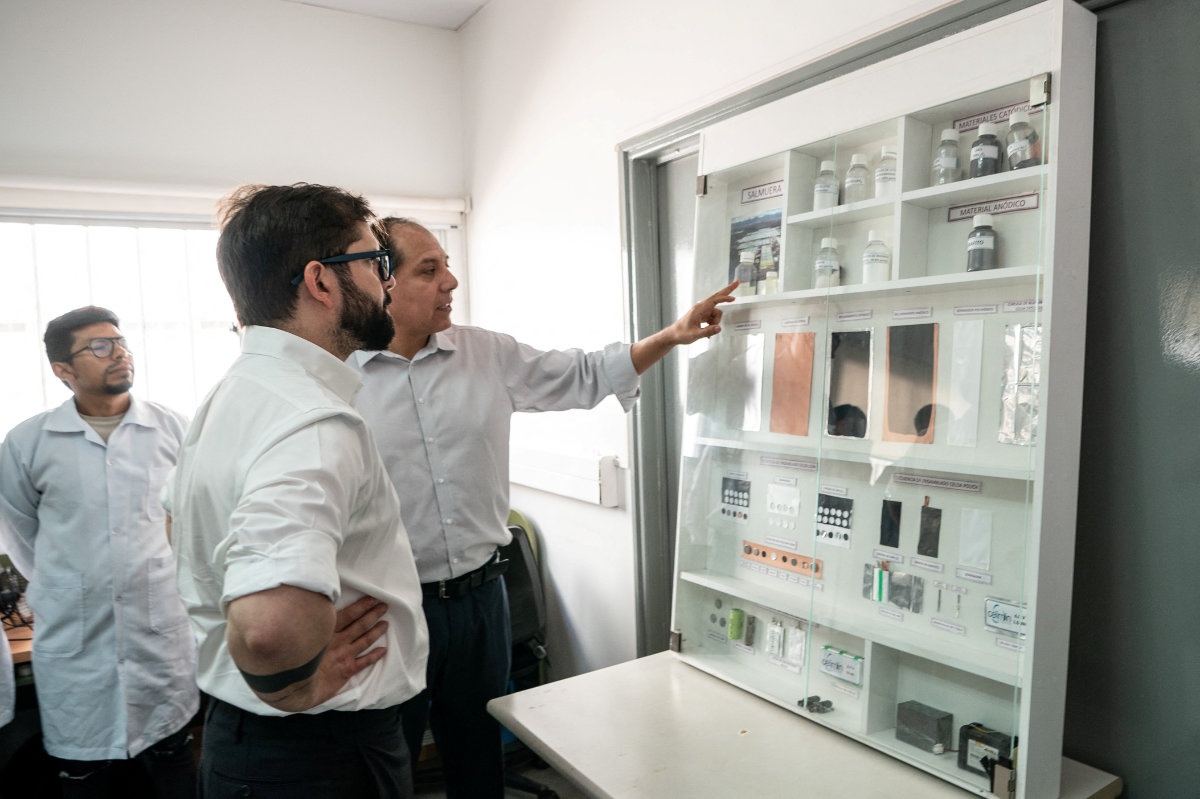


Chile's President Gabriel Boric is shown lithium samples and applications while visiting Universidad de Antofagasta venue on April 21, 2023. (Chilean presidency Handout via REUTERS)

But Chile’s business sector expressed concern.
“We were quite disconcerted” by Boric’s announcement, said Ricardo Mewes, head of the Confederation of Production and Trade, an association that represents Chile’s business community.
Mewes said business leaders had expected there would be a “great private sector participation” in the lithium sector and now the “state will be the one that will control” the industry.
Several analysts said those concerns may go too far.
Saldías, at the Economist Intelligence Unit, said the proposal “actually provides the private sector more opportunity than the existing framework because … there would be more ability to partake in projects than currently exists.”
He cautioned, though, that environmental restrictions on the way lithium is produced and the push for more consultation with local communities could lead to “an increase in the costs of doing business” in Chile.
Machado at Verisk Maplecroft said that “Chile appears to have gone for a model that is in the middle in which the state has the upper hand, given that it’s a resource that is considered strategic.”
That is a different model from neighboring Bolivia, in which the state has full control of the sector, and Argentina, in which the state simply grants concessions for companies to operate.


An aerial view shows the brine pools and processing areas of the Soquimich (SQM) lithium mine on the Atacama salt flat in the Atacama desert of northern Chile on January 10, 2013. (REUTERS//File photo)

Finance Minister Mario Marcel called for calm in the business community. He said that under the plan, private companies will contribute capital, technological knowledge and experience, while the state provides ”financing” and at the same time safeguards environmental conditions of the salt flats and the “relationship with the Indigenous peoples” of the affected area.
It remains unclear whether the government would contribute capital in direct proportion to its ownership stake.
Boric also said the government will go beyond just being involved in mining lithium, saying it will promote the development of lithium products with added value as it strives to become the world’s leading lithium producer.
Boric’s plan is in line with the “direction that the world is going,” said Hersh at Luna Lithium.
“The push to have more added value where minerals are produced and to have a grater share of revenues from the mining activities are understandable long term trends,” she said.
For Hersh the real concern isn’t necessarily Chile, a country with a robust mining industry and existing lithium production. She worries about what message this sends to others in the region that are trying to build up nascent industries, considering Mexico already nationalized its lithium sector.
“You kind of have a rush to the party, you can’t be seen as the uncool president who isn’t doing it,” Hersh said.


Saudi youth turn to AI for art and culture

Updated 13 February 2026
Follow

Saudi youth turn to AI for art and culture

  • Creativity, heritage and technology converge in a new generation of artists

RIYADH: As Saudi Arabia’s Vision 2030 places creativity, culture and technological innovation at the core of national development, the impact of these priorities is becoming increasingly visible across a wide range of disciplines and practices.

Through the use of artificial intelligence, young Saudis are integrating technology into their creative work both as a practical tool and as a medium in its own right. In doing so, they are expanding their capabilities, exploring personal and collective identity, and finding new ways to preserve and reinterpret cultural heritage.

“AI gives young Saudis a new way to interact with their own cultural inheritance,” said Dmitry Zaytsev, founder of Dandelion Civilization, a platform designed to help individuals shape unique professional paths.

Dmitry Zaytsev, founder of Dandelion Civilization. (Supplied)

“Traditional design elements such as calligraphy or geometric motifs were once difficult to modify. Experimentation required resources and formal approval. AI removes that barrier and makes exploration immediate. A creator can test many versions of a pattern and see which ones still feel authentic to them,” he told Arab News.

According to Zaytsev, this emerging form of expression does not signal a rejection of tradition, but rather a deeper engagement with it. “The young creator discovers what can change and what must remain constant. AI becomes a sketchbook that allows culture to evolve through curiosity rather than fear. When creators correct a model or push it toward local rhythm, they strengthen rather than dilute cultural identity,” he explained.

Sarah AlBaiz, an art adviser, researcher and artist, uses code to blend visual art with concepts drawn from culture and philosophy. While her early practice focused primarily on painting, her trajectory shifted during the 2020 AI Artathon, a pioneering international event highlighting collaboration between humans and machines in artmaking, where she discovered how to merge her engineering background with her creative work.

DID YOU KNOW?

• Saudi youth are using AI as a creative tool to reinterpret heritage, from calligraphy to folklore.

• AI is helping artists experiment faster without the traditional barriers of resources or formal approval.

• The Kingdom is backing creative AI nationally, with programs like SAMAI aiming to empower 1 million Saudis for an AI-driven future.

Operating within the field of computational creativity, where technology actively participates in the artistic process, AlBaiz explores themes of finance and faith. “Because they’re two sides of who I am,” she said. “When you talk about values, for example, that is both a term used in finance and trade from an objective perspective, but also moral and spiritual value.”

“When you understand prompting in AI, you can get it to produce almost anything. But it’s also informed by the training data it has,” she said.

Sarah Albaiz's "Diriyah II (2020)" melds a traditional Saudi landmark with the avant-garde. This generative artwork rejuvenates the historic Alsalwa Palace in Diriyah. By infusing Munira AlTheeb's artistry through GAN style transfer, the piece stands as a testament to the evolving narrative of Saudi heritage. (Supplied)

Rather than relying on a single platform, AlBaiz experiments with multiple AI models to test their limitations and audience reception. “I work a lot with language as well, so large language models are right up my street when it comes to computational creativity.”ee

Her work has gained international recognition. At the 2022 Islamic Arts Biennale in Jeddah, she co-created an artwork under the banner of Super Artistic AI that generated Al-Qatt Al-Asiri motifs from southern Saudi Arabia. The piece received an Audience Award.

Beyond her artistic practice, AlBaiz is developing an intelligent art advisory system aimed at helping users navigate the Saudi art landscape. Designed as an initial point of contact, the system would guide users through potential pathways before they engage with a human adviser.

Inverting established gender norms, Sarah Albaiz's digital collage reimagines masculinity. Set against a generative backdrop, its core message "real men cry" challenges familial WhatsApp discourses. (Supplied)

“It’s about understanding what role AI plays in the pursuit of what you want,” she said. “When I decided to focus on Qantara and building the advisory, I recognized that many of the systems required would need to be intelligent systems that offload a lot of work from me and the team.”

“When AI is an enabler rather than the end result, it becomes less intimidating because it feels risk-free for the end user,” she added.

Zaytsev echoed this idea, describing AI as a kind of rehearsal space. “Young people practice conversations, explore sensitive topics and organize their thoughts without social risk. This builds emotional clarity and confidence,” he said.

While generative tools such as large language models attract much of the attention, AI’s creative applications extend far beyond text and image generation.

Fairooz Alawami, trained as both an architect and engineer, uses AI to create self-expressive visual works inspired by dance.

Fairooz AlAwami's work. (Supplied)

“My practice is focused on contextualizing movement,” she said. “Because of my architectural training, I work with 3D modeling software called Rhino, which includes a visual coding language. Within that environment, you can also write code in Python, JavaScript or C#.”

Alawami employs OpenPose to analyze videos of her dancing by mapping points across her body. She then applies another computer vision model, MIDAS, which converts images or videos into depth frames. “If OpenPose gives me a skeleton, MIDAS gives me depth,” she explained. The resulting data is fed into 3D modeling software, where it is refined and manipulated into finished artworks.

She began dancing at a young age. “I didn’t find it, it found me,” she said. Movement later became the foundation of her artistic practice, leading to her first major project around three years ago while completing her master’s degree using the Grasshopper plugin. At the time, the workflow was slow and fragmented, but the arrival of ChatGPT helped streamline the process by making it easier to write and learn code.

Fairooz AlAwami's work. (Supplied)

“I think my love for dance and my love for art and design came together in a way that felt uniquely me,” she said. “Once I found that space, I just ran with it. It is my singular voice.”

Her work also draws heavily on cultural and musical heritage. One recent project was inspired by folklore referenced in the iconic song “Al Leila wa Leila” by Umm Kulthum. Alawami extracted musical stems from the track and mapped them to characters within the narrative. “The vocals were Shahrazad, the storyteller, and each stem represented a different narrative element,” she said. Earlier works were influenced by Islamic architecture and the geometric patterns found throughout Saudi Arabia and the wider Arab world.

“There are some incredible artists using generative AI to do very impressive things, and I don’t think I fall into that camp,” she said. “For me, AI is more like a skills-gap tool that helps me reach where I want to go.

“As humans, whether we realize it or not, the act of creating feeds us in some way. Lowering the barrier to entry makes creativity less intimidating.”

Opinion

This section contains relevant reference points, placed in (Opinion field)

Today, Saudi Arabia’s creative sector is supported by expanding national infrastructure. Initiatives such as the Cultural Scholarship Program place Saudi students in more than 60 universities worldwide, spanning disciplines from archaeology and literature to design, filmmaking and culinary arts. In parallel, the Kingdom launched the SAMAI initiative last year, aiming to equip 1 million Saudis with the skills needed to engage confidently in an AI-driven world.

Within Vision 2030, culture, tourism, digitalization and AI are treated as strategic sectors rather than peripheral concerns. As Saudi Arabia develops its creative economy as a form of soft power, its youth are becoming increasingly digitally fluent. AI tools are now embedded within creative workflows, enabling a new generation to explore heritage, remix traditional aesthetics and develop narratives that resonate on a global stage.