Russian foreign minister visits Cuba, condemns US sanctions

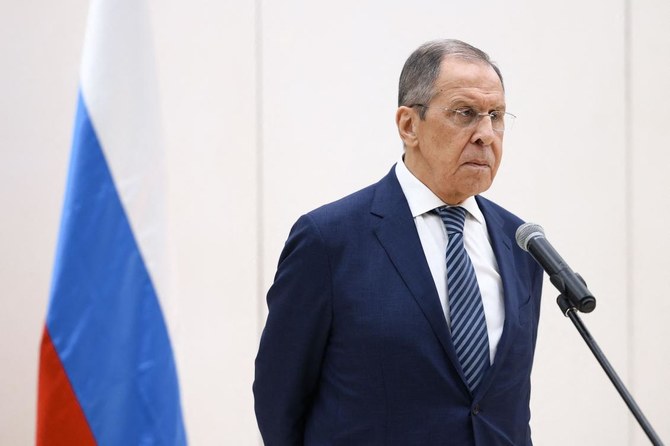
Russian Foreign Minister Sergei Lavrov meets with the media in Havana on Apr. 20, 2023. (AFP)
Short Url
Updated 20 April 2023
Follow

Russian foreign minister visits Cuba, condemns US sanctions

  • During his visit to the island nation, which for decades was a staunch Moscow ally, Lavrov condemned the American economic sanctions on Cuba
  • Rodríguez rejected what he called the “expansionist aspirations” of NATO and the sanctions imposed on Russia

HAVANA: Russian Foreign Minister Sergey Lavrov on Thursday condemned US sanctions against Cuba as he visited the island during the last leg of a Latin American tour that took him to Brazil, Nicaragua and Venezuela.
Lavrov met with his Cuban counterpart Bruno Rodríguez, kicking off the visit by taking part in a wreath-laying ceremony at a memorial in Havana for Cuban independence hero José Martí.
During his visit to the island nation, which for decades was a staunch Moscow ally, Lavrov condemned the American economic sanctions on Cuba, and blasted the US for seeking to impose “its will on the world,” according to a dispatch on the state media outlet Cubadebate.
Rodríguez, for his part, rejected what he called the “expansionist aspirations” of NATO and the sanctions imposed on Russia.
Lavrov was expected to meet later today with recently reelected President Miguel Díaz-Canel.
Cuba has had an extensive relationship with Moscow since the 1960s, when it joined the bloc of socialist countries led by the then Soviet Union, receiving many vital imports — fertilizers, industrial equipment, spare parts and, above all, oil — in exchange for sugar.
Russia, along with Venezuela, is one of Cuba’s few suppliers of oil, sending an undetermined amount to the island, which is undergoing a severe energy crisis.
Also, two weeks ago, Cuban banks started to accept payments with MIR cards, a payment system in Russia that allows Russian tourists to make cash withdrawals and convert rubles to Cuban pesos.
MIR cards are accepted in other partner countries of Russia, including Turkiye and Vietnam, and are operated by the state-owned Russian National Card Payment System.


Flash floods triggered by heavy rains in Afghanistan kill at least 17 people

Updated 9 sec ago
Follow

Flash floods triggered by heavy rains in Afghanistan kill at least 17 people

  • Afghanistan, like neighboring Pakistan and India, is highly vulnerable to extreme weather events, particularly flash floods following seasonal rains
  • Decades of conflict, poor infrastructure, deforestation, and the intensifying effects of climate change have amplified the impact of such disasters

KABUL: The season’s first heavy rains and snowfall ended a prolonged dry spell but triggered flash floods in several areas of Afghanistan, killing at least 17 people and injuring 11 others, a spokesman for Afghanistan’s national disaster management authority said Thursday.

The dead included five members of a family in a property where the roof collapsed on Thursday in Kabkan, a district in Herat province, according to Mohammad Yousaf Saeedi, spokesman for the Herat governor. Two of the victims were children.

Most of the casualties have occurred since Monday in districts hit by flooding, and the severe weather also disrupted daily life across central, northern, southern, and western regions, according to Mohammad Yousaf Hammad, a spokesman for Afghanistan’s National Disaster Management Authority.

Hammad said the floods also damaged infrastructure in the affected districts, killed livestock, and affected 1,800 families, worsening conditions in already vulnerable urban and rural communities.

Hammad said the agency has sent assessment teams to the worst-affected areas, with surveys ongoing to determine further needs.

Afghanistan, like neighboring Pakistan and India, is highly vulnerable to extreme weather events, particularly flash floods following seasonal rains.

Decades of conflict, poor infrastructure, deforestation, and the intensifying effects of climate change have amplified the impact of such disasters, especially in remote areas where many homes are made of mud and offer limited protection against sudden deluges.

The United Nations and other aid agencies this week warned that Afghanistan is expected to remain one of the world’s largest humanitarian crises in 2026. The UN and its humanitarian partners launched a $1.7 billion appeal on Tuesday to assist nearly 18 million people in urgent need in the country.