


At the conclusion of the DP World ILT20 franchise league on Feb. 12, the World Cricket Committee of the Marylebone Cricket Club met, not at Lords in London, but in Dubai.
The venue was the headquarters of the International Cricket Council (ICC), which moved there from Lords in 2005. The choice of venue and the timing to coincide with a franchise league could easily be a metaphor for the way that the game has evolved in the past 20 years.
It may simply have been a point of convenience, given the geographical dispersal of the committee. The chair is British, as are two other members. There are two Sri Lankans, one each from Australia, India, Pakistan, New Zealand, South Africa and the West Indies. Two women and two umpires sit on the committee, which has eight former successful international cricketers, all of whom captained their country. The committee’s purpose is to discuss and advise on contemporary issues affecting the game.
In Dubai, it is understood that most of the meeting focused on the future of the game. The ICC’s Future Tours Programme (FTP) for bilateral cricket is currently on a four-year cycle between 2023 and 2027. Efforts by the committee to consider what the game’s landscape might look like in 10 years, if left to grow organically, are welcome. Blue sky thinking and analysis of the game appear to be in short supply, publicly, at least. At the same time, any attempts at predictions are fraught with uncertainty.
Hence, it is not a surprise that the committee fell back on an analysis of the obvious — that the men’s game, as from the beginning of 2023, is “saturated with franchise competitions.” Heavy investment in these, especially by Indian corporate money, means that none of them will disappear in a hurry. On the contrary, others may emerge. The existing ones have been dovetailed into the current FTP. They also take account of known host countries and potential dates for ICC T20 and ODI World Cup competitions up to and including 2031.
Analysis of these dates and venues reveals that a gap exists in October/November for five of the nine years, the exceptions being 2023, 2027, 2028 and 2031. There would be scope for another franchise competition in those months in a country with the requisite climate and infrastructure, as long as a work-around was possible for the years of exception. Some clashes with Test cricket series would be inevitable, but an initial analysis indicates limited overlap.
An expressed concern of the World Cricket Committee was how to protect international cricket in a landscape that is filled with short-form franchise cricket. It unanimously concluded that the game is at a crossroads. Consequently, it recommended intervention from “various leaders to ensure that international and franchise cricket could thrive together harmoniously.” This sounds like a cry from the heart.
Which “leaders” are being appealed to? The ICC, at whose venue the meeting was held and to which the WCC is a complementary body? Is it those funding the franchises or individual national cricket boards? It is not clear if the ICC has the power to stop a country from establishing an independent franchise league if it wished to do so.
However, there are substantial barriers to entry in funding, facilities, the ability to attract media exposure and players, who, if centrally contracted, need to have the consent of their national boards.
Cricket has shown its ability in the past as a vehicle for renegade breakaway action — Kerry Packer’s World Series in 1977, for example. The current revolution is franchise cricket, played within existing structures, funded largely and increasingly by Indian interests, at least in India, South Africa, the UAE, the Caribbean and the US. This is a dominant regime, which seeks further growth.
Australia, New Zealand, Pakistan, Bangladesh and, so far, England/Wales have their separate funding arrangements, but nowhere near the levels of Indian investment.
Is it possible that a counterweight to this dominance will emerge? Last week, several print media channels suggested that the Saudi Arabian Cricket Federation (SACF) has been actively planning a T20 franchise tournament and has held talks with the IPL and its franchise owners. As reported in Arab News last Saturday, the SACF’s chairman is clear that progress in the Kingdom’s cricket development will be on an open, transparent and measured basis. In particular, additional infrastructure and facilities are required.
Then, there is the issue of players and their availability. The Board of Control for Cricket in India (BCCI) does not allow its contracted players to participate in any franchise tournament in another country.
Pakistani players do participate in the IPL or, so far, in Indian franchise teams. Tournaments without these high-profile cricketers will struggle to attract the attention of their respective diaspora. Franchise cricket needs these restraints to be relaxed.
Cricket linkages have been established between Saudi Arabia and India through the Saudi Tourist Authority’s partnership with the Tata IPL 2023 and with Pakistan, via one of its most famous former cricketers, Wasim Akram. After his visit in February and discussions with the chairman of the SACF, Akram said that he was looking forward to the evolvement of cricket leagues in the country.
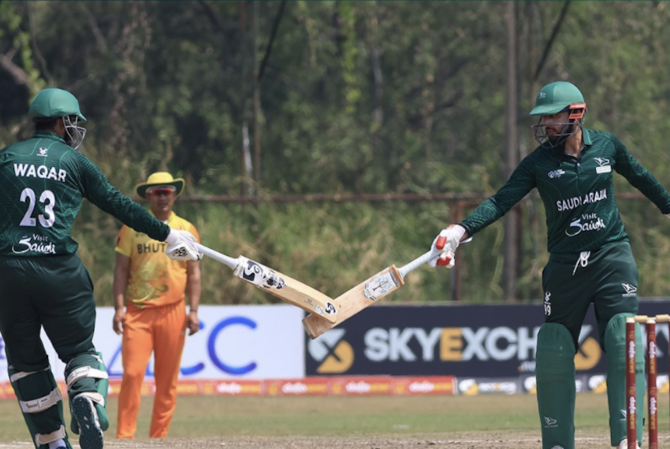
Meanwhile, the Saudi men’s team is making progress. Its first match in the Asia Premier Cup takes place on April 20 against Malaysia, who were comfortably beaten by Nepal in the opening match. There have been straightforward wins in the first two days for Hong Kong against Singapore, the UAE against Kuwait and a less straightforward win for Oman against Qatar. The next measure of the Saudi team’s progress will be judged in its group-stage performances against Malaysia Nepal, Oman and Qatar.
Whatever the outcome, Saudi Arabia ‘s influence and presence within the world of cricket is now being felt and is set to grow. It is the pace of growth that is unknown, a factor which some may have found unsettling.


