

Djokovic tested but prevails in Banja Luka opener

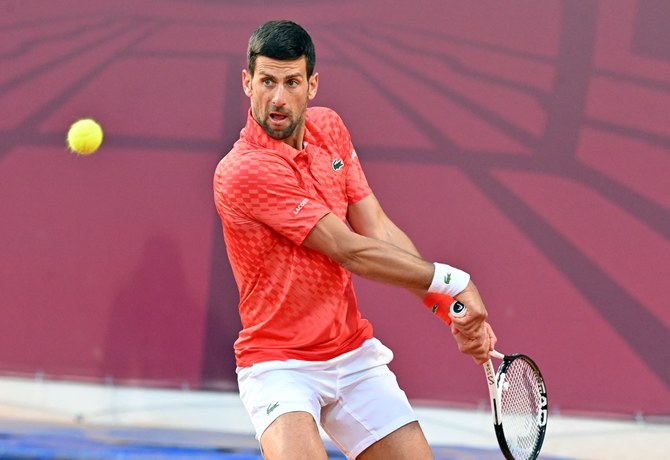
Serbia's Novak Djokovic plays a backhand return to France's Luca van Assche during their tennis singles match at the Sprska Tennis Open ATP 250 series tournament in Banja Luka, on Wednesday. (AFP)
Short Url
Updated 20 April 2023
Follow

Djokovic tested but prevails in Banja Luka opener

  • Despite falling behind to begin the third set, Djokovic recovered swiftly and sealed victory after 2 hours and 38 minutes

BANJA LUKA Bosnia/Herzegovina: Novak Djokovic battled back from a set down to beat French teenager Luca Van Assche 6-7 (4/7), 6-3, 6-2 in his opening match in Banja Luka on Wednesday.

The world No. 1 squandered three set points in the opener before Van Assche took the tie-break, but Djokovic broke twice in the second set to force a deciding set.

He dropped serve right away to start the third set but then broke Van Assche twice in a row, with Djokovic grasping control to eventually put away his 18-year-old opponent.

“It wasn’t easy. This probably will rank as the slowest court and slowest conditions I’ve ever played in. I didn’t expect this to be so slow,” said Djokovic.

“I couldn’t put any ball past him. He was on every single ball for a set and a half until I started to get some rhythm going and some tempo.”

He added: “I’m happy with the way I finished the match. Of course I can always play better but a win is a win.”

Djokovic praised his opponent as a “very promising player.”

“He (Van Assche) has a bright future ahead of him, especially on this surface, he is very fast and agile,” the 35-year-old said.

“It’s normal to expect that new, young players will emerge, generational change is a normal thing in every sport, but I didn’t want to lose to an 18-year-old. It was definitely an additional motivation for me.”

Former French Open junior champion Van Assche, the youngest player in the world’s top 100 at No. 87, had served Djokovic ample warning of his potential by beating Stan Wawrinka in round one.

Djokovic said Monday his elbow was not in “ideal condition” following a third-round exit last week at the Monte Carlo Masters, during which he was broken eight times by Lorenzo Musetti.

After Wednesday’s match, Djokovic said his elbow was “fine... holding up well.”

“These conditions are not ideal for joints and my elbow... but I am glad that I managed to endure. I am healthy and eager for new victories.”

Van Assche earned the first break of the match for a 5-4 lead but failed to serve out for the set. He then saved three set points at 5-6 before eventually taking a surprise lead.

For the second set Djokovic disposed of the black compression sleeve on his right arm he also wore in Monaco, sweeping through without offering Van Assche a single break opportunity.

Despite falling behind to begin the third set, Djokovic recovered swiftly and sealed victory after 2 hours and 38 minutes.

During Wednesday’s press conference, Djokovic also mentioned, jokingly, a possible future career as a coach.

Asked whom he would like to coach, Djokovic replied, smiling: “(Nick) Kyrgios,” with whom he once had an icy relationship.

“If I could coach Kyrgios, he would probably win five Grand Slams. But it would cost him a lot of money, too much money.”

The Serb, who is bidding for a record 23rd men’s Grand Slam title at the French Open next month, will play countryman Dusan Lajovic or Gregoire Barrere of France in the quarterfinals.


New Zealand looks to its batting depth, game-breakers at the T20 World Cup

Updated 56 min 43 sec ago
Follow

New Zealand looks to its batting depth, game-breakers at the T20 World Cup

  • The Black Caps’ best effort in nine World Cups was in 2021 when they were well beaten by Australia in the final
  • The latest T20 World Cup starts Saturday in India and Sri Lanka over the next month

WELLINGTON, New Zealand: New Zealand will lean heavily on its batting depth and proven match-winners to balance a depleted attack as it attempts to win the T20 World Cup for the first time.
The Black Caps’ best effort in nine World Cups was in 2021 when they were well beaten by Australia in the final.
That record reflects New Zealand’s love-hate relationship with a format to which it seems well adapted with its high percentage of allrounders. New Zealand played the first-ever T20 international, against Australia, and its win-loss record in around 260 internationals is roughly 50 percent.
The latest T20 World Cup starts Saturday in India and Sri Lanka over the next month.
New Zealand heads into the tournament on the back of a humbling T20 series loss to India in India. In the fifth game, New Zealand conceded a record 271-5, which included a century from 40 balls by Ishan Kishan.
New Zealand’s weakened bowling attack was under the pump throughout the series. In the third match, India chased down New Zealand’s 153-9 with only two wickets down and 10 overs remaining.
Asked at the end of the series if there was anything New Zealand could have done to contain the Indian batters, skipper Mitchell Santner joked, “Maybe push the boundaries back a little bit!”
But Santner was happy with the intelligence New Zealand gained from the India series ahead of its World Cup opener against Afghanistan at Chennai.
“We look at the series as a whole. We learned a lot of good stuff,” Santner said. “It’s not easy as a bowling unit. We’ve got to find ways against very good batters.”
New Zealand will ask much of the 31-year-old pacer Jacob Duffy, who will be playing at his first T20 World Cup. Duffy had an extraordinary breakout season in 2025, taking 81 wickets in a calendar year to break the New Zealand record held by Richard Hadlee. He is the No. 4-ranked T20 bowler in the world.
Apart from Duffy, the New Zealand pace lineup includes Lockie Ferguson, Matt Henry and Kyle Jamieson, who came in as a late replacement for the injured Adam Milne. Ben Sears is the traveling reserve and may see action as Henry and Ferguson may both take short breaks for paternity leave.
Santner and Ish Sodhi are the main spin options, with Glenn Phillips, Rachin Ravindra and Michael Bracewell providing backup.
Sodhi said the batters spent time facing spin in their tournament preparation.
“At training the boys wanted to face spinners and see what their boundary and single options were, so it was really cool that everyone is training specifically for that,” he said.
New Zealand’s strong batting lineup comprises of Finn Allen, Mark Chapman, Devon Conway, Daryl Mitchell, Rachin Ravindra and Tim Seifert. Seifert will also keep wicket while the allrounders Jimmy Neesham, who provides an extra pace option, Bracewell and Phillips balance the squad.
“We’ve got plenty of power and skill in the batting, quality bowlers who can adapt to conditions plus five allrounders who all bring something slightly different,” New Zealand coach Rob Walter said.
“This is an experienced group and the players are no strangers to playing in the subcontinent, which will be valuable.”
New Zealand’s squad includes players with franchise experience around the world who bring a match-winning element.
Allen has a strike rate of 165.45 in T20 internationals and 175.23 in domestic or franchise T20 cricket.
Phillips has a strike rate of 141.56 in international T20s and provides athleticism in the field, reflected by his 52 catches.
“World Cups are special and there’s few better places to play one than in India, which is very much the heartbeat of the modern game,” Walter said. “I’m really happy with the skills and experience of this squad. We have a group which can make New Zealand proud.”
New Zealand is drawn in Group D with Afghanistan, Canada, South Africa and the UAE.