

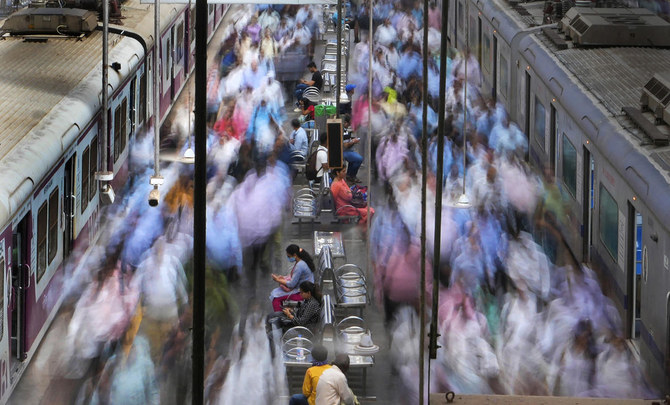

NEW DELHI: India is on track to surpass China by mid-2023 as the world’s most populous nation, United Nations data said Wednesday, raising questions about whether a booming, young Indian population will fuel economic growth for years to come or become a liability.
While India’s 254 million people between ages 15 and 24 is the largest number in the world, China is struggling with an aging population and stagnant population growth. That has sparked expectations that the demographic changes could pave the way for India to become an economic and global heavyweight.
India’s young citizenry could drive the country’s economic growth for years to come, but it might just as easily become a problem if they aren’t adequately employed. Economists have cautioned that even as India’s economy is among the fastest-growing as its population rises, joblessness has also swelled.
Tech giant Apple, among other companies, hopes to turn India into a potential manufacturing hub as it moves some production out of China, where wages are rising as the working age population shrinks.
The UN report said India will have about 2.9 million people more than China sometime in the middle of this year. India will have an estimated 1.4286 billion people versus mainland China’s 1.4257 billion at that time, according to UN projections. Demographers say the limits of population data make it impossible to calculate an exact date; India has not done a census since 2011.
China has had the world’s largest population since at least 1950, the year the UN began issuing population data. Both China and India have more than 1.4 billion people, and combined they make up more than a third of the world’s 8 billion people.
Not long ago, India wasn’t expected to become the most populous until later this decade. But the timing has been sped up by a drop in China’s fertility rate, with families having fewer children.
India, by contrast, has a much younger population, a higher fertility rate, and has seen a decrease in infant mortality over the last three decades. Still, the country’s fertility rate has been steadily falling, from over five births per woman in 1960 to just over two in 2020, according to World Bank data.
The country’s population has more than quadrupled since gaining independence 76 years ago. As India looks set to become the world’s largest country, it is grappling with the growing threat of climate change, deep inequalities between its urban and rural populations, economic disparities between its men and women, and a widening religious divide.
In a survey of 1,007 Indians conducted by the UN in conjuction with the report, 63 percent of respondents said economic issues were their top concern when thinking about population change, followed by worries about the environment, health and human rights.
“The Indian survey findings suggest that population anxieties have seeped into large portions of the general public. Yet, population numbers should not trigger anxiety or create alarm,” Andrea Wojnar, the United Nations Population Fund’s representative for India, said in a statement. She added that they should be seen as a symbol of progress and development “if individual rights and choices are being upheld.”
Many are banking on India’s rising number of working age people to give it a “demographic dividend,” or the potential for economic growth when a country’s young population is eclipses its share of older people who are beyond their working years. It’s what helped China cement its place as a global power.
“So far, we have not been able to tap into our demographic dividend adequately. While the working age population has grown quite substantially, employment has not grown,” said Mahesh Vyas, director of the Center for Monitoring the Indian Economy. He added that the country has struggled to create additional employment in the last six years, with the number of jobs stagnant at 405 million
India has had a phenomenal transformation — from an impoverished nation in 1947 into an emerging global power whose $3 trillion economy is Asia’s third largest. It is a major exporter of things like software and vaccines, and millions have escaped poverty into a growing, aspirational middle class as its high-skilled sectors have soared.
But so has joblessness. According to CMIE statistics from 2022, only 40 percent of working age Indians are employed.
Poonam Muttreja, head of the Population Foundation of India, agreed, saying the country must plan better for its young people.
“This large population will need a huge investment in skills for them to take advantage of the opportunities that will come up in the economy for participating in jobs. But we have to also create more jobs for them,” she said, adding that investments were also needed in education.
China responded to news of the UN report on Wednesday with Foreign Ministry spokesperson Wang Wenbin saying “a country’s demographic dividend depends not only on quantity but also on quality.”
“The population is important, so is talent... China’s demographic dividend has not disappeared, the talent dividend is taking place and development momentum remains strong,” Wang said at a briefing.


