

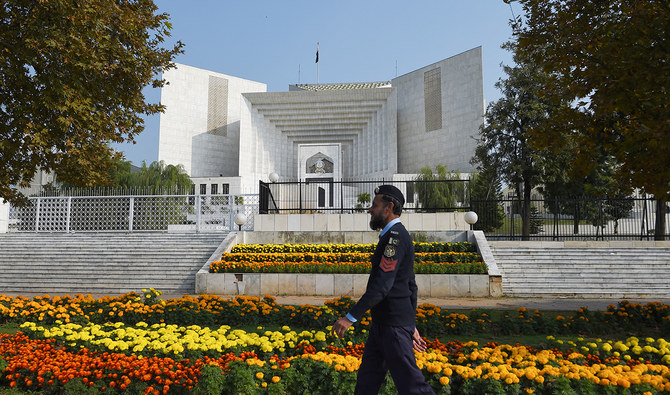

ISLAMABAD: The Supreme Court of Pakistan on Wednesday turned down a plea by the defense ministry that sought elections in Pakistan on the same date, but said it is willing to allow some room and change the date for elections in Punjab if political parties can agree on one.
The defense ministry, responsible for allocating security for election duty, on Tuesday moved the apex court to request polls be held across Pakistan on the same date. Pakistan's top court, in a landmark judgment earlier this month, ordered polls be held in Punjab on May 14.
The top judiciary and the opposition Pakistan Tehreek-e-Insaf party of former Prime Minister Imran Khan have been locked in a standoff with the coalition government at the center over provincial snap polls.
Prime Minister Shehbaz Sharif’s government says it is not economically viable to hold snap elections in two provinces, Punjab and Khyber Pakhtunkhwa, where Khan had dissolved the governments in January this year, ahead of a general election due in October.
Voting is constitutionally mandated within 90 days of the dissolution of a legislative assembly.
The apex court turned down the defense ministry's plea a day after the country’s top military and intelligence officials briefed the Supreme Court judges on Pakistan's security situation.
“Can the defense ministry request to hold elections together,” Chief Justice Umar Ata Bandial asked during the hearing, adding that the petition is ‘unmaintainable.’
After it ordered elections in Punjab be held on May 14, the apex court also directed the federal government to release funds and arrange security for the polls in Punjab and Khyber Pakhtunkhwa.
The federal cabinet and parliament have repeatedly rejected the court's demand to provide Rs21 billion ($74 million) in funds to the Election Commission of Pakistan (ECP) for polls to be held.
As tensions between the government and the judiciary heightened, the Supreme Court directed the central bank to allocate and release the required funds to the election regulator by April 17. Undaunted, the parliament refused to budge, refusing to release the funds through a motion on Monday.
The state bank and the election commission on Tuesday submitted their compliance reports to the top court about the non-provision of said funds.
During the hearing, Attorney-General of Pakistan Mansoor Usman Awan informed the court that parliament had rejected the government’s bill for the funds.
“If the funds are not provided for the elections, there may be serious consequences,” the chief justice warned, rebuffing the government’s stance that the security situation in Pakistan was deteriorating. The top judge said elections were held in the past even when militancy in the South Asian country was at its peak.
The ECP earlier this month unilaterally delayed elections in the two provinces till October, citing paucity of funds and lack of security personnel as reasons. “Who will give the guarantee that the security situation will improve on October 8,” the chief justice questioned.
The attorney general requested the court to grant it respite as political parties were willing to negotiate on when to hold elections.
“We are trying to initiate a political dialogue in the country,” the attorney-general informed the court, adding that the ruling alliance, except one political party, was willing to hold dialogue with former prime minister Imran Khan's PTI.
He informed the court about the committees constituted by both the opposition and ruling parties to end the political impasse. “If things get sorted out, excessive security may not be needed for the elections,” he said.
“If the court grants some respite, the matter can be resolved,” he argued.
The controversy was triggered in January when Khan’s party and allies dissolved the Punjab and Khyber Pakhtunkhwa assemblies to force early elections nationwide, since Pakistan historically holds the provincial and national elections together.
The government of PM Sharif has refused to accept the apex court's verdict to hold polls in the two provinces, and has referred to the three judges who announced it as “biased” against the ruling coalition.
Agreeing with the attorney-general, the chief justice said his words "carry weight" but reminded him that May 14, the date fixed by the court for Punjab polls, was near.
“If the political parties come together, the court can make room for them and change the date of elections,” the chief justice said. “If not, elections will be held on May 14.”
The three-member bench led by the chief justice issued notices to all political parties for their input on talks and election date.
“If there is consensus on talks, it will be okay, otherwise, we will order elections for May 14,” the chief justice remarked.


