

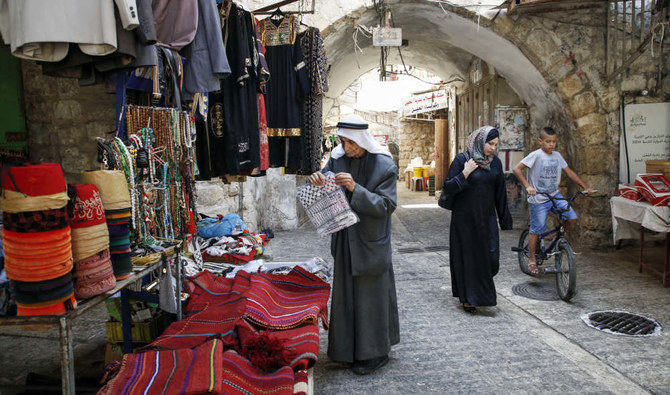
Eid preparations among Palestinians in full swing in the West Bank

A Palestinian man browses merchandise as another woman walks by in an alley in the old market of the divided West Bank city of Hebron. (AFP/File)
Short Url
Updated 18 April 2023
Follow

Eid preparations among Palestinians in full swing in the West Bank

  • In the last few days of Ramadan, markets are bustling with shoppers stocking up on Eid supplies
  • Business owners report brisk trade despite higher prices for most goods during Ramadan this year

RAMALLAH: Preparations are well underway among Palestinians in the West Bank and East Jerusalem for Eid Al-Fitr, which is expected to fall on April 21.

Markets are bustling with shoppers and many stores remain open past midnight. Confectioners, butchers, barbers, clothing and shoe stores, toy shops, jewelers, gift shops and cafes all report brisk business late into the night.

Traffic police have closed city center streets to vehicular traffic to allow more freedom of movement for shoppers and help traders who display their goods in makeshift roadside stalls.

On Tuesday, the Palestinian government gave public-sector employees an advance payment of 30 percent of their April salaries so that they can buy the Eid supplies they need. In addition, this month the government will pay them their full salary for the first time in a year, after cutting wages because of a severe financial crisis.

Meanwhile, shoppers have been faced with a sharp increase in the prices of all goods during Ramadan, a trend that is expected to continue until the end of the Eid holiday. Families on low incomes facing particular hardship have received assistance from charities during the holy month.

In the last few days of Ramadan, communal iftars continue in homes and restaurants, and the number of people making an effort to get together with family and friends has increased.

Duha Asous, from the village of Burin, near Nablus, spent Laylat Al-Qadr (the Night of Power) at Al-Aqsa Mosque. The holiest night of the year for Muslims, marking the night the Qur’an was sent from Heaven to the world, it is celebrated on one of the odd-numbered nights during the last 10 days of Ramadan.

Asous then returned home to start making special Eid cakes, a tradition she inherited from her mother. On each of the last three days of the holy month she makes 4 kilograms of the date-and-walnut cakes and hands them out to neighbors, relatives and the poor.

Amer Izz Al-Din Hamdan, from the old city of Nablus, told Arab News the traffic congestion since Eid shopping began in earnest has been unprecedented this year.

“Nablus is famous for making high-quality and distinctive oriental sweets, in addition to the famous nut roasters,” he said.

“The prices are lower than those in neighboring cities while the quality is higher, so shoppers from the surrounding villages and cities rush to shop in Nablus.”

Many Palestinians living in Israel also come to shop in West Bank cities in the run-up Eid, providing the local economies with a boost.

Hamdan said he likes to go shopping with his children a week before Eid, to try to avoid the crowds. In keeping with local traditions, he buys salty fish to eat on the morning of Eid. Special seasonal cakes, chocolate, coffee and nuts are other essential hospitality items, he added, and his family also burns incense in the house on Eid morning.

“An atmosphere of joy prevails in the markets of Nablus, which are crowded with shoppers,” Hamdan said. “Most of the families leave their homes after dinner for Eid shopping.”

Ashraf Abu Eid, the owner of Al-Amin Butchery in Ramallah, told Arab News that a sharp increase in meat prices a week before the start of Ramadan had affected demand throughout the holy month.

“A kilo of veal is sold for $15 and a kilo of lamb is sold for $23,” he said. “We prepared ourselves for a prosperous sales season and brought all kinds of meat but the season was not as good as that in previous years. Sales decreased by 50 percent compared with the previous Ramadan.”

Imad Muna, a prominent figure in the Jerusalemite community, told Arab News that markets in Jerusalem’s Old City and eastern area has experienced a tremendous economic boom during Ramadan thanks to the tens of thousands of people from the West Bank who had come to pray at Al-Aqsa Mosque. Thousands of Palestinians who live in Israel also came to pray at the mosque and shop at Palestinian markets in the city, he added.

“Ramadan was a good season for reviving the city’s markets, economically,” said Muna.


Israel bars Al-Aqsa imam from entering mosque in Ramadan

Updated 4 sec ago
Follow

Israel bars Al-Aqsa imam from entering mosque in Ramadan

  • ‘This ban is a grave matter for us as our soul is tied to Al-Aqsa, Al-Aqsa is our life’

JERUSALEM: A senior imam of the Al-Aqsa Mosque in East Jerusalem said on Tuesday that Israeli authorities had barred him from entering the compound, just days before the start of the holy month of Ramadan.

“I have been barred from the mosque for a week, and the order can be renewed,” Sheikh Muhammad Al-Abbasi said.
He said he was not informed of the reason for the ban, which came into effect from Monday.

FASTFACT

A Waqf source said 33 of its employees had been barred from entering the compound in the week leading up to Ramadan.

“I had only returned to Al-Aqsa a month ago after spending a year in the hospital following a serious car accident,” Abbasi said. “This ban is a grave matter for us, as our soul is tied to Al-Aqsa. Al-Aqsa is our life.”
On Monday, Israeli police said they had recommended issuing 10,000 permits for Palestinians from the occupied West Bank, who require special permission to enter Jerusalem.
Arad Braverman, a senior Israeli police officer in occupied Jerusalem, said forces would be deployed “day and night” across the compound.
He said thousands of police would also be on duty for Friday prayers, which draw the largest crowds of Muslim worshippers.
The Palestinian Jerusalem Governorate said it had been informed that permits would again be restricted to men over 55 and women over 50, mirroring last year’s criteria.
It added that Israeli authorities had prevented the Islamic Waqf — the Jordanian-run body that administers the site — from carrying out routine preparations, including installing shade structures and setting up temporary medical clinics.
A Waqf source said 33 of its employees had been barred from entering the compound in the week leading up to Ramadan.
Under long-standing arrangements, Jews may visit the Al-Aqsa compound —  but they are not permitted to pray there.
Palestinians fear the status quo it is being eroded.
In a separate development, Israeli NGOs have raised the alarm over a settlement plan signed by the government which they say would mark the first expansion of Jerusalem’s borders into the occupied West Bank since 1967. Palestinians view East Jerusalem as the capital of their future state.
The proposal, published in early February but reported by Israeli media only on Monday, comes as international outrage mounts over creeping measures aimed at strengthening Israeli control over the West Bank.
Critics say these actions by the Israeli authorities are aimed at the de facto annexation of the Palestinian territory.
The planned development, announced by Israel’s Ministry of Construction and Housing, is formally a westward expansion of the Geva Binyamin, or Adam, settlement situated northeast of Jerusalem in the West Bank.
In a statement, the ministry said the development agreement included the construction of around 2,780 housing units for the settlement, with an investment of roughly $38.7 million.
But the area to be developed lies on the Jerusalem side of the separation barrier built by Israel in the early 2000s, while Geva Binyamin sits on the West Bank side of the barrier, and the two are separated by a road.
Israeli settlement watchdog Peace Now said there would be no “territorial or functional connection” between the area to be developed and the settlement.
“The new neighborhood will be integral to the city of Jerusalem,” Lior Amihai, Peace Now’s executive director, said.
“What is unique about that one is that it will be connected directly to Jerusalem, but it will be beyond the annexed municipal border. So it will be in complete West Bank territory, but just adjacent to Jerusalem,” he said.