

Boycott threat to Lebanon parliamentary session in row over municipal elections

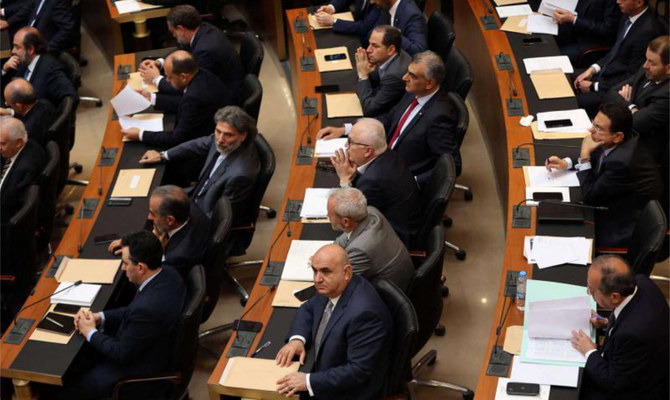
Tuesday morning’s parliamentary session will be followed in the afternoon by a Cabinet meeting to discuss the means of securing funds for municipal elections. (AFP/File)
Short Url
Updated 17 April 2023
Follow

Boycott threat to Lebanon parliamentary session in row over municipal elections

  • Christian religious leaders launch scathing attack on MPs seeking to extend mandate of civic bodies

BEIRUT: The Lebanese Forces party’s parliamentary bloc has threatened to boycott a legislative session on Tuesday aimed at extending the mandate of municipalities and delaying elections.

On Monday, party chief Samir Geagea said: “If the mandate of the municipal councils is extended, we will challenge this extension.”

Hezbollah and the Amal Movement, as well as the Free Patriotic Movement and its allies, were expected to take part in the session that could see approval given for an extension to the mandate of municipal councils to avoid the costs and logistics of holding elections.

Lebanon’s Ministry of Interior had slated municipal elections for May and Christian opposition parties and Forces of Change MPs are insisting they go ahead, as well as presidential elections, claiming the parties in power are stalling for time because they fear losing their grip on the municipalities.

The elections were initially postponed for 12 months because they coincided with the parliamentary elections.

Geagea pointed out that the money needed to fund the municipal elections could be secured through special drawing rights similar to those used by the government to meet electricity, medicine, passport, and other consumer payments.

“The opposition axis and the Free Patriotic Movement are disrupting the presidential elections, paralyzing the country and institutions, preventing the establishment of the actual state, and working to disrupt municipal elections,” he told a press conference.

Maronite Patriarch Bechara Boutros Al-Rahi and Beirut’s Metropolitan Greek Orthodox Archbishop Elias Aoude launched a scathing attack on deputies seeking to extend the mandate of municipalities.

In a joint statement, they said: “If they can ensure the quorum for holding a parliamentary session to extend the mandate of municipal councils, what is preventing them from securing the necessary quorum for holding a parliamentary session to elect a president of the republic?”

On Sunday, Al-Rahi said: “You are underestimating the people and the constitution and renewing expired terms after their mandate ended.

“What an absurd and shameful reason not to have enough money to cover the costs of the election.

“Why did you not secure the necessary funds to conduct these elections? You are not worthy of the responsibility that has been assigned to you.”

Aoudi said: “The authorities in the country have become a cause of death for the country and the people, due to their corruption in all facilities and sectors.

“Parliament has completed a quarter of its term, and it is still confused and indecisive; it did not fulfil its simplest duties and primarily, it did not elect a president.

“Parliament’s role in monitoring and accountability is almost absent, and in legislation, it has not yet succeeded in approving the reform laws that are necessary to stop the deterioration and revive the country,” he added.

MP Ghada Ayoub said: “Those who are capable of holding a session to extend the mandate can hold a session to fund municipal elections.

“To those who claim they are careful not to create a vacuum in local authorities, including mayors and municipalities, and those who do not want to put pressure on the government to pay from the SDR (special drawing rights), why not approve a legislative proposal to open an exceptional line of credit?”

Tuesday morning’s parliamentary session will be followed in the afternoon by a Cabinet meeting to discuss the means of securing funds for municipal elections.

However, if an extension of the mandate is approved the Cabinet’s agenda will be limited to approving increases in the salaries and allowances of employees in the public sector.

The Cabinet was also reportedly due to consider submitting a proposal to legislate for the issuance of new denominations of 500,000 and 1 million Lebanese pound banknotes. The highest-value banknote currently in circulation is 100,000 pounds.

Retired Lebanese army staff and public sector workers were planning to gather in Beirut’s Riad Al-Solh square, near government headquarters, to demand that salaries be returned to their real purchasing value.

They claim that tens of thousands of retired soldiers and civilians were now living below the poverty line.


Gaza ceasefire enters phase two despite unresolved issues

Updated 16 January 2026
Follow

Gaza ceasefire enters phase two despite unresolved issues

  • Under the second phase, Gaza is to be administered by a 15-member Palestinian technocratic committee operating under the supervision of a so-called “Board of Peace,” to be chaired by Trump

JERUSALEM: A US-backed plan to end the war in Gaza has entered its second phase despite unresolved disputes between Israel and Hamas over alleged ceasefire violations and issues unaddressed in the first stage.
The most contentious questions remain Hamas’s refusal to publicly commit to full disarmament, a non-negotiable demand from Israel, and Israel’s lack of clarity over whether it will fully withdraw its forces from Gaza.
The creation of a Palestinian technocratic committee, announced on Wednesday, is intended to manage day-to-day governance in post-war Gaza, but it leaves unresolved broader political and security questions.
Below is a breakdown of developments from phase one to the newly launched second stage.

Gains and gaps in phase one

The first phase of the plan, part of a 20-point proposal unveiled by US President Donald Trump, began on October 10 and aimed primarily to stop the fighting in the Gaza Strip, allow in aid and secure the return of all remaining living and deceased hostages held by Hamas and allied Palestinian militant groups.
All hostages have since been returned, except for the remains of one Israeli, Ran Gvili.
Israel has accused Hamas of delaying the handover of Gvili’s body, while Hamas has said widespread destruction in Gaza made locating the remains difficult.
Gvili’s family had urged mediators to delay the transition to phase two.
“Moving on breaks my heart. Have we given up? Ran did not give up on anyone,” his sister, Shira Gvili, said after mediators announced the move.
Israeli Prime Minister Benjamin Netanyahu said efforts to recover Gvili’s remains would continue but has not publicly commented on the launch of phase two.
Hamas has accused Israel of repeated ceasefire violations, including air strikes, firing on civilians and advancing the so-called “Yellow Line,” an informal boundary separating areas under Israeli military control from those under Hamas authority.
Gaza’s Hamas-run health ministry said Israeli forces had killed 451 people since the ceasefire took effect.
Israel’s military said it had targeted suspected militants who crossed into restricted zones near the Yellow Line, adding that three Israeli soldiers were also killed by militants during the same period.
Aid agencies say Israel has not allowed the volume of humanitarian assistance envisaged under phase one, a claim Israel rejects.
Gaza, whose borders and access points remain under Israeli control, continues to face severe shortages of food, clean water, medicine and fuel.
Israel and the United Nations have repeatedly disputed figures on the number of aid trucks permitted to enter the Palestinian territory.

Disarmament, governance in phase two

Under the second phase, Gaza is to be administered by a 15-member Palestinian technocratic committee operating under the supervision of a so-called “Board of Peace,” to be chaired by Trump.
“The ball is now in the court of the mediators, the American guarantor and the international community to empower the committee,” Bassem Naim, a senior Hamas leader, said in a statement on Thursday.
Trump on Thursday announced the board of peace had been formed and its members would be announced “shortly.”
Mediators Egypt, Turkiye and Qatar said Ali Shaath, a former deputy minister in the Ramallah-based Palestinian Authority, had been appointed to lead the committee.
Later on Thursday, Egyptian state television reported that all members of the committee had “arrived in Egypt and begun their meetings in preparation for entering the territory.”
Al-Qahera News, which is close to Egypt’s state intelligence services, said the members’ arrival followed US Middle East envoy Steve Witkoff’s announcement on Wednesday “of the start of the second phase and what was agreed upon at the meeting of Palestinian factions in Cairo yesterday.”
Shaath, in a recent interview, said the committee would rely on “brains rather than weapons” and would not coordinate with armed groups.
On Wednesday, Witkoff said phase two aims for the “full demilitarization and reconstruction of Gaza,” including the disarmament of all unauthorized armed factions.
Witkoff said Washington expected Hamas to fulfil its remaining obligations, including the return of Gvili’s body, warning that failure to do so would bring “serious consequences.”
The plan also calls for the deployment of an International Stabilization Force to help secure Gaza and train vetted Palestinian police units.
For Palestinians, the central issue remains Israel’s full military withdrawal from Gaza — a step included in the framework but for which no detailed timetable has been announced.
With fundamental disagreements persisting over disarmament, withdrawal and governance, diplomats say the success of phase two will depend on sustained pressure from mediators and whether both sides are willing — or able — to move beyond long-standing red lines.