Jordan’s tourism income surges 88% as visitors flock to the country

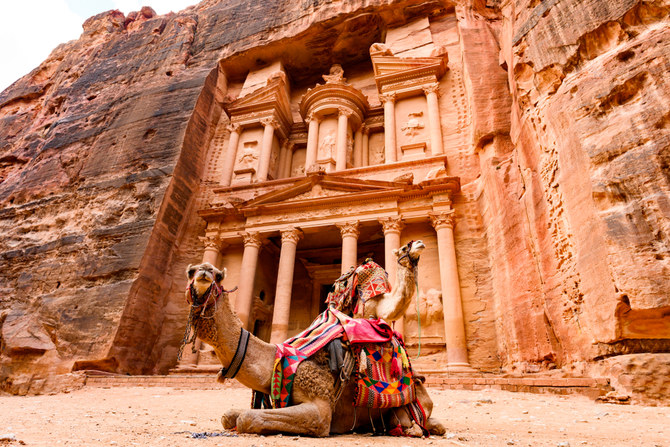
Camels in front of Al Khazneh (The Treasury) at Petra, a historical and archaeological city in southern Jordan (Shutterstock)
Short Url
Updated 17 April 2023
Follow

Jordan’s tourism income surges 88% as visitors flock to the country

RIYADH: Jordan’s tourism income surged 88.4 percent in the first quarter of 2023 from the same period in the previous year to hit $1.671 billion on the back of a notable boost in tourism arrivals.  

The country has recorded an unparalleled surge in the number of tourists coming to the country, with more than 1.47 million sightseers visiting during the first quarter of 2023.

This record number represents an increase of 90.7 percent compared with the 774,111 holidaymakers who visited during the same period last year, the Jordan News Agency reported. 

It surpasses the figure for the first quarter of 2019, which was considered a “golden year” for tourism in Jordan, when 1.146 million visitors and 966,483 overnight tourists visited the country.

Jordan’s central bank data also showed a 68.4 percent spike in Jordanians’ spending on tourism during that period, reaching $422.3 million.   

Tourism income in March grew by 49 percent compared to March of 2022 to total $614.7 million, revealed the data. 

As for tourism expenditure in March, it rose 26.2 percent compared to the same month last year, hitting $139.9 million.

Furthermore, the latest Ministry of Tourism and Antiquities monthly bulletin revealed an 80.9 percent rise in the number of overnight tourists to 1.204 million during the quarter, compared with 665,779 a year earlier.

Jordan has a large number of renowned tourist landmarks and other attractions, including the “Golden Triangle” encompassing Petra, Wadi Rum, Aqaba and the Dead Sea, the Roman Theater in Amman and Mount Nebo.

There is also Ajloun Castle, Jerash, the site of the baptism of Jesus Christ, and Karak Castle. 

Last month, the country’s northern town of Umm Qais was honored at the UN World Tourism Organization’s Best Tourism Villages awards ceremony in AlUla. 

Imad Hijazin, secretary-general of Jordan’s Ministry of Tourism and Antiquities, said at the time: “Putting the village of Umm Qais on the list will bolster the kingdom’s status on the global tourism map.” 

“This achievement comes within the ministry’s vision, and is in compliance with its tourism development plan through the Jordan National Tourism Strategy 2021-2025,” he added. 

Hijazin further noted that the location’s recognition would contribute to empowering local communities, and increasing job opportunities. 


Saudi minister at Davos urges collaboration on minerals

Global collaboration on minerals essential to ease geopolitical tensions and secure supply, WEF hears. (Supplied)
Updated 51 min 44 sec ago
Follow

Saudi minister at Davos urges collaboration on minerals

  • The reason of the tension of geopolitics is actually the criticality of the minerals

LONDON: Countries need to collaborate on mining and resources to help avoid geopolitical tensions, Saudi Arabia’s minister of industry and mineral resources told the World Economic Forum on Tuesday.

“The reason of the tension of geopolitics is actually the criticality of the minerals, the concentration in different areas of the world,” Bandar Alkhorayef told a panel discussion on the geopolitics of materials.

“The rational thing to do is to collaborate, and that’s what we are doing,” he added. “We are creating a platform of collaboration in Saudi Arabia.”

Bandar Alkhorayef, Saudi Minister of Industry and Mineral Resources 

The Kingdom last week hosted the Future Minerals Forum in Riyadh. Alkhorayef said the platform was launched by the government in 2022 as a contribution to the global community. “It’s very important to have a global movement, and that’s why we launched the Future Minerals Forum,” he said. “It is the most important platform of global mining leaders.”

The Kingdom has made mining one of the key pillars of its economy, rapidly expanding the sector under the Vision 2030 reform program with an eye on diversification. Saudi Arabia has an estimated $2.5 trillion in mineral wealth and the ramping up of extraction comes at a time of intense global competition for resources to drive technological development in areas like AI and renewables.

“We realized that unlocking the value that we have in our natural resources, of the different minerals that we have, will definitely help our economy to grow to diversify,” Alkhorayef said. The Kingdom has worked to reduce the timelines required to set up mines while also protecting local communities, he added. Obtaining mining permits in Saudi Arabia has been reduced to just 30 to 90 days compared to the many years required in other countries, Alkhorayef said.

“We learned very, very early that permitting is a bottleneck in the system,” he added. “We all know, and we have to be very, very frank about this, that mining doesn’t have a good reputation globally.

“We are trying to change this and cutting down the licensing process doesn’t only solve it. You need also to show the communities the impact of the mining on their lives.”

Saudi Arabia’s new mining investment laws have placed great emphasis on the development of society and local communities, along with protecting the environment and incorporating new technologies, Alkhorayef said. “We want to build the future mines; we don’t want to build old mines.”