Fighting rages in Sudan as death toll climbs to 97

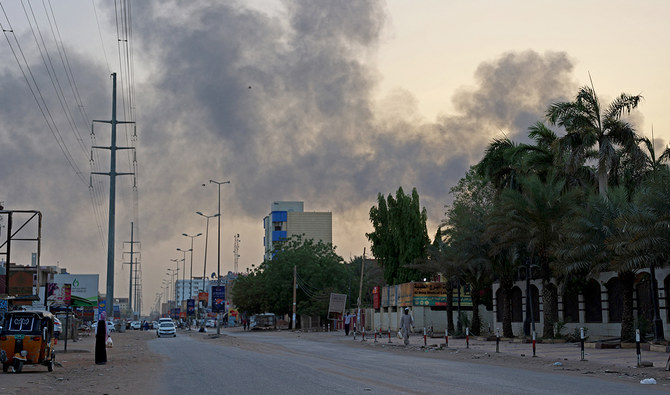
Smoke billows above residential buildings in east Khartoum on April 16, 2023, as fighting in Sudan raged for a second day in battles between rival generals. (Photo courtesy: AFP)
Short Url
Updated 17 April 2023
Follow

Fighting rages in Sudan as death toll climbs to 97

  • Raging battles trigger international outcry with appeals for cease-fire
  • Fighting broke out last week after bitter disagreement over power-sharing

KHARTOUM: Explosions rocked the Sudanese capital Khartoum Monday as fighting between the regular army and paramilitaries raged for a third day with the death toll rising to nearly 100.
The violence erupted Saturday after weeks of power struggles between Sudan’s army chief Abdel Fattah Al-Burhan and his deputy, Mohamed Hamdan Daglo, who commands the powerful paramilitary Rapid Support Forces (RSF).
The raging battles triggered a wide international outcry with appeals for an immediate cease-fire and dialogue.
“The death toll among civilians in clashes since it began on Saturday ... has reached 97,” the doctors’ union said in a statement early Monday, noting the figure does not include all casualties as many could not reach hospitals due to difficulties in movement.
It said hundreds of civilians were wounded in the clashes.
Loud gunfire and deafening explosions echoed across the streets of Khartoum Monday morning as clashes continued, according to AFP journalists.
A stench of gunpowder lingered as plumes of thick black smoke emanated from damaged buildings, according to witnesses.
The fighting broke out after bitter disagreements between Burhan and Daglo over the planned integration of the RSF into the regular army — a key condition for a final deal aimed at ending a crisis since the 2021 military coup they orchestrated together.
The coup has already derailed a transition to civilian rule following the 2019 ouster of president Omar Al-Bashir and piled on a spiraling economic crisis in Sudan.
The clashes forced Sudanese to hunker down in their homes with fears of a prolonged conflict that could plunge the country into deeper chaos, dashing hopes for return to civilian rule.
Since Saturday, the two sides have traded blame over who started the fighting.
Each has claimed the upper hand by declaring control of key sites, including the airport and the presidential palace but none of their claims could be independently verified.
Fighting also raged in other parts of Sudan including the western Darfur region and in the eastern border state of Kassala.
The Saturday killing of three staff from the World Food Programme in North Darfur clashes prompted the agency to suspend all operations in the impoverished country.
Medics have pleaded for safe corridors for ambulances and a cease-fire to treat the victims because the streets are too dangerous for transporting casualties to hospital.
The RSF was created under Bashir in 2013, emerging from the Janjaweed militia that his government unleashed against non-Arab ethnic minorities in Darfur a decade earlier, drawing accusations of war crimes.
The latest violence sparked by the two generals has reflected the deep-seated divisions between the regular army and the RSF.
Despite the wide calls for a cease-fire, the two generals appeared in no mood for talks.
Burhan, who rose through the ranks under the three-decade rule of now-jailed Bashir, has said the coup was “necessary” to include more factions in politics.
Daglo later called the coup a “mistake” that failed to bring about change and reinvigorated remnants of Bashir’s regime ousted by the army in 2019 following mass protests.


Ireland’s defense gaps exposed as EU presidency nears

Cathal Berry, former Irish army special forces member, on The Curragh plain. (AFP)
Updated 7 sec ago
Follow

Ireland’s defense gaps exposed as EU presidency nears

  • Militarily neutral Ireland is not a NATO member, yet its waters — seven times its landmass — account for around 16 percent of the EU’s total

THE CURRAGH: Sheep amble around steel fences skirting Ireland’s largest military base on a grassy plain west of Dublin, a bucolic scene masking an underfunded defense force struggling with outdated equipment.

Ireland’s threadbare military and its long-standing policy of neutrality are under heightened scrutiny as the country prepares to assume the rotating EU presidency from July.

“Ireland is the only EU country with no primary radar system, nor have we sonar or anti-drone detection equipment — let alone the ability to disable drones,” said former Irish special forces member Cathal Berry.

“We can’t even monitor the airspace over our capital city and main airport,” he said as he surveyed Ireland’s main military base at The Curragh.

Militarily neutral Ireland is not a NATO member, yet its waters — seven times its landmass — account for around 16 percent of the EU’s total.

Nearly three-quarters of transatlantic subsea cables run close to or beneath them.

But the Irish army numbers only a few thousand troops, is focused largely on UN peacekeeping missions and has neither a combat air force nor a sizeable navy.

Ireland’s annual defense spending of roughly €1.2 billion is the lowest in Europe at around 0.2 percent of the GDP, well below the EU average of 1.3.

“Neutrality itself is actually a fine policy. If you want to have it, it must be defended,” said retired Irish army colonel Dorcha Lee.

“That’s the whole point. Undefended neutrality is absolutely definitely not the way to go.”

Berry points to a long-standing “complacency” about defense in Ireland that has fueled a vacuum in debate over neutrality and military spending.

“If you wanted to squeeze the EU without any risk of NATO retaliation, Ireland is where you’d come,” he said, adding that also applied to US interests in Europe.

US tech giants like Google, Apple and Meta have their European headquarters in Ireland, supported by vast data centers that analysts say are vulnerable to cyberattacks.

European Council President Antonio Costa said he was still “confident” Ireland could protect EU summits during its presidency.

Defense Minister Helen McEntee has pledged that new counter-drone technology will be in place by then.

Speaking in front of a row of aging army vehicles at the Curragh military site, she also announced a broader increase in military spending, although the actual details remain unclear.

On Dec. 17, the Irish government said it plans to buy a military radar system from France at a reported cost of between €300 and €500 million (around $350-$585 million).

For Paul Murphy, a left-wing opposition member of parliament, “scaremongering over allegedly Russian drones with concrete evidence still unprovided” is

giving the government cover to steer Ireland away from neutrality toward NATO.

“But it’s more important than ever that we’re genuinely neutral in a world that is increasingly dangerous,” he told AFP.

Ireland has historically prioritized economic and social spending over defense investment, he said.

“Joining an arms race that Ireland cannot compete in would waste money that should be spent on real priorities like climate change,” he added.

Pro-neutrality sentiment still holds sway among the Irish public, with an Irish Times/Ipsos poll earlier this year finding 63 percent of voters remained in favor of it.

And very few voices in Ireland are calling to join NATO.

Left-winger Catherine Connolly, who won Ireland’s presidential election in October by a landslide, is seen as a pacifist.

“I will be a voice for peace, a voice that builds on our policy of neutrality,” she said in her victory speech.