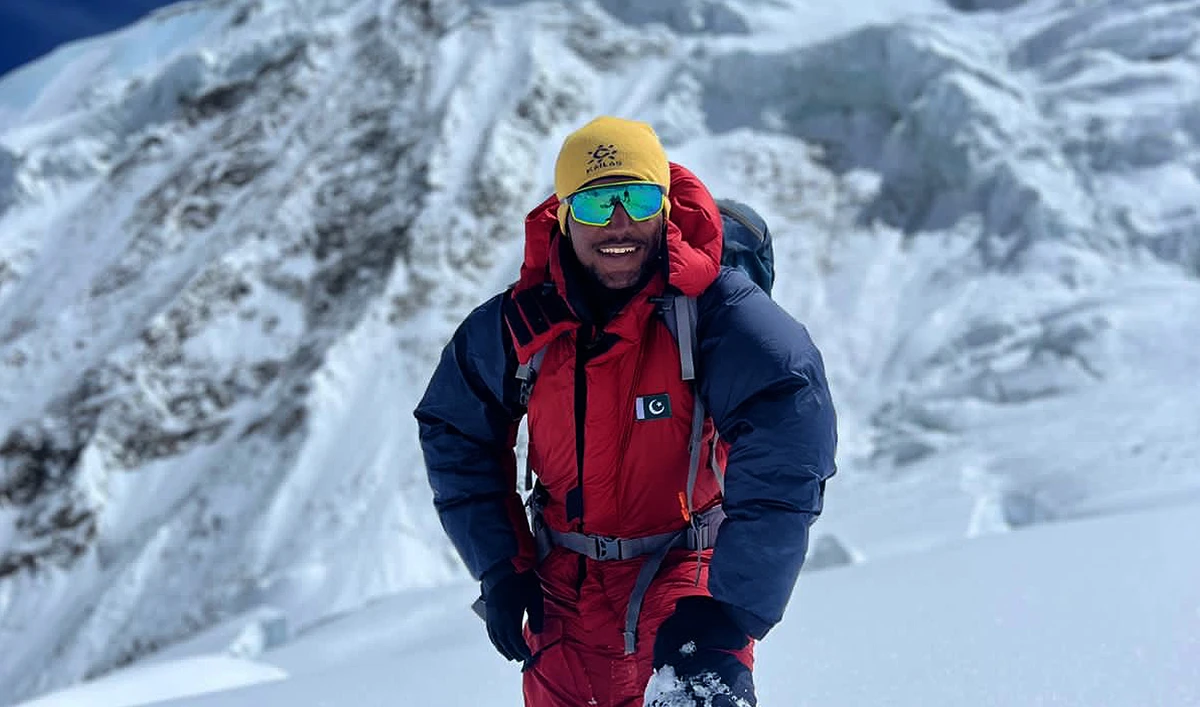
Pakistani mountaineer Sajid Ali Sadpara successfully climbs Mt Annapurna without supplemental oxygen

This picture, posted on April 11, 2023, features Pakistani mountaineer Sajid Ali Sadpara during his expedition at Mount Annapurna in Nepal. (Photo courtesy: Twitter/sajid_sadpara)
Short Url
Updated 15 April 2023
Follow

Pakistani mountaineer Sajid Ali Sadpara successfully climbs Mt Annapurna without supplemental oxygen

  • The 8,091-meter-high Mount Annapurna in Nepal is a tough climb and has claimed the lives of more than 60 climbers
  • Sadpara, the son of Muhammad Ali Sadpara, has already summited K2, Gasherbrum-I, Gasherbrum-II and Nepal’s Manaslu

KHAPLU, Gilgit-Baltistan: Pakistani mountaineer Sajid Ali Sadpara has successfully summited Mount Annapurna, the world’s 10th highest peak, without supplementary oxygen, officials of Pakistani mountaineering clubs said on Saturday.

At a height of 8,091 meters above the sea level, Mount Annapurna in Nepal is widely considered to be a tough climb and has claimed the lives of more than 60 climbers striving to make an ascent.

Sadpara, the son of Pakistan’s late iconic high-altitude mountaineer Muhammad Ali Sadpara, has already summited K2 (8,611 meters) twice as well as Nepal’s Manaslu (8,163 meters). The mountaineer has also successfully climbed Gasherbrum-I (8,080 meters) and Gasherbrum-II (8,035 meters) without supplementary oxygen.

Karrar Haidri, general-secretary for the Alpine Club of Pakistan, said congratulated Sadpara and the Seven Summit Treks team for successfully reaching the Annapurna summit.

“This is a happy [moment] that Sajid Ali Sadpara has summited one of the most dangerous peaks of the world, the tenth highest [mountain of the world],” Haidri told Arab News.

“This was a hard movement because he was leading and summited the peak in spite of the harsh weather. Sajid is a young mountaineer and his dream is to scale all 14 peaks of the world, which is an incomplete dream of his father.”

Nepalese mountaineer Chhang Dawa Sherpa, who is also the expedition director for the Seven Summit Trek, also congratulated Sadpara on the successful ascent.

“Wake up Pakistan!!! Sajid Ali Sadpara, a son of legend Ali Sadpara, [successfully] reached the top of Mt. Annapurna this afternoon, unsupported and without using supplementary O2, as a part of @sst8848 Annapurna Exped,” he wrote on Twitter.


In February 2021, Sadpara’s father Muhammad Ali, Iceland’s John Snorri, and Chile’s Juan Pablo Mohr went missing while attempting to scale the world’s most dangerous peak in winter. They were last sighted at around 10am on February 5, 2021 at what is considered the most difficult part of the climb: the Bottleneck, a steep and narrow gully just 300 meters shy of the 8,611-meter-high K2.

Ali and his expedition members were making their second attempt at climbing K2 during the winter. It is believed the group had reached the summit but encountered a problem on the way down.

In January 2021, a team of 10 Nepali climbers had made history by becoming the first to ever scale K2 in winter.
Security forces kill four militants in Pakistan’s volatile southwest, military says

Updated 13 January 2026
Follow

Security forces kill four militants in Pakistan’s volatile southwest, military says

  • Balochistan, Pakistan’s largest province by land area bordering Iran and Afghanistan, has long been the site of a low-level insurgency
  • The Balochistan government has recently established a threat assessment center to strengthen early warning, prevent ‘terrorism’ incidents

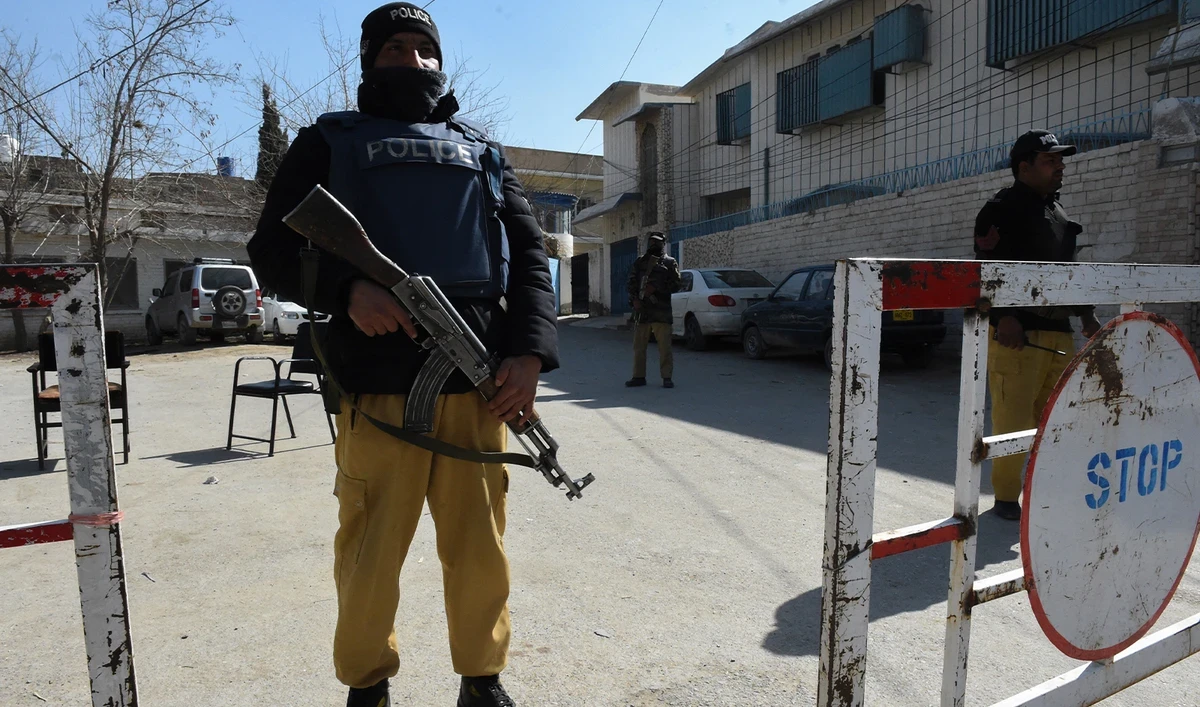
ISLAMABAD: Pakistani security forces gunned down four militants in an intelligence-based operation in the southwestern Balochistan province, the military said on Tuesday.

The operation was conducted in Balochistan’s Kalat district on reports about the presence of militants, according to the Inter-Services Public Relations (ISPR), the Pakistani military’s media wing.

The “Indian-sponsored militants” were killed in an exchange of fire during the operation, while weapons and ammunition were also recovered from the deceased, who remained actively involved in numerous militant activities.

“Sanitization operations are being conducted to eliminate any other Indian-sponsored terrorist found in the area,” the ISPR said in a statement.

There was no immediate response from New Delhi to the statement.

Balochistan, Pakistan’s largest province by land area bordering Iran and Afghanistan, has long been the site of a low-level insurgency involving Baloch separatist groups, including the Balochistan Liberation Army (BLA) and the Balochistan Liberation Front (BLF).

Pakistan accuses India of supporting these separatist militant groups and describes them as “Fitna Al-Hindustan.” New Delhi denies the allegation.

The government in Balochistan has also established a state-of-the-art threat assessment center to strengthen early warning and prevention against “terrorism” incidents, a senior official said this week.

“Information that was once scattered is now shared and acted upon in time, allowing the state to move from reacting after incidents to preventing them before they occur,” Balochistan Additional Chief Secretary Hamza Shafqaat wrote on X.

The development follows a steep rise in militancy-related deaths in Pakistan in 2025. According to statistics released by the Pakistan Institute for Conflict and Security Studies (PICSS) last month, combat-related deaths in 2025 rose 73 percent to 3,387.

These included 2,115 militants, 664 security forces personnel, 580 civilians and 28 members of pro-government peace committees, the think tank said.