

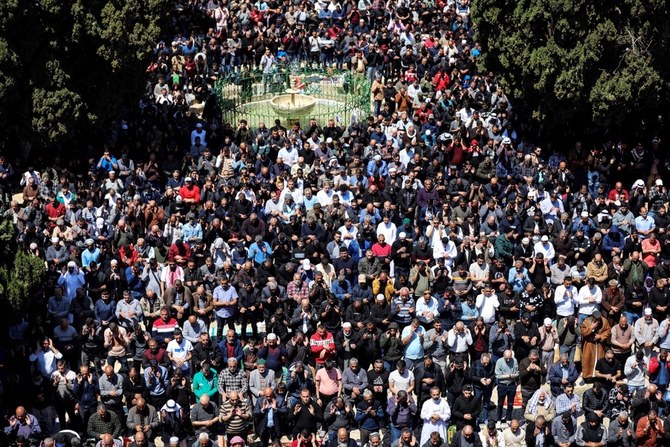
250,000 perform final Friday Ramadan prayers at Al-Aqsa

Palestinians pray on the fourth Friday of the holy month of Ramadan on Al-Aqsa. (Reuters)
Short Url
Updated 15 April 2023
Follow

250,000 perform final Friday Ramadan prayers at Al-Aqsa

  • Massive Israel security presence on streets of Jerusalem to police key date in Islamic calendar

RAMALLAH: A massive Israeli security presence lined the streets of Jerusalem as up to 250,000 Palestinian Muslims performed the fourth and probably final Friday prayer of Ramadan at Al-Aqsa Mosque.

More than 3,200 police, border police and Shin Bet security agents were deployed on roads leading to the mosque.

Authorities allowed women of all ages, men over the age of 55 and children under 12 to enter Jerusalem from the West Bank without permits to perform Friday prayers.

Ramadan is a rare chance for many Palestinians to visit Jerusalem and pray at Al-Aqsa. For many, this was their first time in the city.

Ahmed Khassib, 51, from Ramallah, told Arab News: “I am delighted to be able to perform the fourth Friday prayer of Ramadan at Al-Aqsa Mosque.

“I cannot obtain a permit to pray at Al-Aqsa Mosque except on Fridays during Ramadan, so I wait for this opportunity throughout the year.”

Praying at the mosque, Khasib said, “carries a message that Al-Aqsa is for Muslims.”

During his Friday sermon, Sheikh Ekrimeh Sabri, the imam of Al-Aqsa Mosque, told worshippers: “You who came to the blessed Al-Aqsa Mosque from all parts of holy Palestine, you who have crossed the unjust military checkpoints, your march to the blessed Aqsa for the evening prayer and Taraweeh prayers is to remind the 2 billion Muslims of the world of the captive Al-Aqsa.”

Abd Al-Salam Abu Askar, a Palestinian from the Gaza Strip who lives in Ramallah, told Arab News that inflammatory comments about Al-Aqsa by far-right Israeli National Security Minister Itamar Ben-Gvir had made Palestinians more determined to challenge Israeli restrictions on worshipping there.

When they felt the mosque was in danger, he said, they flocked to it during Ramadan, especially on Fridays.

“If the military checkpoints surrounding the city of Jerusalem allowed all citizens of the West Bank and Gaza Strip to visit Al-Aqsa, the number of worshippers would exceed half a million today,” Abu Askar said.


In first Christmas sermon, Pope Leo decries conditions for Palestinians in Gaza

Updated 5 sec ago
Follow

In first Christmas sermon, Pope Leo decries conditions for Palestinians in Gaza

VATICAN CITY: Pope Leo decried conditions for Palestinians in Gaza in his Christmas sermon on Thursday, in an unusually ​direct appeal during what is normally a solemn, spiritual service on the day Christians across the globe celebrate the birth of Jesus.
Leo, the first US pope, said the story of Jesus being born in a stable showed that God had “pitched his fragile tent” among the people of the world.
“How, then, can we not think of the ‌tents in ‌Gaza, exposed for weeks to rain, ‌wind ⁠and ​cold?” he ‌asked.
Leo, celebrating his first Christmas after being elected in May by the world’s cardinals to succeed the late Pope Francis, has a more quiet, diplomatic style than his predecessor and usually refrains from making political references in his sermons.
But the new pope has also lamented the conditions for Palestinians in Gaza several ⁠times recently and told journalists last month that the only solution in ‌the decades-long conflict between Israel and the ‍Palestinian people must include a Palestinian ‍state.
Israel and Hamas agreed to a ceasefire in ‍October after two years of intense bombardment and military operations, but humanitarian agencies say there is still too little aid getting into Gaza, where nearly the entire population is homeless.
In Thursday’s service with ​thousands in St. Peter’s Basilica, Leo also lamented conditions for the homeless across the globe and the destruction ⁠caused by the wars roiling the world.
“Fragile is the flesh of defenseless populations, tried by so many wars, ongoing or concluded, leaving behind rubble and open wounds,” said the pope.
“Fragile are the minds and lives of young people forced to take up arms, who on the front lines feel the senselessness of what is asked of them and the falsehoods that fill the pompous speeches of those who send them to their deaths,” he said.
Later on Thursday the pope will ‌deliver a twice-yearly “Urbi et Orbi” (to the city and the world) message and blessing, which usually addresses global conflicts.