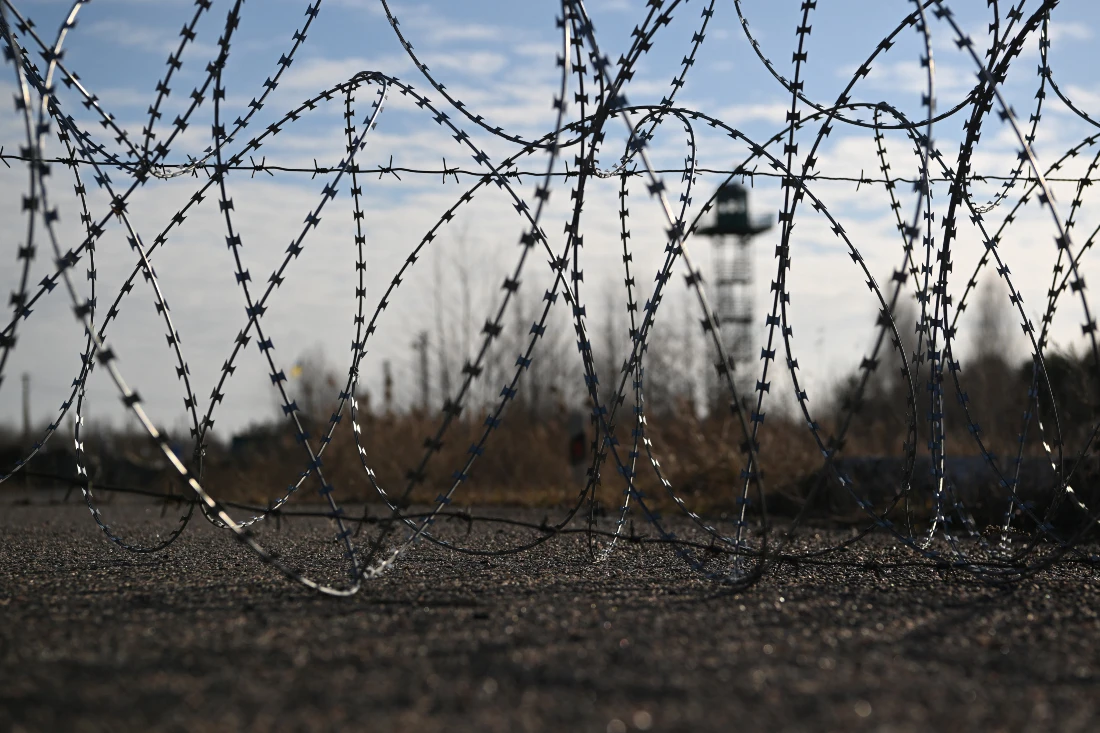
Russia trained Belarusian pilots in nuclear weapons use

Russia has a union agreement with Belarus that envisions close political, economic and military ties. (File/AFP)
Short Url
Updated 14 April 2023
Follow

Russia trained Belarusian pilots in nuclear weapons use

  • It was another attempt by the Kremlin leader to dangle the nuclear threat to discourage the West from supporting Ukraine

MOSCOW: Belarusian air force crews have completed their training for using tactical nuclear weapons as part of Russia’s plan to deploy the weapons to its ally Belarus amid the fighting in neighboring Ukraine, the Russian Defense Ministry said Friday.
The ministry released a video in which a Belarusian pilot said that the training course in Russia had given the crews of the Belarusian air force’s Su-25 ground attack jets the necessary skills for using the weapons.
Russian President Vladimir Putin declared last month that Moscow planned to put some of its tactical nuclear weapons in Belarus. It was another attempt by the Kremlin leader to dangle the nuclear threat to discourage the West from supporting Ukraine.
Russia has a union agreement with Belarus that envisions close political, economic and military ties. Russian troops used Belarusian territory to roll into Ukraine from the north in February 2022 and have maintained a presence in Belarus.
The deployment of Russian tactical nuclear weapons to Belarus would put them closer to potential targets in Ukraine and NATO members in Eastern and Central Europe. Belarus shares a 1,250-kilometer (778-mile) border with NATO members Latvia, Lithuania and Poland.
Such weapons are intended to destroy enemy troops on the battlefield. They have a relatively short range and much less power compared with nuclear warheads fitted to long-range strategic missiles, which are capable of obliterating whole cities.
Putin said that construction of storage facilities for tactical nuclear weapons would be completed in Belarus by July 1. Russia also has helped modernize Belarusian warplanes to adapt them to carrying nuclear weapons and provided the country with Iskander short-range missiles that could be fitted with a nuclear warhead.
Putin has emphasized that Russia would retain control over any nuclear weapons deployed to Belarus, just as the US controls its tactical nuclear weapons on the territory of its NATO allies.
Belarus, Kazakhstan and Ukraine had Soviet nuclear weapons stationed in their territory, but handed them over to Russia after the 1991 collapse of the Soviet Union.

Pope names veteran Vatican diplomat as ambassador to the US to manage relations with Trump

Updated 4 sec ago
Follow

Pope names veteran Vatican diplomat as ambassador to the US to manage relations with Trump

  • Italian Archbishop Gabriele Caccia, 68, is currently the Holy See’s ambassador to the UN
  • He replaces French-born Cardinal Christophe Pierre

ROME: Pope Leo XIV on Saturday named a veteran Vatican diplomat as his new ambassador to the United States to manage one of the Holy See’s most important bilateral relationships at a crucial time, with ties strained over the Trump administration’s war in Iran and immigration crackdown.
Italian Archbishop Gabriele Caccia, 68, is currently the Holy See’s ambassador to the United Nations in New York. He replaces French-born Cardinal Christophe Pierre, who at age 80 is retiring as apostolic nuncio in Washington.
Caccia served as the Holy See’s ambassador to Lebanon and the Philippines before being posted to the UN in 2019. Ordained a priest in Milan in 1983, Caccia later served as “assessor” in the Vatican secretariat of state, a key administrative post in the Holy See’s most important office.
He inherits a complicated and consequential dossier on both the US church and state fronts at a time of global turmoil.
Pierre’s tenure as ambassador was notable for clear signs of friction between the leadership of the US Conference of Catholic Bishops, which tends to skew conservative, and the more progressive priorities of Pope Francis’ pontificate.
The relationship with the US and its church is crucial for the Holy See, not least because US Catholics are the most generous donors to the Holy See’s coffers.
Leo, history’s first US-born pope, is well aware of the dynamic, having served as Francis’ point man on bishop nominations for two years before his 2025 election. Leo has emphasized a message of pacification and unity in the church.
The first Trump administration clashed with Francis especially on migration, and that tension has continued in Leo’s pontificate and the second Trump term. Leo has repeatedly insisted that the Trump administration respect the human dignity of migrants, while acknowledging its right to its borders.
More recently, Leo has expressed “profound concern” about the US-Israeli war in Iran and urged both sides to “stop the spiral of violence before it becomes an irreparable abyss.”
In comments last Sunday, Leo called for the resumption of diplomacy. Weapons, he said, only sow “destruction, pain and death.”
In a major foreign policy speech earlier this year, Leo also made clear he opposed the US aggressive use of military power, in an apparent reference to Washington’s incursion in Venezuela and threats to take Greenland. He denounced how nations were using force to assert their dominion worldwide and “completely undermine” peace and the post-World War II international legal order.
Caccia said in a statement Saturday he was humbled by Leo’s appointment and faith in naming him ambassador to his native country.
“I receive this mission with both joy and a sense of trepidation,” according to a statement reported by Vatican News. He said his was a mission “at the service of communion and peace,” recalling that this year marks the 250th anniversary of the US independence.
The current president of the US conference, Archbishop Paul S. Coakley, welcomed Caccia’s appointment and offered the US hierarchy’s “warmest welcome and our prayerful support.”
The Holy See has a tradition of diplomatic neutrality, though Leo has spoken out strongly against the humanitarian toll of Israel’s military action in Gaza and Russia’s invasion of Ukraine.