
KARACHI: As Pakistan struggles with its most serious economic crisis in years, leading charity organizations say the rising prices of food and other commodities have caused funding from donors to “substantially decline,” raising fears that long-running free food distribution centers would have to close down.
Pakistan’s inflation soared to a record 35 percent last month. Food inflation in March was at 47.1 percent and 50.2 percent for urban and rural areas respectively while one report compiled by a leading Pakistani economist said poverty was expected to rise to 42.5 percent from 36 percent last year.
The turmoil has hit charities too, in the form of smaller donations of the traditional zakat alms for the poor, while many regular donors, even those who gave small amounts, had disappeared.
Charity drives to distribute free flour and cash have also led to deadly chaos, with at least 16 people killed since last month in stampedes and violence at distribution points, shocking Pakistan, especially during the Islamic fasting month of Ramadan, a time for giving and spiritual reflection.
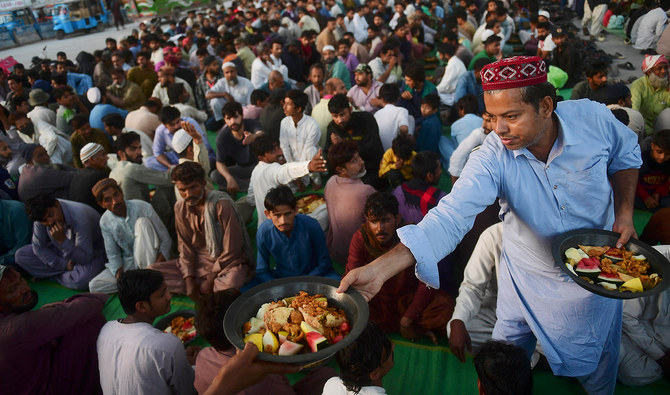
In Pakistan, evening street meals in Ramadan are widely organized by charities for the poor or by local communities which pool food donations.
“The [donation] amount has substantially declined as around 60-70 percent of people are not showing donations as compared to previous years,” Arif Lakhani, a trustee of the Saylani Welfare Trust, a leading charity organization and one of the largest free food distribution networks in Pakistan, said.
Lakhani said Saylani provides free food daily to around 500,000 people.
“The funding has been reduced by 70 percent, and the number of free food seekers has increased,” he said. “This is a difficult time for all NGOs, and it seems we will be forced to shut down many dastarkhawans [food spreads].”
As the charities scramble for scarce donations, Pakistan remains engaged with the International Monetary Fund to finalize a bailout agreement and secure $1.1 billion funding, part of a $6.5 billion bailout package agreed to in 2019. Talks, ongoing since November, have not yet borne fruit.
Meanwhile, prices have been pushed higher by a weakening currency, energy tariff increases and a usual Ramadan spike. Another major reason why donations were declining, Lakhani said, was that industries and factories in the country were shutting down in response to the government imposing restrictions on imports to prevent the outflow of US dollars amid a foreign exchange crisis.
Irfan Chotani, a member of the Al-Qadir Foundation, a charity organization that has been distributing free food among the poor for the past eight years, said the worsening economic situation had led to a rise in free food seekers.
“This year, the rush of people coming to get free food is almost double compared to the previous years,” Chotani told Arab News.
“The number of aid seekers was around 500 people [daily] during the previous years but this year, the number has increased to 850 to 900 … The inflow of people has almost doubled.”
Qazi Sadaruddin, the director of community services at Alkhidmat Foundation, a leading Pakistani non-profit organization, said the number of those seeking aid had increased by 20 percent this year compared to previous years.
“Those earning Rs25,000 ($88) to Rs30,000 ($106) are more in our society, and their numbers have increased,” he added.
Citizens looking for free food at a distribution center in Karachi earlier this month said the rising cost of food and unemployment had forced them to seek alms.
“If things were cheaper we would have broken the fast at home but the goods are so expensive that we are forced to come here,” Muhammad Mumtaz, an embroidery worker, told Arab News.
“I am unemployed, there is inflation,” Muhammad Jan, another free food seeker, said, “and I can’t afford food, that is why I have come here for iftar.”