

Kim Jong Un: North Korea’s new solid-fuel ICBM meant to ’strike horror’ on enemies

1 / 2
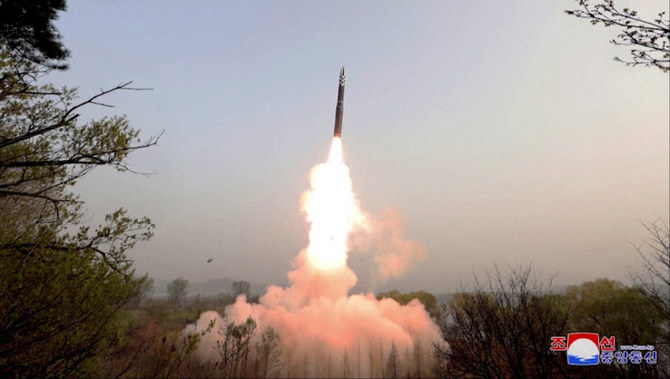
A view of a test launch of a new solid-fuel ICBM Hwasong-18 at an undisclosed location in North Korea on April 14, 2023. (KCNA via REUTERS TV)
2 / 2
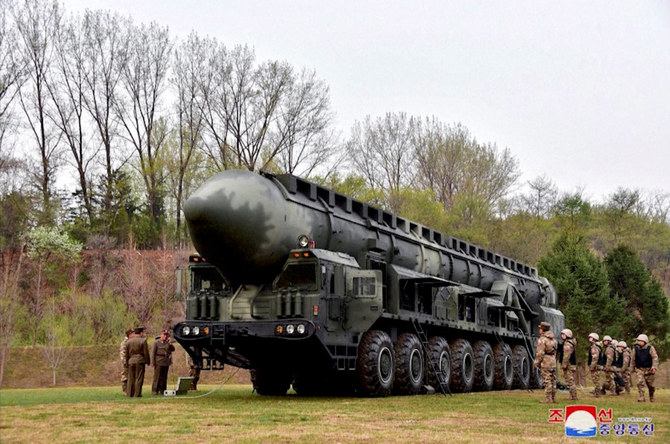
A view of a missile and its launcher during a test launch of a new solid-fuel ICBM Hwasong-18 at an undisclosed location in North Korea. (KCNA via REUTERS TV)
Short Url
Updated 14 April 2023
Follow

Kim Jong Un: North Korea’s new solid-fuel ICBM meant to ’strike horror’ on enemies

  • Developing a solid-fuel ICBM has long been seen as a key goal for North Korea, as it could help the North deploy missiles faster during a war

SEOUL: North Korea said on Friday it had tested a new solid-fuel intercontinental ballistic missile (ICBM), the Hwasong-18, to “radically promote” the country’s nuclear counterattack capability, state media reported.

Leader Kim Jong Un guided the test, and warned it would make enemies “experience a clearer security crisis, and constantly strike extreme uneasiness and horror into them by taking fatal and offensive counter-actions until they abandon their senseless thinking and reckless acts.”
North Korea has criticized recent US-South Korean joint military exercises as escalating tensions, and has stepped up weapons tests in recent months.
State media released photos of Kim watching the launch, accompanied by his wife, sister and daughter, and the missile covered in camouflage nets on a mobile launcher.
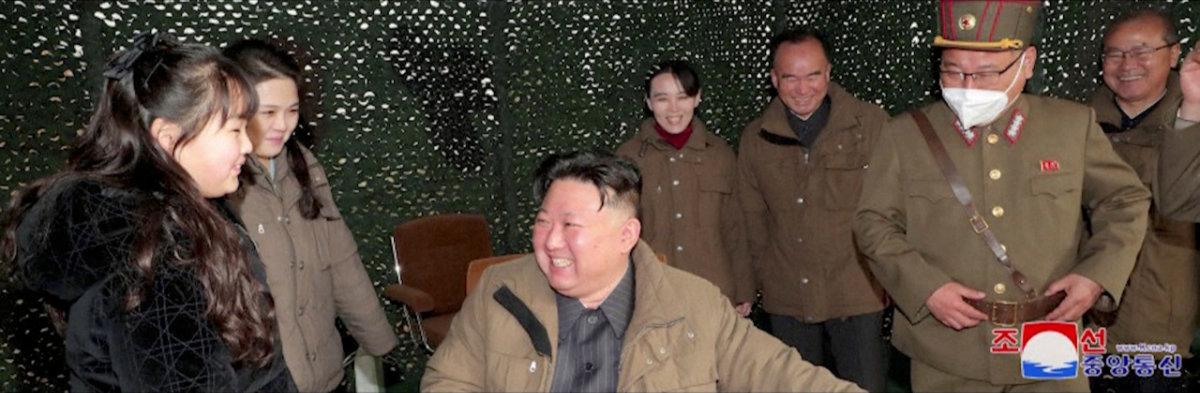


North Korean leader Kim Jong Un, his wife Ri Sol Ju and daughter Kim Ju Ae attend a test launch of a new solid-fuel ICBM Hwasong-18 at an undisclosed location. (KCNA via REUTERS TV)

“The development of the new-type ICBM Hwasongpho-18 will extensively reform the strategic deterrence components of the DPRK, radically promote the effectiveness of its nuclear counterattack posture and bring about a change in the practicality of its offensive military strategy,” KCNA said, using the initials of its official name.
“Pho” means “artillery” in Korean.
Analysts said it is the North’s first use of solid propellants in an intermediate-range or intercontinental ballistic missile.
Developing a solid-fuel ICBM has long been seen as a key goal for North Korea, as it could help the North deploy missiles faster during a war.
More tests?
Most of the country’s largest ballistic missiles use liquid fuel, which requires them to be loaded with propellant at their launch site — a time-consuming and dangerous process.
“For any country that operates large-scale, missile based nuclear forces, solid-propellant missiles are incredibly desirable capability because they don’t need to be fueled immediately prior to use,” said Ankit Panda, a senior fellow at the US-based Carnegie Endowment for International Peace. “These capabilities are much more responsive in a time of crisis.”
North Korea will most keep some liquid-fuel systems, complicating the calculations of the US and its allies during a conflict, Panda said.
Vann Van Diepen, a former US government weapons expert who now works with the 38 North project, said solid-fuel missiles are easier and safer to operate, and require less logistical support — making them harder to detect and more survivable than liquids.
North Korea first displayed what could be a new solid-fuel ICBM during a military parade in February after testing a high-thrust solid-fuel engine in December.
Analysts said the US could determine between a solid- or liquid-fueled launch with early warning satellites that can detect differences in the infrared data produced by various missile types.
The latest launch came days after Kim called for strengthening war deterrence in a “more practical and offensive” manner to counter what North Korea called moves of aggression by the United States.
The missile, fired from near Pyongyang, flew about 1,000 km (620 miles) before landing in waters east of North Korea, officials said. North Korea said the test posed no threats to its neighboring countries.
A South Korean military official said the missile’s maximum altitude was lower than 6,000 km, the apogee of some of last year’s record-breaking tests.
Chang Young-keun, a missile expert at the Korea Aerospace University, said the apogee appears to have been lower than previous ICBM tests.
“North Korea could have opted to focus on collecting data necessary to check its features at different stages than going full speed at the first launch,” added Kim Dong-yup, a professor at the University of North Korean Studies. “As it was a test that did not demonstrate its normal flight pattern, North Korea will likely conduct some more tests.”


Boys recount ‘torment’ at hands of armed rebels in DR Congo

Updated 2 sec ago
Follow

Boys recount ‘torment’ at hands of armed rebels in DR Congo

BUNIA: Forcibly recruited into a rebel militia affiliated with the Daesh group, two boys revealed the “torment” of living in its camps as members committed massacres in the Democratic Republic of Congo’s northeast.
The two minors freed from the Allied Democratic Forces (ADF) gave AFP an unprecedented account of the shadowy group, notorious for its extreme brutality.
Paluku, a frail 12-year-old, spent two months with the ADF after rebels killed his mother during an attack on his village in eastern North Kivu province. His brother and sister were also captured.
Edouard, 17, spent a gruelling four years with the ADF — formed by Ugandan rebels who took refuge in DRC — after he was kidnapped at age 12.
The two boys, using pseudonyms, spoke on condition of anonymity at a center specializing in the care of minors recruited by armed groups in the region, whose location AFP has chosen not to disclose to avoid potential reprisals.
Their accounts were confirmed by health and security sources.
Round-faced Edouard, a fast-talker, did not mince his words in describing his years of “torment” within the ADF.
“We suffered terribly,” he said.
After their capture, Edouard and Paluku were sent to ADF bases hidden in the dense forest of northeast DRC where the elusive rebels avoid patrols by the Congolese army and Ugandan forces deployed there since 2021.
The bases consist of simple tents and tarps, easy to move in the event of an attack.
Most occupants are women and children, according to security sources, contributing to the group’s operations — but also serving as human shields.
New recruits are swiftly forced to convert to Islam and learn Arabic, but also English and Swahili, Edouard said.
“I was also trained in medicine to treat the wounded, and we learned how to handle weapons and clean them,” he said.
Paluku said he underwent similar training, as well as learning how to “steal food, clothing and medicine to bring back to the ADF camp.”

- Floggings -

Children play a central role in supplying the group, security sources said. Those who fail to bring back loot face severe punishment.
The wives of the ADF commanders, some of whom are particularly influential, also exercise power over the young recruits.
When the fighters go out on “operations,” the youngest among them like Paluku, were “supposed to bring something back for the chief’s wife,” he said, like soap, cooking oil or fabric.
“To get it we have to loot people’s belongings, and if a chief’s wife accuses you to her husband of not bringing back what she asked for, she can demand that you be killed,” he said.
Edouard and Paluku said they were subjected to incessant corporal punishment.
Girls and boys were whipped or thrown into pits for several weeks over the slightest misbehavior.
“I was punished with lashes because I refused to go kill people,” Paluku said with a long stare.
Edouard took part in combat with the group at least three times against the Congolese army or local militias.
“They beat us mostly when we lost our weapons and ammunition, claiming we had wasted them for nothing or lost them on the front,” he explained.
Faced with such an accusation, Edouard said a chief ordered that he be whipped.
“I fell ill because of those lashes. I told the chief outright I was no longer able to go fight on the front, I begged him to send others who were capable, but that made him even more angry, and I was whipped once again,” he said.

- Trauma -

About 10 children freed from the ADF arrive on average each month at the reception center in the troubled northeast Ituri province.
“These children have suffered psychological trauma and torture, and when they arrive here, most are aggressive,” said Madeleine, a psychologist at the center.
After a few weeks spent around other children and staff, their aggression fades, she said.
But there are other scars to contend with.
Edouard became addicted to drugs administered by the rebels after he was wounded in combat.
Suffering from speech disorders, he talks constantly and sometimes incoherently, disturbing other residents, Madeleine said.
After a year at the center receiving ongoing treatment, Edouard recounted the horrors of his experience with a shy smile and a lively, excitable gaze.
Paluku meanwhile had a darker expression, recalling his sister who remains a hostage.
“She has become the wife of one of the ADF chiefs,” he said.