

North Korea says it tested another ‘underwater nuclear attack drone’

1 / 2
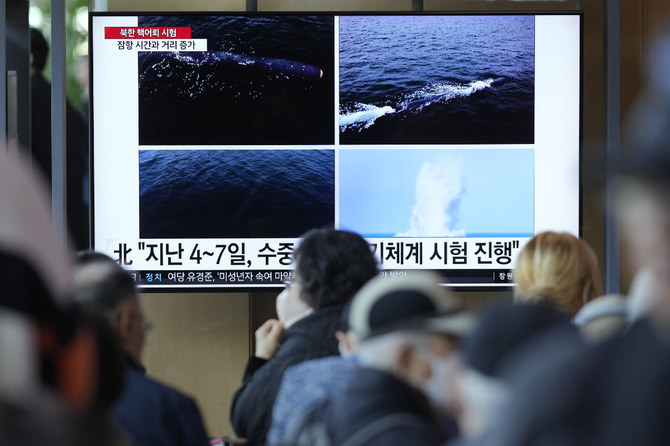
A combination of images on North Korea's weapons tests, released by Pyongyang's official Korean Central News Agency, are shown on a South Korean news broadcast in Seoul on April 8, 2023. (AP Photo/Lee Jin-man)
2 / 2
This undated picture taken from the period of April 4 to 7, 2023, Pyongyang's official Korean Central News Agency, on April 8 shows an underwater strategic weapon system submerging in the East Sea, also known as the Sea of Japan. (AFP)
Short Url
Updated 08 April 2023
Follow

North Korea says it tested another ‘underwater nuclear attack drone’

  • Pyongyang calls its supposed underwater nuclear attack drone "Haeil", which means tsunami in Korean
  • South Korea says it was “capable of monitoring and detecting such drones infiltrating underwater”

SEOUL: North Korea claimed Saturday it had tested another underwater nuclear attack drone, in its latest response to South Korean and United States military drills, though analysts have questioned whether Pyongyang has such a weapon.

In recent weeks, North Korea has tested what state media have described as an underwater nuclear-capable drone, and also carried out the launch of an intercontinental ballistic missile.
“A national defense science research institute in the DPRK carried out a test of underwater strategic weapon system from April 4 to 7,” the official Korean Central News Agency said.
“The underwater nuclear attack drone ‘Haeil-2’... cruised 1,000 km of simulated underwater distance ... for 71 hours and 6 minutes.”
KCNA added that “the test warhead accurately detonated underwater. The test perfectly proved the reliability of the underwater strategic weapon system and its fatal attack ability.”
North Korea has claimed to have conducted three tests of underwater drones in less than three weeks so far.
On March 23, it claimed to have conducted the first test of the Haeil, which means tsunami in Korean, able to unleash a “radioactive tsunami” as it blamed US-South Korea exercises for a deteriorating regional security situation.
Five days later it said it had carried out a second test.
In response South Korean Defense Minister Lee Jong-sup told MPs Seoul was “capable of monitoring and detecting such drones infiltrating underwater.”
Satellite imagery has also indicated a high level of activity at North Korea’s main nuclear complex after leader Kim Jong Un ordered the production of weapons-grade nuclear material be ramped up.
North Korea last year declared itself an “irreversible” nuclear power and Kim recently called for an “exponential” increase in weapons production, including tactical nuclear weapons.
South Korea and the United States on Wednesday staged joint air drills involving at least one US nuclear-capable B-52H strategic bomber, Seoul’s military said.
North Korea views such exercises as rehearsals for invasion, and has responded to other recent drills with a spate of increasingly provocative banned weapons tests.
North Korea is seeking to diversify its delivery mechanisms in addition to increasing its nuclear stockpile.
Russia has also reportedly developed a similar weapon — nuclear-capable Poseidon torpedoes — but mastering the complex technology required for such weaponry might yet be beyond North Korea, experts said.
But the North’s claims about the tests should not be “easily dismissed for being exaggerated,” Choi Gi-il, professor of military studies at Sangji University, told AFP.
“While the North could have exaggerated the degree of success to some extent, they appear to show Pyongyang’s underlying confidence in this technology, some of which could have been transferred from Russia.”
Russia and North Korea have not officially commented on the transfer of the underwater drone technology, Choi added.


China says Philippines distorted facts about incident near disputed atoll

Updated 17 December 2025
Follow

China says Philippines distorted facts about incident near disputed atoll

  • The Chinese ministry defended its coast guard’s actions as “reasonable, lawful, professional and restrained”

BEIJING: China’s defense ministry accused the Philippines on Wednesday of distorting the facts about an incident involving the Chinese coast guard and Filipino fishermen near a South China Sea shoal, a charge Manila strongly rejected.
The Philippine coast guard said over the weekend that three Filipino fishermen were injured and two fishing vessels damaged when Chinese coast guard ships cut their anchor lines and fired water cannon near the Sabina Shoal on Friday, actions the Philippine defense secretary denounced as “dangerous” and “inhumane.”
The Chinese ministry defended its coast guard’s actions as “reasonable, lawful, professional and restrained,” and vowed to “take strong and effective measures” in response to “all acts of infringement and provocation,” according to a statement released on its social media account.
“The Philippine side amassed a large number of ships in an organized and premeditated manner to illegally intrude” into the atoll’s lagoon, the ministry said. “Philippine personnel even threatened Chinese coast guard on site with a knife,” it added.
Philippine defense ministry spokesperson Arsenio Andolong maintained that Manila has evidence to counter China’s assertions.
“The facts are not distorted. They are documented, timestamped, and corroborated by video recordings, vessel logs, and on-site reporting by the Philippine Coast Guard,” Andolong said in a statement.
“The Philippines is not hyping the issue, the facts speak for themselves. These are aggressive and excessive actions of an encroaching state,” he added.
Sabina Shoal, which China refers to as Xianbin Reef and the Philippines as the Escoda Shoal, lies in the Philippines’ exclusive economic zone 150 km (95 miles) west of Palawan province.
China claims almost the entire South China Sea, a waterway supporting more than $3 trillion of annual commerce. The areas Beijing claims cut into the exclusive economic zones of Brunei, Indonesia, Malaysia, the Philippines and Vietnam.
An international arbitral tribunal ruled in 2016 that Beijing’s sweeping claims had no basis under international law, a decision China rejects.