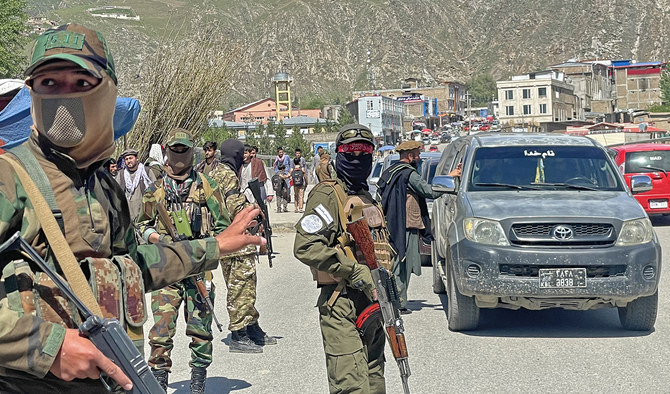
KABUL: Defence has received the largest share of funds in Afghanistan's budget as the Taliban government aims to boost forces by a third and build anti-aircraft missile capacity, the army chief told Reuters in a rare interview to foreign media.
The defence ambitions of the Taliban, which took over in 2021, come in the face of strong international criticism of its policies, such as restrictions on work and education for women, that have hampered steps towards diplomatic recognition.
In his remarks on Tuesday, Qari Fasihuddin Fitrat, a Taliban commander from the northern region of Badakhshan and the chief of army staff, condemned incursions by foreign drones into Afghan airspace.
Defence forces now numbering 150,000 are targeted to be increased by 50,000, he said, speaking in his office in the highly fortified defence ministry in Kabul, the capital, although he did not reveal the precise figure of the funds.
"The ministry of defence is the top-ranked in the budget," he said, adding that it received a significantly higher sum than other ministries, as it was a priority in the budget, which is largely funded by boosted tax and customs revenue.
Since their takeover, the Taliban have spent 1-1/2 years building a civilian administration and a national military out of an insurgent force that fought a 20-year war against foreign forces and the previous U.S.-backed Afghan government.
No foreign nation has formally recognized the government, which is battling economic headwinds following sanctions on the banking sector and the cutoff of all development aid.
Fitrat said a major defence focus was securing Afghan airspace against drones and other incursions.
"Anti-aircraft missiles are the need of countries," he said, adding that all nations sought developed weapons to ensure the integrity of their territory and airspace, a problem Afghanistan also faced.
"There is no doubt that Afghanistan is trying, and doing its best, to have it."
But Fitrat declined to elaborate on where authorities were looking to procure anti-aircraft missiles from.
He also stopped short of naming Pakistan, against which the Taliban administration has regularly protested, accusing its neighbour of allowing drones to enter Afghanistan.
"We are doing our best to find a solution for the protection of our airspace. We will work on it by using all our capability," Fitrat added.
"From where we will obtain it is confidential, but we should have it."
Pakistan's foreign ministry did not immediately respond to a request for comment.
Pakistan officials have not confirmed whether its airspace is used for drone access to Afghanistan.
"We have always tried, and will try, to solve the issue using diplomatic ways, and we have done our best to be patient regarding these cases," Fitrat said, but sounded a note of caution.
"Neighbouring countries should not let our patience be exhausted."
Ties between the neighbours have occasionally been tense as as Pakistan has accused the Taliban administration of allowing Afghan territory to be used as a haven for militant groups.
Among these is the Pakistani Taliban (TTP), which has stepped up attacks in Pakistan in recent months.
The Taliban administration denies allowing its territory to be used for attacks on others, however.
There have been border clashes between the forces of both, and analysts say that in the event of conflict escalating, Pakistan's airforce would give it a strong edge.
Fitrat said former security personnel, who form a significant share of Afghanistan's forces, were being paid and treated in the same way as Taliban fighters.
The comments follow concern voiced by international rights groups and the United Nations that some former members of Afghan security forces members were targeted or killed.
While the Taliban have declared a general amnesty for former combatants, saying they would investigate cases of wrongdoing, they have not detailed legal action regarding alleged extrajudicial targeting.


Taliban aim to boost Afghan security forces, anti-aircraft capacity — army chief
https://arab.news/rm8zn
Taliban aim to boost Afghan security forces, anti-aircraft capacity — army chief

- Defence forces now numbering 150,000 to be increased by 50,000, says Taliban commander
- Says major defence focus was securing Afghan airspace against drones and other incursions

‘Doomsday Clock’ moves closer to midnight over threats from nukes, climate change, AI
- At the end of the Cold War, the clock was as close as 17 minutes to midnight. In the past few years, to address rapid global changes, the group has changed from counting down the minutes until midnight to counting down the seconds
WASHINGTON: Earth is closer than it’s ever been to destruction as Russia, China, the US and other countries become “increasingly aggressive, adversarial, and nationalistic,” a science-oriented advocacy group said Tuesday as it advanced its “Doomsday Clock” to 85 seconds till midnight.
The Bulletin of the Atomic Scientist members had an initial demonstration on Friday and then announced their results on Tuesday.
The scientists cited risks of nuclear war, climate change, potential misuse of biotechnology and the increasing use of artificial intelligence without adequate controls as it made the annual announcement, which rates how close humanity is from ending.
Last year the clock advanced to 89 seconds to midnight.
Since then, “hard-won global understandings are collapsing, accelerating a winner-takes-all great power competition and undermining the international cooperation” needed to reduce existential risks, the group said.
They worry about the threat of escalating conflicts involving nuclear-armed countries, citing the Russia-Ukraine war, May’s conflict between India and Pakistan and whether Iran is capable of developing nuclear weapons after strikes last summer by the US and Israel.
International trust and cooperation is essential because, “if the world splinters into an us-versus-them, zero-sum approach, it increases the likelihood that we all lose,” said Daniel Holz, chair of the group’s science and security board.
The group also highlighted droughts, heat waves and floods linked to global warming, as well as the failure of nations to adopt meaningful agreements to fight global warming — singling out US President Donald Trump’s efforts to boost fossil fuels and hobble renewable energy production.
Starting in 1947, the advocacy group used a clock to symbolize the potential and even likelihood of people doing something to end humanity.
At the end of the Cold War, it was as close as 17 minutes to midnight. In the past few years, to address rapid global changes, the group has changed from counting down the minutes until midnight to counting down the seconds.
The group said the clock could be turned back if leaders and nations worked together to address existential risks.


