

IMF cuts Pakistan’s growth outlook to 0.5% in 2023

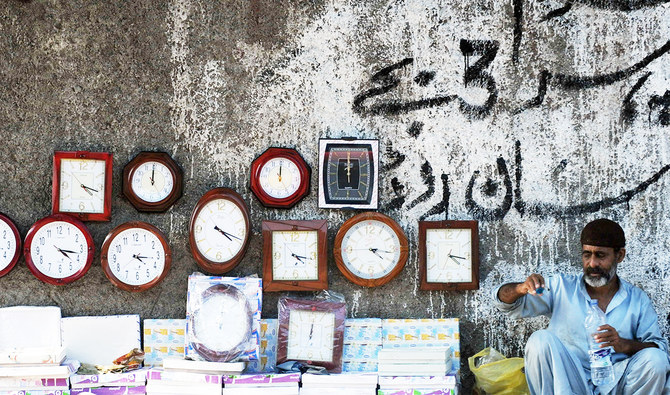
A Pakistani vendor (R) waits for customers as he sells cheap clocks on a footpath in Saddar bazaar, a neighbourhood of Karachi, on March 15, 2010. (AFP /FILE)
Short Url
Updated 12 April 2023
Follow

IMF cuts Pakistan’s growth outlook to 0.5% in 2023

  • Last year, IMF predicted Pakistan's growth rate to be 3.5% in the ongoing fiscal year
  • World Economic Outlook also predicts 27.1% inflation and 7% unemployment in Pakistan

ISLAMABAD: Pakistan’s economic woes are expected to continue in the ongoing year, making the International Monetary Fund (IMF) revise the country’s growth forecast to 0.5 percent along with high inflation and unemployment rates.

The international lending agency made the forecast in its latest World Economic Outlook report at a time when the Pakistani government is striving to secure external financing to shore up its dwindling foreign exchange reserves.

The country was forced to limit its imports in recent months due to a massive dollar liquidity crunch amid its negotiations with the IMF for about a $1 billion tranche under a $7 billion loan program.

Despite protracted negotiations, the two sides failed to reach a staff-level agreement over the issue that has remained pending since last September.

The IMF shared Pakistan’s economic outlook in tabulated form, along with its other member states, showing a projected growth rate of 0.5 percent in 2023 along with 27.1 percent inflation and seven percent unemployment for the same period.

“Tentative signs in early 2023 that the world economy could achieve a soft landing — with inflation coming down and growth steady — have receded amid stubbornly high inflation and recent financial sector turmoil,” the report said at the outset while presenting the overall global economic outlook.

It added that debt levels remained high in much of the world, “limiting the ability of fiscal policymakers to respond to new challenges.”

Last October, the IMF estimated that Pakistan’s economic growth would be 3.5 percent for the current fiscal year, though it has now downgraded its own estimate in the new report.

Pakistan’s gross domestic product (GDP) stood at six percent in 2022, and the IMF expects it to grow once again in 2024 to 3.5 percent.

As the country’s economic crisis lingers on, its finance minister Ishaq Dar decided to cancel its trip to the United States last week to attend the spring meetings of the IMF and World Bank.

However, he announced he would attend important bilateral and multilateral meetings virtually and send a Pakistani delegation to Washington as well.


Aramco’s 13% rally helps Saudi stocks post second weekly gain

Updated 12 March 2026
Follow

Aramco’s 13% rally helps Saudi stocks post second weekly gain

RIYADH: Saudi Aramco extended its year-to-date rally to nearly 13 percent on Thursday, helping the Kingdom’s benchmark stock index secure a second straight weekly gain despite a weaker final trading session.  

Saudi Aramco shares, which carry the heaviest weighting on the Saudi Exchange, closed at SR26.86 ($7.16), leaving the stock 12.72 percent higher since the start of 2026. The stock also remained 3.09 percent above last week’s close, even after falling 1.1 percent in Thursday’s session.

The rise in energy shares came as escalating tensions in the Middle East pushed oil prices above $100 a barrel, after attacks on tankers in the Gulf and the Strait of Hormuz heightened concerns over supply disruptions.

The Tadawul All Share Index maintained its weekly uptrend, rising nearly 1.07 percent week on week to close at 10,778.32, despite falling 0.45 percent in Thursday’s session. Compared with the first trading day of the year, the index has gained 4.01 percent.

Total trading turnover on the benchmark index reached SR5.05 billion at Thursday’s close, with 88 stocks advancing and 176 declining.

Aramco’s performance continued to anchor sentiment after the company reported adjusted net income of $104.7 billion for 2025 earlier this week, while net profit fell 12.1 percent year on year to $93.39 billion, compared with $106.25 billion in 2024, as lower crude prices weighed on earnings despite higher sales volumes across oil, gas and refined products.

On a March 10 earnings call, Aramco CEO Amin Nasser warned that prolonged disruption in the Strait of Hormuz could have severe implications for global energy markets. Roughly 20 percent of the world’s oil normally passes through the waterway each day, but shipments have been largely blocked.

“There would be catastrophic consequences for the world’s oil markets and the longer the disruption goes on ... the more drastic the consequences for the global economy,” he said.

“While we have faced disruptions in the past, this one by far is the biggest crisis the region’s oil and gas industry has faced.”

Saudi equities showed mixed performance in Thursday’s session. The MSCI Tadawul Index fell 5.99 points, or 0.40 percent, to close at 1,476.76.

The Kingdom’s parallel market Nomu gained 132.47 points, or 0.6 percent, to close at 22,370.4, with 38 stocks advancing and 34 declining.

On March 11, the International Energy Agency announced the release of 400 million barrels of oil from its reserves, the largest such move in its history. As part of that, the US said it would release 172 million barrels starting next week.