

Cuba gives green light to US dollar deposits, reversing ban

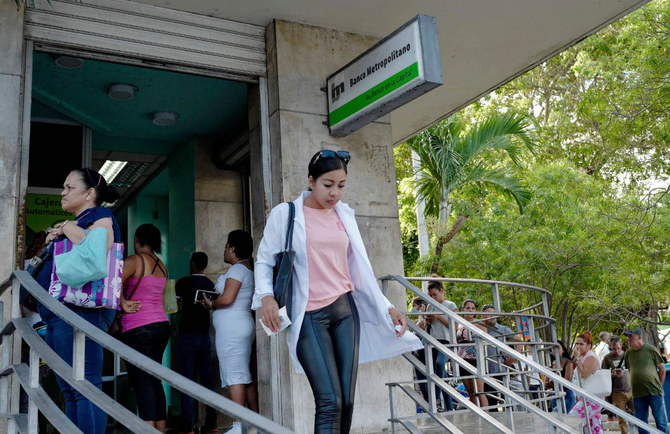
A woman walks out of a bank in Havana, on April 11, 2023, a day after the Cuban government announced a surprise reversal of a US dollar deposit ban. (AFP)
Short Url
Updated 12 April 2023
Follow

Cuba gives green light to US dollar deposits, reversing ban

  • Cuban authorities banned the flow of US dollars into the country in June 2021, arguing an embargo from the United States made it impossible for Cuba to move the money abroad

HAVANA: The Cuban government, in a reversal of a ban enacted in 2021, has given the green light to US dollar deposits into the local banking system as the Caribbean island nation undergoes an economic crisis.
“From this moment on, financial and banking institutions will accept cash deposits of US dollars into bank accounts,” Cuba’s central bank said in a resolution published late Monday in the official gazette.
The central bank said the step was “advisable” given Cuba’s current economic situation, which is seeing foreign currency begin to trickle in as the tourist sector recovers from the impacts of the COVID-19 pandemic.
The measure “will benefit the nation’s economic activity and the population, despite US measures that hinder the financial flow out of Cuba and prevent US cash deposits abroad,” Cuban Foreign Minister Bruno Rodriguez said on Twitter on Tuesday.
Cuban authorities banned the flow of US dollars into the country in June 2021, arguing an embargo from the United States made it impossible for Cuba to move the money abroad.
The US trade embargo on Cuba was put in place in the years after the country’s 1959 revolution under the argument of prohibiting the flow of funds to what it has dubbed a Communist regime.
Cuba has repeatedly denounced the US embargo, with the United Nations General Assembly recently voting overwhelmingly to end it. The non-binding resolution was opposed only by the US and Israel.
The move by the Cuban government comes after annual inflation hit 39 percent in 2022, and shortages of foreign currency, medicine, fuel and food have exacerbated.
The limited availability of dollars has caused a de facto black market to form, with some Cubans looking to save up enough greenbacks to emigrate off the island.
A record 220,000 Cubans were registered at the US-Mexico border in fiscal year 2022, according to US immigration data.
“This is a good measure to begin to clean up the Cuban economy,” economist Omar Everleny said. “Dollars have still been circulating on the black market, and they never reach the Cuban state.”


EU should consider forming combined military force: defense chief

Updated 4 sec ago
Follow

EU should consider forming combined military force: defense chief

  • Kubilius floated creating a “powerful, standing ‘European military force’ of 100,000 troops” that could eventually replace US forces
  • Trump has heightened fears among NATO allies over Washington’s reliability by insisting he wants to take over Greenland

BRUSSELS: EU countries should weigh whether to set up a combined military force that could eventually replace US troops in Europe, the bloc’s defense chief said Sunday.
EU defense commissioner Andrius Kubilius floated creating a “powerful, standing ‘European military force’ of 100,000 troops” as a possible option to better protect the continent.
“How will we replace the 100,000-strong American standing military force, which is the back-bone military force in Europe?” he asked in a speech in Sweden.
The suggestion comes as US President Donald Trump has heightened fears among NATO allies over Washington’s reliability by insisting he wants to take over Greenland.
Worries over Trump’s commitment to Europe have already spurred countries to step up efforts to bolster their militaries in the face of the threat posed by Russia.
Ideas about establishing a central European army have floated around for years but have largely failed to gain traction as nations are wary of relinquishing control over their militaries.
The US has pushed its European allies to increasingly take over responsibility for their own security, and raised the prospect it could shift forces from Europe to focus on China.
“In such times, we should not run away from the most pressing questions on our institutional defense readiness,” said Kubilius, a former Lithuanian prime minister.
In his speech Kubilius also advocated for the creation of a “European Security Council” of key powers — including potentially Britain — that could help the continent take decisions over its own defense quicker.
“The European Security Council could be composed of key permanent members, along with several rotational members,” he said.
“In total around 10-12 members, with the task to discuss the most important issues in defense.”
He said the first focus of such a body should be trying to change the dynamics in the war in Ukraine to ensure that Kyiv does not end up losing.
“We need to have a clear answer — how is the EU going to change that scenario?,” he said.
“This is the reason why we need to have a European Security Council now!“