

UN faces ‘appalling choice’ about Afghan mission after Taliban bans female staff

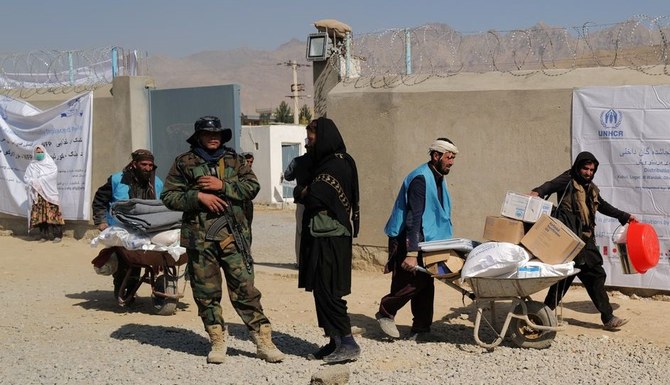
UNHCR workers push wheelbarrows loaded with aid for displaced Afghan families as a Taliban fighter secures the area outside a distribution center, Kabul, Afghanistan, Oct. 28, 2021. (Reuters)
Short Url
Updated 12 April 2023
Follow

UN faces ‘appalling choice’ about Afghan mission after Taliban bans female staff

  • About 3,000 Afghan UN staff, men and women, told to stay home while UN carries out a review of its operations in the country
  • The UN ban is the latest in a series of restrictions on women’s rights imposed by the Taliban since regaining control of Afghanistan in 2021

KABUL: The Taliban’s refusal to allow Afghan women to work for the UN is forcing the global organization to make an “appalling choice” about whether it can continue its mission in Afghanistan, it said on Tuesday as it launched an operational review.

The UN revealed last week that it had received notification of the restrictions from the Taliban government.

“Through this ban, the Taliban de facto authorities seek to force the United Nations into having to make an appalling choice between staying and delivering in support of the Afghan people, and standing by the norms and principles we are duty-bound to uphold,” the UN Assistance Mission in Afghanistan said on Tuesday.

“It should be clear that any negative consequences of this crisis for the Afghan people will be the responsibility of the de facto authorities.”

Taliban officials did not immediately respond to a request for comment from Arab News.

In response to the notification of the ban, the UN has launched a review of its operations in the country that will continue until May 5. It told 3,000 Afghan staff, men and women, not to go to work while it completes “necessary consultations,” makes required adjustments, and accelerates contingency plans.

The Taliban has imposed a series of restrictions on the rights of Afghan women and girls since regaining control of the country in 2021, including a ban on education beyond the sixth grade. Women are also barred from working, studying or traveling without a male companion.

The ban on female UN workers is an extension of restrictions announced in December preventing most women from working for nongovernmental organizations, which sparked heavy international criticism.

However, the global outcry against the actions of the Taliban is not proving effective, said Ramzia Sayedi, a women’s rights activist in Kabul.

“The Taliban have been trying to isolate Afghan women … since they took control of the country,” she told Arab News.

“Such condemnation will not solve the issues of Afghan women because the Taliban do not consider themselves as responsible towards women in the country and they are not committed to women’s rights.”


Brazil’s Lula urges Trump to treat all countries equally

Updated 6 sec ago
Follow

Brazil’s Lula urges Trump to treat all countries equally

NEW DELHI: Brazil’s President Luiz Inacio Lula da Silva urged Donald Trump on Sunday to treat all countries equally after the US leader imposed a 15 percent tariff on imports following an adverse Supreme Court ruling.
“I want to tell the US President Donald Trump that we don’t want a new Cold War. We don’t want interference in any other country, we want all countries to be treated equally,” Lula told reporters in New Delhi.
The conservative-majority Supreme Court ruled six to three on Friday that a 1977 law Trump has relied on to slap sudden levies on individual countries, upending global trade, “does not authorize the President to impose tariffs.”
Lula said he would not like to react to the Supreme Court decisions of another country, but hoped that Brazil’s relations with the United States “will go back to normalcy” soon.
The veteran leftist leader is expected to travel to Washington next month for a meeting with Trump.
“I am convinced that Brazil-US relation will go back to normalcy after our conversation,” Lula, 80, said, adding that Brazil only wanted to “live in peace, generate jobs, and improve the lives of our people.”
Lula and Trump, 79, stand on polar opposite sides when it comes to issues such as multilateralism, international trade and the fight against climate change.
However, ties between Brazil and the United States appear to be on the mend after months of animosity between Washington and Brasilia.
As a result, Trump’s administration has exempted key Brazilian exports from 40 percent tariffs that had been imposed on the South American country last year.

‘Affinity’ 

“The world doesn’t need more turbulence, it needs peace,” said Lula, who arrived in India on Wednesday for a summit on artificial intelligence and a bilateral meeting with Prime Minister Narendra Modi.
Ties between Washington and Brasilia soured in recent months, with Trump angered over the trial and conviction of his ally, the far-right former Brazil president Jair Bolsonaro.
Trump imposed sanctions against several top officials, including a Supreme Court judge, to punish Brazil for what he termed a “witch hunt” against Bolsonaro.
Bolsonaro was sentenced to 27 years in prison for his role in a botched coup bid after his 2022 election loss to Lula.
Lula said that, as the two largest democracies in the Americas, he looked forward to a positive relationship with the United States.
“We are two men of 80 years of age, so we cannot play around with democracy,” he said.
“We have to take this very seriously. We have to shake hands eye-to-eye, person-to-person, and to discuss what is best for the US and Brazil.”
Lula also praised Modi after India and Brazil agreed to boost cooperation on critical minerals and rare earths and signed a raft of other deals on Saturday.
“I have a lot of affinity with Prime Minister Modi,” he said.
Lula will travel to South Korea later on Sunday for meetings with President Lee Jae Myung and to attend a business forum.