

Pakistan’s election body seeks amendments to existing laws to ensure transparent polls

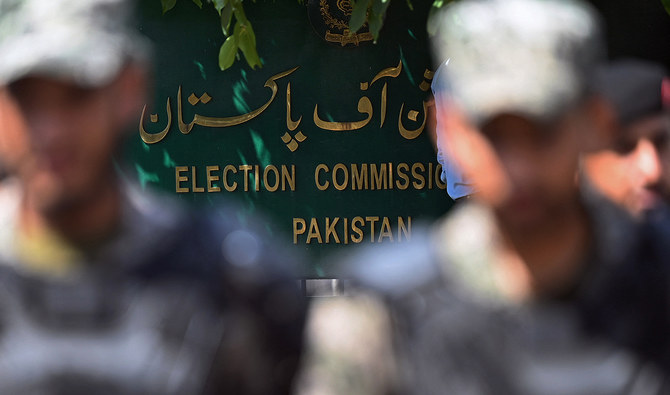
In this file photo, taken on August 2, 2022, paramilitary soldiers stand guard outside the Pakistan’s election commission building in Islamabad. (Photo courtesy: AFP/File)
Short Url
Updated 11 April 2023
Follow

Pakistan’s election body seeks amendments to existing laws to ensure transparent polls

  • The election commission blames an ‘overbearing’ judicial attitude for its ‘eroding’ constitutional authority
  • It requests parliament to empower it to announce or alter election schedule without any external interference

ISLAMABAD: Pakistan’s election regulatory body said on Monday its authority to conduct free and fair polls across the country had been “eroded” in the wake of the recent political developments, asking legislators to empower it to determine the election program on its own by amending relevant legal provisions.

The request was made by Chief Election Commissioner Sikandar Sultan Raja in a letter to the National Assembly speaker and Senate chairman after the country’s top court dismissed his institution’s decision to postpone the Punjab and Khyber Pakhtunkhwa (KP) polls and reschedule them in October this year.

The letter said the Election Commission of Pakistan (ECP) was an autonomous body formed under Article 218 (2) of the constitution and was required to conduct transparent elections by making necessary arrangements with the help of other state institutions.

It added that the commission was the “sole arbiter” to decide whether conducive environment existed to conduct the election or not, though the recent Supreme Court judgments in the Punjab and KP election delay case had divested it of its constitutional power.

“[The] ECP, in keeping with its mandate under Article 218 (3) to ensure free and transparent elections, has consistently strived to uphold the writ of law, fair play and merit in letter and spirit,” said the letter. “However, ... its writ has systematically been challenged on several occasions. In practice, ECP’s authority has been eroded.”

Referring to an “overbearing” judicial attitude in the past, the chief election commissioner asked whether it was still possible for the ECP to conduct free and fair elections in the country.

The letter suggested amendments to Sections 57 (1) and 58 of the election laws to empower the ECP to announce or alter election schedule without any external institutional interference.

It may be recalled that the Supreme Court of Pakistan had ordered elections in the country’s most prosperous and populous Punjab province on May 14. The apex court also said the decision by the election commission to delay polls to October 8 from April 30 owing to security reasons and lack of funding was “unconstitutional.”

The top court directed the federal government to release Rs21 billion ($74 million) in funds to the ECP by April 10 so that it could conduct the polls, directing the election regulator to submit a report on the matter by April 11.


Pakistan deputy PM directs authorities to monitor food prices ahead of Ramadan 

Updated 27 January 2026
Follow

Pakistan deputy PM directs authorities to monitor food prices ahead of Ramadan 

  • Prices of essential food items surge during holy month of Ramadan due to hoarding, profiteering by traders
  • Deputy PM Ishaq Dar directs authorities to prevent artificial price hikes, exploitation of consumers in Ramadan

ISLAMABAD: Pakistan’s Deputy Prime Minister Ishaq Dar on Tuesday directed authorities to monitor prices of essential food items ahead of Ramadan to prevent artificial price hikes and consumers from getting exploited, his office said. 

Pakistani increasingly shop for essential food items during the holy month of Ramadan, as millions across the country fast from dawn till sunset. Prices of essential food items surge during the holy month every year as traders often indulge in hoarding and profiteering. 

Dar chaired a meeting to review the availability and prices of essential commodities across the country on Tuesday, his office said. 

“DPM/FM [foreign minister] directed federal & provincial authorities to continue close monitoring, particularly in view of the approaching month of Ramazan, to prevent any artificial price hike or exploitation of consumers by unscrupulous elements,” Dar’s office said in a statement.

A central moon sighting committee in Pakistan, the Ruet-e-Hilal Committee, determines when Ramadan begins. The Islamic month is expected to start this year after mid-February, around Feb. 17 or Feb. 18.

Pakistan’s government also announces subsidies for the masses during the holy month to lower the prices of essential food items. 

In 2024, the Shehbaz Sharif-led government announced a Ramadan package comprising a subsidy of $26.8 million (Rs7.5 billion) to lower the prices of essential items for over 30,96,00,000 families.