

New Yemen peace talks ‘will protect people of the south,’ says Southern Transitional Council head

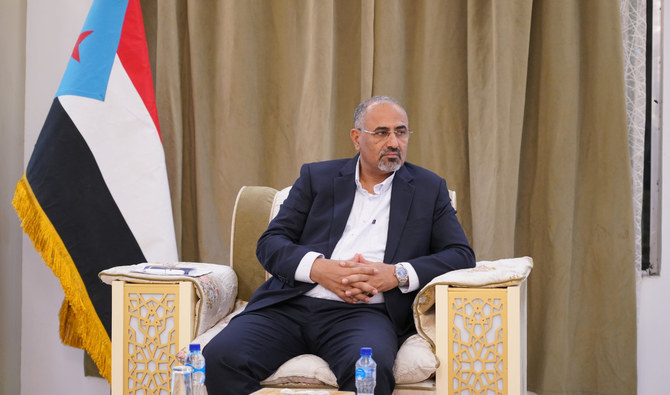
The Southern Transitional Council was set up in May 2017, with the aim of a separation of southern Yemen from the rest of the country, as it was before 1990. Al-Zubaidi is a former governor of Aden, the southern capital. (@AidrosAlzubidi)
Short Url
Updated 11 April 2023
Follow

New Yemen peace talks ‘will protect people of the south,’ says Southern Transitional Council head

  • Saudi officials have been in Sanaa since Sunday for talks with the Iran-backed Houthi militia

RIYADH: Protecting the rights of people in southern Yemen is a key aim of talks to end the country’s war, Yemen’s southern separatist leader told Arab News on Monday.

Maj. Gen. Aidarous Al-Zubaidi, president of the Southern Transitional Council and deputy head of Yemen’s Presidential Leadership Council, said all the country’s leaders were closely cooperating with the Arab Coalition and were in full agreement with the coalition on a roadmap for the political process in Yemen.

Saudi officials have been in Sanaa since Sunday for talks with the Iran-backed Houthi militia, as part of newefforts to end Yemen’s nine-year conflict.

Saudi Arabia’s delegation, led by the Kingdom’s ambassador to Yemen, Mohammed bin Saeed Al-Jaber, met Mahdi Al-Mashat, head of the Houthis’ supreme political council. An Omani delegation is also taking part in the talks.

“The peace roadmap and negotiations that are due to take place over the coming days will shed light on all issues and concerns of the nation, foremost of which is the case of our people in the south,” Al-Zubaidi told Arab News.

The Southern Transitional Council was set up in May 2017, with the aim of a separation of southern Yemen from the rest of the country, as it was before 1990. Al-Zubaidi is a former governor of Aden, the southern capital.

The Presidential Leadership Council was established a year ago as the executive body of Yemen’s internationally recognized government.


Israel defense minister vows to stay in Gaza, establish outposts

Updated 23 December 2025
Follow

Israel defense minister vows to stay in Gaza, establish outposts

  • His remarks, reported across Israeli media, come as a fragile US-brokered ceasefire between Israel and Hamas holds in Gaza

JERUSALEM: Defense Minister Israel Katz on Tuesday vowed Israel will remain in Gaza and pledged to establish outposts in the north of the Palestinian territory, according to a video of a speech published by Israeli media.
His remarks, reported across Israeli media, come as a fragile US-brokered ceasefire between Israel and Hamas holds in Gaza.
Mediators are pressing for the implementation of the next phases of the truce, which would involve an Israeli withdrawal from the territory.
Speaking at an event in the Israeli settlement of Beit El in the occupied West Bank, Katz said: “We are deep inside Gaza, and we will never leave Gaza — there will be no such thing.”
“We are there to protect, to prevent what happened (from happening again),” he added, according to a video published by Israeli news site Ynet.
Katz also vowed to establish outposts in the north of Gaza in place of settlements that had been evacuated during Israel’s unilateral disengagement from the territory in 2005.
“When the time comes, God willing, we will establish in northern Gaza, Nahal outposts in place of the communities that were uprooted,” Katz said, referring to military-agricultural settlements set up by Israeli soldiers.
“We will do this in the right way and at the appropriate time.”
Katz’s remarks were slammed by former minister and chief of staff Gadi Eisenkot, who accused the government of “acting against the broad national consensus, during a critical period for Israel’s national security.”
“While the government votes with one hand in favor of the Trump plan, with the other hand it sells fables about isolated settlement nuclei in the (Gaza) Strip,” he wrote on X, referring to the Gaza peace plan brokered by US President Donald Trump.
The next phases of Trump’s plan would involve an Israeli withdrawal from Gaza, the establishment of an interim authority to govern the territory in place of Hamas and the deployment of an international stabilization force.
It also envisages the demilitarization of Gaza, including the disarmament of Hamas, which the group has refused.
On Thursday, several Israelis entered the Gaza Strip in defiance of army orders and held a symbolic flag-raising ceremony to call for the reoccupation and resettlement of the Palestinian territory.