TEL AVIV: Israeli Prime Minister Benjamin Netanyahu vowed to restore security “on all fronts” after surging violence that included rocket fire from Lebanon and Syria and two more deaths on Monday.
Netanyahu also reinstated the defense minister whose firing he announced last month.
Heavy clashes, shootings, rocket strikes and a car-ramming attack have marred a period when the Muslim holy month of Ramadan coincides with the Jewish Passover and Christian Easter.
The latest casualties were a Palestinian teenager and a British-Israeli mother who succumbed on Monday to injuries from a West Bank gun attack that earlier killed her two daughters.
The day after Israeli police on Wednesday stormed the prayer hall of Jerusalem’s Al-Aqsa mosque — Islam’s third-holiest site — more than 30 rockets were fired from Lebanese soil into Israel.
The Israeli army said the attack was most likely carried out by the Palestinian armed movement Hamas.
Israel then bombarded the Gaza Strip and southern Lebanon, targeting “terror infrastructures” it said belonged to Hamas.
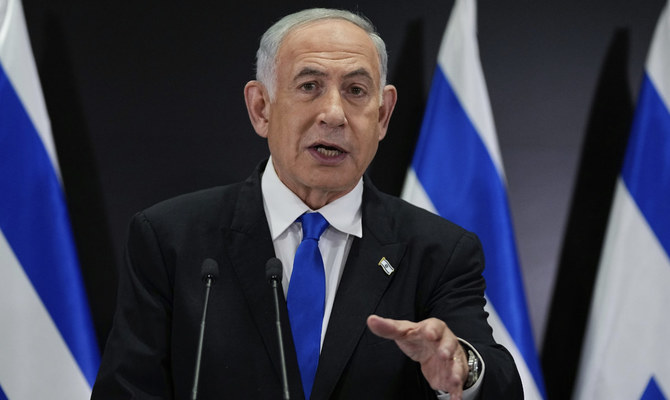
“We will not allow the terrorist Hamas to establish itself in Lebanon,” by acting on “all fronts,” Netanyahu said at a news conference Monday.
Israeli-Palestinian violence had already intensified since Netanyahu’s new government took power in December, a coalition with extreme-right and ultra-Orthodox Jewish parties.
The latest surge came late last month after he announced a “pause” for dialogue on judicial reform legislation, which split the nation and caused divisions in his government.
Among the political casualties was Yoav Gallant, whom the prime minister dismissed on March 26 after he called for a halt to the legislative process, citing national security concerns and threats by reserve military personnel not to report for duty.
Netanyahu is currently battling very low levels of domestic popularity. A recent survey showed him likely to lose if an election were held now.
At his news conference, Netanyahu said he and Gallant had “difficult disputes” but he had decided to put them in the past.
“Gallant remains in his post and we will continue to work together for the safety of the citizens of Israel,” he added.
In Tel Aviv, several hundred protesters took to the streets to denounce the government and condemn the prime minister’s speech, according to images broadcast by Israeli television.
Earlier Monday several government ministers joined a protest march by Jewish settlers, held under tight security in the north of the occupied West Bank.
In the latest shooting in the territory, Israeli forces killed a Palestinian teenager, Mohammed Fayez Balhan, 15, and wounded two other people, the Palestinian health ministry said, during what the army described as a raid to arrest a “terror suspect.”
The Israeli army confirmed its forces were operating in the Aqabat Jaber camp, the site of previous deadly Israeli raids this year, near Jericho, where soldiers were seeking “to apprehend a terror suspect.”
The army said troops responded with live fire after “suspects opened fire toward (soldiers), hurled explosive devices and Molotov cocktails.”
A suspect was taken in by security forces, they added.
Clashes erupted when the army entered the camp and surrounded several houses, according to Palestinian news agency Wafa. A Palestinian security official told AFP that five individuals had been arrested during the raid.
Hamas said it mourned the “young martyr” and praised those “standing up to this arrogant enemy.”
The operation came as a Jerusalem hospital confirmed that a British-Israeli woman, Lucy (Leah) Dee, had died after being seriously injured in a shooting attack Friday in the West Bank that killed her two daughters, aged 16 and 20.
Their car came under fire in the Jordan Valley, where Jericho is also located. The families were residents of Efrat, a Jewish settlement in the West Bank.
British Foreign Secretary James Cleverly tweeted that there could be “no justification” for the “senseless violence.”
Israel has occupied the West Bank since the 1967 Six-Day War and hundreds of thousands of Jewish settlers live in Israeli-approved settlements there which are considered illegal under international law.
Hundreds of Israelis marched Monday in the north of the West Bank, pushing for state approval of an Israeli settler outpost.
Several government ministers — including Israel’s far-right National Security Minister Itamar Ben-Gvir — appeared at the march to Eviatar, whose residents agreed to leave in 2021 while officials examined their case.
Addressing the crowd, Ben-Gvir said “the response to terror is to build” settlements.
Violence has flared anew since Israeli police stormed the prayer hall of Al-Aqsa mosque in a pre-dawn operation aimed at dislodging “law-breaking youths and masked agitators” they said had barricaded themselves inside.
Late Friday, an Italian tourist was killed and seven others wounded in a car-ramming attack in Tel Aviv.
The Israeli army also said it had launched strikes on targets in Syria Sunday after rockets fired from there landed in the Israeli-occupied Golan Heights.
The conflict has this year claimed the lives of at least 94 Palestinians, 19 Israelis, one Ukrainian and one Italian, according to an AFP count based on Israeli and Palestinian official sources.
These figures include, on the Palestinian side, combatants and civilians, including minors, and on the Israeli side, mostly civilians, including minors, and three members of the Arab minority.


![]()

Israel’s Netanyahu vows to restore security as violence surges
Short Url
https://arab.news/v7rkq
Israel’s Netanyahu vows to restore security as violence surges
- The latest surge came late last month after he announced a “pause” for dialogue on judicial reform legislation, which split the nation and caused divisions in his government


Latest updates


Recommended


© 2026 SAUDI RESEARCH & PUBLISHING COMPANY, All Rights Reserved And subject to Terms of Use Agreement.