ACWA Power’s Jazlah water desalination project gets commercial operation certificate   

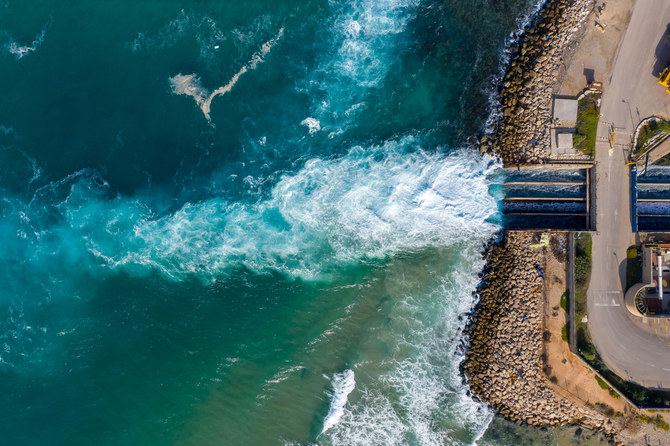
Jazlah desalination plant is the first project to be launched by the Saudi Water Partnership Co. in the Eastern Province. (Shutterstock)
Short Url
Updated 25 April 2023
Follow

ACWA Power’s Jazlah water desalination project gets commercial operation certificate   

RIYADH: ACWA Power’s Jazlah Water Desalination Co. has received the commercial operation certificate from its customer Saudi Water Partnership Co. for the production of 600,000 cubic meters of desalinated water per day. 

Jazlah is owned by a consortium led by ACWA Power, which holds a 40.2 percent stake, with other strategic partners -- Gulf Investment Corp. and AlBawani Water & Power Co. 

With an investment value of $650 million, the consortium is responsible for designing, constructing, commissioning, operating and maintaining the desalination plant in Jubail using the latest Reverse Osmosis Technology.  

ACWA Power said in a bourse filing that the financial impact of this project is expected to be reflected during the second quarter of 2023. 

Jazlah desalination plant is the first project to be launched by the Saudi Water Partnership Co. in the Eastern Province, as the project contains four water tanks with a capacity of 600,000 cubic meters.  

ACWA Power said the project has successfully capitalized on local content with nearly SR850 million ($227 million) injected into the national economy, indicating the rising role of the private sector in developing local content 

It added that the project contributes more effectively to achieving the development goals of the Kingdom’s Vision 2030. 

The project chose to use reverse osmosis technology as opposed to alternative thermal technology as it typically uses less energy than thermal desalination plants.  Reverse osmosis is defined as a water purification system that uses semipermeable membranes and pressure to separate salts from water. 

The 25-year water purchase agreement that the consortium signed with the Saudi Water Partnership Co. involves designing, constructing, commissioning, operating and maintaining the desalination plant as well as associated potable water storage and electrical special facilities. 

The company had awarded the engineering procurement construction part of the contract to a consortium consisting of Power China, SEPCO-III and Abengoa. 

In addition to the core desalination process of an RO, the project consists of four tanks which are enough for one day of supply. It used 13.5 km of overhead transmission line and 3.5 km of interface dispatch line. The desalination project has used a total undersea piping of 11.5 km. 


Kuwait to boost Islamic finance with sukuk regulation

Updated 05 February 2026
Follow

Kuwait to boost Islamic finance with sukuk regulation

  • The move supports sustainable financing and is part of Kuwait’s efforts to diversify its oil-dependent economy

RIYADH: Kuwait is planning to introduce legislation to regulate the issuance of sukuk, or Islamic bonds, both domestically and internationally, as part of efforts to support more sustainable financing for the oil-rich Gulf nation, Prime Minister Sheikh Ahmad Abdullah Al-Ahmad Al-Sabah said on Wednesday.

Speaking at the World Governments Summit in Dubai, Al-Sabah highlighted that Kuwait is exploring a variety of debt instruments to diversify its economy. The country has been implementing fiscal reforms aimed at stimulating growth and controlling its budget deficit amid persistently low oil prices. Hydrocarbons continue to dominate Kuwait’s revenue stream, accounting for nearly 90 percent of government income in 2024.

The Gulf Cooperation Council’s debt capital market is projected to exceed $1.25 trillion by 2026, driven by project funding and government initiatives, representing a 13.6 percent expansion, according to Fitch Ratings.

The region is expected to remain one of the largest sources of US dollar-denominated debt and sukuk issuance among emerging markets. Fitch also noted that cross-sector economic diversification, refinancing needs, and deficit funding are key factors behind this growth.

“We are about to approve the first legislation regulating issuance of government sukuk locally and internationally, in accordance with Islamic laws,” Al-Sabah said.

“This enables us to deal with financial challenges flexibly and responsibly, and to plan for medium and long-term finances.”

Kuwait returned to global debt markets last year with strong results, raising $11.25 billion through a three-part bond sale — the country’s first US dollar issuance since 2017 — drawing substantial investor demand. In March, a new public debt law raised the borrowing ceiling to 30 billion dinars ($98 billion) from 10 billion dinars, enabling longer-term borrowing.

The Gulf’s debt capital markets, which totaled $1.1 trillion at the end of the third quarter of 2025, have evolved from primarily sovereign funding tools into increasingly sophisticated instruments serving governments, banks, and corporates alike. As diversification efforts accelerate and refinancing cycles intensify, regional issuers have become regular participants in global debt markets, reinforcing the GCC’s role in emerging-market capital flows.

In 2025, GCC countries accounted for 35 percent of all emerging-market US dollar debt issuance, excluding China, with growth in US dollar sukuk issuance notably outpacing conventional bonds. The region’s total outstanding debt capital markets grew more than 14 percent year on year, reaching $1.1 trillion.