

In Islamabad, Palestinian community celebrates Ramadan with traditional dishes 

Palestinian community attend an iftar dinner at the residence of Palestinian Ambassador to Pakistan, Ahmed Jawad A.A. Rabei, in Islamabad, Pakistan on April 8, 2023. (AN photo)
Short Url
Updated 09 April 2023
Follow

In Islamabad, Palestinian community celebrates Ramadan with traditional dishes 

  • The Palestinian community in Pakistan celebrates an iftar at the ambassador’s residence every year 
  • Ambassador Ahmed Rabei’s wife makes traditional dishes to give the community ‘home-like feel’ 

ISLAMABAD: Palestine’s Ambassador to Pakistan Ahmed Jawad A.A. Rabei on Saturday hosted an iftar for the Palestinian community at his residence in Islamabad, where traditional Palestinian dishes such as ‘Maqluba,’ ‘Mansaf,’ ‘Qidreh,’ ‘Musakhan,’ ‘Warek Enab,’ ‘Qatayef’ and ‘Qizha’ were prepared for the guests to break their fast with. 

Muslims around the world come together to celebrate the values of unity, solidarity and tolerance during the holy month of Ramadan. In Pakistan, the Palestinian community also observes the sacred month and celebrates an iftar at the ambassador’s residence every year, where they enjoy traditional Palestinian cuisine and feel a sense of connection to their cultural heritage while living far from their homeland. 

“We invite our Palestinian people here, students and families living in our great country Pakistan to share iftar together,” Ambassador Rabei told Arab News. 

“Till now we have about 300 Palestinian people in Pakistan, including students and families.” 

Palestinian students traveled all the way from Karachi, Hyderabad, Lahore, Nawabshah and Peshawar to the Pakistani capital to participate and band together at the annual iftar event, the diplomat said. 

“Although I miss my people and family living in Palestine and also praying in Al-Aqsa mosque, I feel Pakistan like a second home,” the ambassador said. 


Palestine’s Ambassador to Pakistan Ahmed Jawad A.A. Rabei addresses guests during an iftar dinner at his residence in Islamabad, Pakistan, on April 8, 2023. (AN photo)

His wife, Amal Rabei, said they cooked traditional Palestinian dishes to give the community a “home-like feel.” 

“We have cooked Maqluba and Qidreh, these are Palestinian dishes, and Mansaf, another Palestinian dish, Musakhan,” she told Arab News. 


The picture taken on April 8, 2023, shows a traditional Palestinian dish called ‘Maqluba.’ (AN photo)

Eman Jihad, a Palestinian student, expressed her joy over the gathering and for seeing people who spoke the same language as she did. 

“It feels really good to gather with friends and people who talk in the same language that you do as living in Pakistan is totally different than living in Palestine,” she told Arab News. 
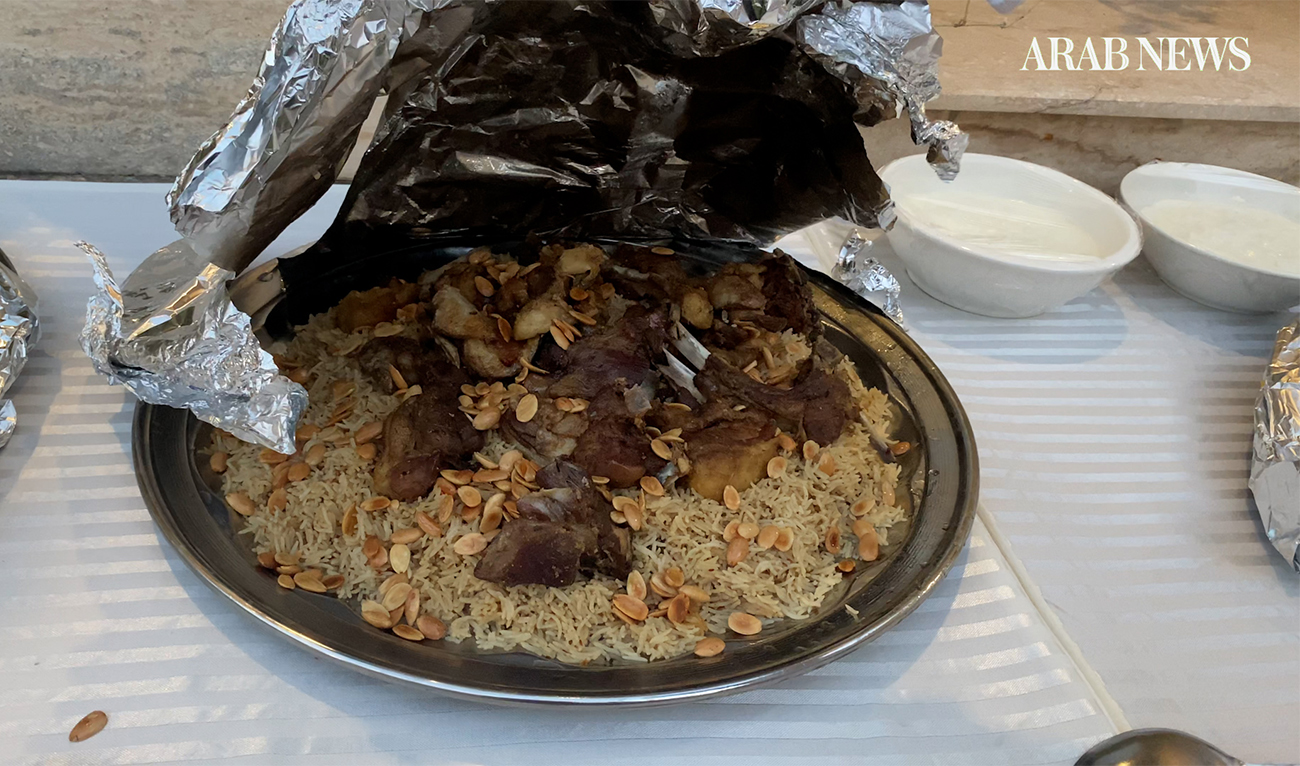


The picture taken on April 8, 2023, shows a traditional Palestinian dish comprised of rice and lamb. (AN photo)

Jihad said being able to converse in her native language, savor traditional food, and socialize with individuals from her country gave her a “sense of belonging” and made her feel at home. 

“Talking the same language, eating traditional food, having some people from your nature, from your country from your surroundings, it feels so good, it feels so like home for us,” she added. 

Yasmin Abuawad Shaheen, the ambassador’s daughter, said the purpose of the iftar was to demonstrate unity and enjoy the festivity of Ramadan. 

“The purpose is that we want to gather each other because we are Muslims and we want to enjoy it with our brothers and sisters from Palestine and Pakistan,” she told Arab News. 


Pakistan bulk cargo terminal signs deal to ship copper-gold output from Reko Diq

Updated 6 sec ago
Follow

Pakistan bulk cargo terminal signs deal to ship copper-gold output from Reko Diq

  • Pakistan International Bulk Terminal says the deal positions it as the primary logistics gateway for Reko Diq’s mineral output
  • A top Barrick Mining official says the agreement marks a ‘step forward,’ with exports from the project expected to begin in 2028

ISLAMABAD: A bulk cargo terminal operating at Pakistan’s Port Qasim has signed an agreement to handle and export copper-gold commodities from Reko Diq, including minerals, metals and other natural earth resources, in a move expected to support multibillion-dollar mineral exports from the country, the company said on Monday.

The terminal operator, Pakistan International Bulk Terminal Limited (PIBT), said the agreement positions it as the primary export gateway for Reko Diq’s mineral output and strengthens Pakistan’s ambitions to expand its footprint in global commodity markets.

The deal covers logistics, storage and exports for output from the Reko Diq copper-gold project in southwestern Balochistan province, one of the world’s largest undeveloped mineral deposits, with shipments expected to begin from 2028.

“This agreement is a historic milestone for PIBT and Pakistan, enabling exports from one of the world’s most significant mining projects and serving as a cornerstone for national economic growth,” Sharique Azim Siddiqui, CEO of PIBT, said in a statement.

He expressed appreciation to the government, the Special Investment Facilitation Council, the Ministry of Maritime Affairs and the Port Qasim Authority for their “pivotal role.”

Barrick Mining Corporation, which is developing Reko Diq, also welcomed the agreement.

“We’re delighted to have signed this important agreement with PIBT which marks another step forward in ensuring that Reko Diq delivers lasting value to all our stakeholders but particularly the people of Balochistan and Pakistan,” Mark Hill, the company’s top official, said.

PIBT is a fully mechanized multipurpose bulk terminal located at Port Qasim and was developed with a $305 million investment in partnership with the International Finance Corporation.

The terminal currently has an annual handling capacity of 12 million tons of imports and 4 million tons of exports, with further investment planned to upgrade its export systems, the company said.