

Amid unprecedented inflation, jirga in northwestern Pakistani town caps dowry for marriages

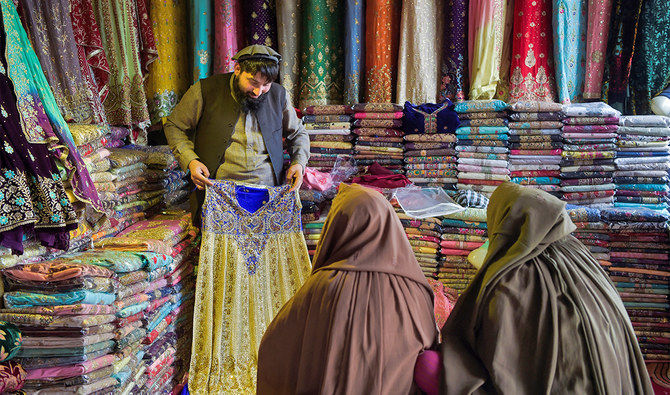
In this picture taken on February 12, 2020, women shop for clothing in a store in a bazaar in Peshawar, Pakistan. (AFP/File)
Short Url
Updated 09 April 2023
Follow

Amid unprecedented inflation, jirga in northwestern Pakistani town caps dowry for marriages

  • Dowry is an ages-old tradition in South Asia under which bride’s family gives valuables to groom on their marriage
  • A jirga in Lower Dir fixed a tola of gold, priced at $753, as dowry for marriages, drawing anger from activists

PESHAWAR: A jirga, or a council of tribal elders, in the northwestern Pakistani district of Lower Dir has fixed a tola (11.7 grams) of gold as dowry in order to help poor families marry off their children, locals said on Saturday, amid biting inflation in the South Asian country. 

Dowry is a centuries-old tradition in South Asia, including Pakistan, under which the bride’s family gives furniture, jewelry, cash and other tangible items to the groom on their marriage. 

Traditionally in parts of Lower Dir, 2-5 tolas of gold is fixed as dowry that most of the poor families cannot afford since its prices have soared manifold recently. In Pakistan, precious metals are mostly measured in tolas (a tola equals .44 troy ounce), with a tola of gold currently costing Rs215,800 ($753). 

Malik Abdullah Shah, a local elder and former mayor of Machaley town where the decision was reached, said residents of his remote hamlet were mostly poor who couldn’t afford to marry their sons and daughters off amid inflation that clocked in at 35.37 percent in March. 

“In view of the present-day realities amid inflation, hunger and constant depreciation of our currency, we have decided to determine the dowry amount at a minimum so that our daughters and sons can tie the knot,” Shah told Arab News on Saturday. 

The jirga also asked residents of Machaley town to follow the verdict and warned that those violating it would be fined Rs1 million ($3,583) and excommunicated, according to a copy of the decision seen by Arab News. 

The decision offers a “ray of hope” to poor families and is justified in view of the hike in commodity prices, Shah added. 

When contacted, Feroze Jamal Shah, caretaker information minister of Khyber Pakhtunkhwa, told Arab News it was not an agreement reached by a broader community. 

“I’m not aware of the nitty gritty of the decision but the government isn’t bound to implement it,” he said. 

But Shad Begum, a human rights activist, said the jirga’s decision wasn’t based on fair justice as many women neither have share in property nor they have other assets. 

If one looks at the basis of dowry, it is “discrimination toward girls” whose marital values are determined by the worth of their dowries, she added. 

“The jirga should have given a free will to everyone to decide about dowry with mutual consensus,” Begum told Arab News. 

Activists say fixing dowries would leave women vulnerable to domestic violence if their in-laws were unhappy with a dowry. 

Shahida Shah, another human rights activist, said there is no minimum dowry amount mentioned in Islam nor there was any dowry limit in the constitution, adding that laws were made against the “despicable custom” but they could not be implemented. 

“Identifying dowry is the mutual consent of a couple. Rest are self-made beliefs invented by the society and tribal families,” she added. 

Pakistan regulator amends law to facilitate capital raising by listed companies

Updated 4 sec ago
Follow

Pakistan regulator amends law to facilitate capital raising by listed companies

  • The amendments address challenges faced by listed companies when raising further capital from existing shareholders through a rights issue
  • Previously, listed companies were prohibited from announcing a rights issue if the company, officials or shareholders had any overdue amounts

KARACHI: The Securities and Exchange Commission of Pakistan (SECP) has notified amendments to the Companies (Further Issue of Shares) Regulations 2020 to facilitate capital raising by listed companies while maintaining adequate disclosure requirements for investors, it announced on Monday,

The amendments address challenges faced by listed companies when raising further capital from existing shareholders through a rights issue. Previously, listed companies were prohibited from announcing a rights issue if the company, its sponsors, promoters, substantial shareholders, or directors had any overdue amounts or defaults appearing in their Credit Information Bureau (CIB) report.

This restriction constrained financially stressed yet viable companies from raising capital, even in circumstances where existing shareholders were willing to support revival, restructuring, or continuation of operations, according to the SECP.

“Under the amended framework, the requirement for a clean CIB report will not apply if the relevant persons provide a No Objection Certificate (NOC) regarding the proposed rights issue from the concerned financial institution(s),” the regulator said.

The notification of the amendments follows a consultative process in which the SECP sought feedback from market stakeholders, including listed companies, issue consultants, professional bodies, industry associations, law firms, and capital market institutions.

The amendments are expected to enhance market confidence, improve access to capital for listed companies, and strengthen transparency within the rights issue framework, according to the SECP.

“To ensure transparency and protect investors’ interests, companies in such cases must make comprehensive disclosures in the rights offer document,” the regulator said.

“These disclosures must include details of any defaults or overdue amounts, ongoing recovery proceedings, and the status of any debt restructuring.”

The revised regulations strike an “appropriate balance” between facilitating corporate rehabilitation and enabling investors to make informed investment decisions, the SECP added.