

Islamabad police say fully equipped, ready to provide security to New Zealand team

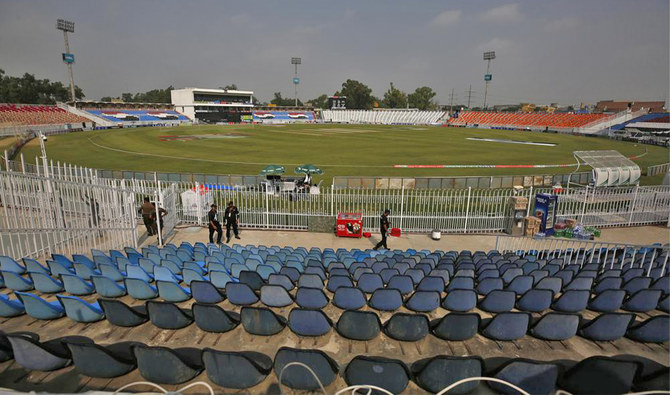
Pakistani police officers stand guard an enclosure of the Pindi Cricket Stadium ahead of the first one day international cricket match between Pakistan and New Zealand at the Pindi Cricket Stadium, in Rawalpindi, Pakistan, on September 17, 2021. (AP/File)
Short Url
Updated 09 April 2023
Follow

Islamabad police say fully equipped, ready to provide security to New Zealand team

  • Pakistan will host New Zealand for five T20s starting April 14, followed by five one-day internationals
  • The five-match Twenty20 series will be played in Lahore (April 14, 15, 17) and Rawalpindi (April 20, 24) 

ISLAMABAD: The Islamabad police are fully equipped and will provide “end-to-end, foolproof” security to the New Zealand cricket team for their upcoming tour of Pakistan. 

Pakistan will host New Zealand for five T20s starting April 14, followed by five one-day internationals. The five-match Twenty20 series will be played in Lahore (April 14, 15, 17) and Rawalpindi (April 20, 24). 

Local media reports suggested that Islamabad police had “refused” to assist their counterparts in the twin city of Rawalpindi with the security, citing a lack of resources. However, the Islamabad police have denied it. 

“Islamabad Capital Police is fully equipped and shall provide end-to-end, foolproof and world class security to New Zealand cricket team during their forthcoming visit,” an Islamabad police spokesperson told Arab News. 

The spokesperson said the capital police would play a key role in providing “flawless security” to the visitors in collaboration with other stakeholders in Islamabad and Rawalpindi. 

The ODIs will be played in Rawalpindi (April 27, 29) and Karachi (May 3, 5, 7). 

T20 squad: Babar Azam (captain), Shadab Khan (vice-captain), Faheem Ashraf, Fakhar Zaman, Haris Rauf, Iftikhar Ahmed, Ihsanullah, Imad Wasim, Mohammad Haris, Mohammad Nawaz, Mohammad Rizwan, Naseem Shah, Saim Ayub, Shaheen Shah Afridi, Shan Masood and Zaman Khan 

ODI squad: Babar Azam (captain), Shadab Khan (vice-captain), Abdullah Shafique, Fakhar Zaman, Haris Rauf, Haris Sohail, Ihsanullah, Imam-ul-Haq, Mohammad Nawaz, Mohammad Rizwan, Mohammad Wasim, Naseem Shah, Salman Ali Agha, Shaheen Shah Afridi, Shan Masood and Usama Mir 


At UNSC, Pakistan warns competition for critical minerals could fuel global conflict

Updated 54 min 58 sec ago
Follow

At UNSC, Pakistan warns competition for critical minerals could fuel global conflict

  • The demand for critical minerals has surged worldwide due to rapid expansion of electric vehicles, advanced electronics and clean energy technologies
  • Pakistan’s representative says all partnerships in critical minerals sector must be ‘cooperative and not exploitative’ and respect national ownership

ISLAMABAD: Ambassador Asim Iftikhar Ahmad, Pakistan’s permanent representative to the United Nations (UN), has warned that intensifying global competition over critical minerals could become a new driver of global conflict, urging stronger international cooperation and equitable access to resources vital for the world’s energy transition.

The warning comes as demand for critical minerals and rare earth elements surges worldwide due to the rapid expansion of electric vehicles, advanced electronics and clean energy technologies, with governments and companies increasingly competing to secure supply chains while raising concerns that this may lead to geopolitical rivalries in the coming years.

Speaking at a Security Council briefing on ‘Energy, Critical Minerals, and Security,’ Ahmad said experience showed that the risks of instability increased where mineral wealth intersected with weak governance, entrenched poverty and external interference.

“Access to affordable, reliable and sustainable energy is essential for development, stability and prosperity. The global transition toward renewable energy, electric mobility, battery storage and digital infrastructure has sharply increased the demand for critical minerals,” he said.

“This upsurge has generated new geopolitical and geo-economic pressures. If not managed responsibly, competition over natural resources can affect supply chains, aggravate tensions, undermine sovereignty and contribute to instability.”

In several conflict-affected settings, he noted, illicit extraction, trafficking networks and opaque financial flows have fueled armed conflict and violence, weakened state institutions and deprived populations of legitimate revenues.

“The scramble for natural resources and its linkage to conflict and instability is therefore not new,” Ahmad told UNSC members at the briefing. “Pakistan believes that natural resources must serve as instruments of economic development and shared prosperity, and not coercion or conflict.”

He urged the world to reaffirm the right of peoples to permanent sovereignty over their natural resources, saying all partnerships in the critical minerals sector must be cooperative and not exploitative, respect national ownership, ensure transparent contractual arrangements and align with host countries’ development strategies.

“In order to prevent the exploitation of mineral-producing countries and regions, particularly in fragile and conflict-affected settings, support their capacity-building for strengthening domestic regulatory institutions, combating illicit financial flows, ensuring environmental safeguards, and promoting equitable benefit-sharing with local communities,” he asked member states.

“Promote equitable participation in global value chains. Developing countries must be enabled to move beyond extraction toward processing, refining and downstream manufacturing. Technology transfer, skills development and responsible investment are essential to avoid perpetuating structural imbalances.”