


RIYADH: For an economy that has benefited so much from the rise of the oil-reliant automobile industry, it might be expected that Saudi Arabia would want to maintain the status quo.
This could not be further from the truth, and the Kingdom is showing that like so many aspects of the global economy, it wants to be at the front and center of the new reality.
Just look at the 160 vehicle factories that are now online in Saudi Arabia, producing a range of cars, engine parts, and accessories to help the domestic sector flourish and also to fuel innovation, with many dedicated to electric vehicles.
The Saudi Ministry of Industry and Mineral Resources has revealed that the breakdown of the factories is 33 for parts, accessories, and engines, 21 for vehicles and structures including processing works, and 106 for trailer and semi-trailer vehicles or trucks.
Together with optimized cost structures, those plants pose a suitable infrastructure to further propel innovation-driven use cases within the Kingdom, according to a recent report released by leading management consultancy firm Arthur D. Little Middle East.
This is especially true considering that car sales in Saudi Arabia are expected to grow by 2025 at a compound annual rate of 24 percent.

“Electric vehicle manufacturing facilities are necessary to stimulate local demand through competitive pricing and a quicker time to market,” said Joseph Salem, partner, travel and transport practice at Arthur D. Little Middle East, in an interview with Arab News.
“In addition, they play a key role in serving neighboring nations while taking regional specifications into account. Furthermore, the establishment of EV manufacturing facilities can also create job opportunities and boost the economy of the region,” Salem added.
The Kingdom aims to produce about 300,000 cars by 2030, and will account for 50 percent of car sales in the Gulf Cooperation Council countries by 2025 from about 1.15 million cars, 62,000 of which are electric cars.
Electric cars are projected to account for between 5 and 7 percent of the growth in the Kingdom, according to the National Center for Industrial Development.
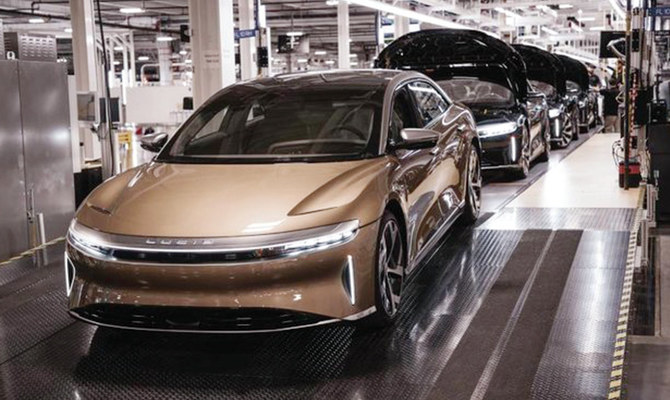
Three of the major manufacturing projects currently in Saudi Arabia include Lucid, Ceer — both dedicated to electric vehicles — and SNAM, for conventional cars.
In January 2022, president of The Saudi National Automotive Manufacturing Co., or SNAM, Fahad Al-Duhaish confirmed laying the foundation stone for the first car assembly plant in Jubail Industrial City. The assembly plant, along with the testing area, will reach 120,000 sq. m, he told Al Arabiya. The production capacity of the plant is set to hit 30,000 cars annually, he said.
HIGHLIGHTS
• Saudi Arabia has ambitious goals to achieve 45 percent clean mobility and 25 percent autonomous mobility penetration by 2030, and with everything going on in the automobile sector, the future looks both promising and in favor of the Kingdom.
• Through the strategic use of data and technology, the Kingdom’s Transport General Authority is continuously encouraging and propelling investment as well as sustainable development.
Two months later, in May, US-based Lucid Motors signed agreements to build a production factory in the Kingdom with an annual capacity of 155,000 zero-emission electric vehicles.
Lucid is expected to receive financing and incentives of up to $3.4 billion over the next 15 years to build and operate the manufacturing facility in the Kingdom. To be located in King Abdullah Economic City, AMP-2 is the Public Investment Fund-backed electric vehicle manufacturer’s first production facility outside the US, according to a statement.
“We are keen to achieve high and sustainable human capital localization in line with Vision 2030. With our recently launched Lucid Future Talent program—in collaboration with the Human Resources Development Fund — we plan to provide the right training to enrich and prepare local talent to fill future job opportunities in the Kingdom,” Managing Director and VP of Lucid Middle East Faisal Sultan told Arab News.
“The Lucid Air vehicle sets new standards in both range and efficiency, while offering world-beating performance wrapped in a luxury-forward design,” he added.
There was another boost for the sector in November 2022, when Emaar The Economic City announced the sale of an industrial plot to Ceer National Automotive Co. to build a specialized factory for electric vehicles in a move that will create thousands of high-skilled jobs.
The deal was valued at $95.53 million, which Ceer will pay Emaar EC in installments over 15 years, the company said in a statement to Tadawul.

Electric vehicle manufacturing facilities are necessary to stimulate local demand through competitive pricing and a quicker time to market.
Joseph Salem Partner, travel and transport practice at Arthur D. Little Middle East
Once complete, the manufacturing facility will create thousands of direct and indirect high-skilled jobs, the majority of which will be filled by Saudi nationals. Construction at the site will begin in early 2023.
“These manufacturing facilities are part of Saudi Arabia’s efforts to diversify its economy and reduce its dependence on oil exports,” Salem disclosed.
“Both Lucid and Ceer are investing heavily in research and development to produce electric vehicles that can compete with global brands, and the government is providing support through incentives and regulations to encourage growth in the industry,” he explained.
The Kingdom’s Transport General Authority has a vital role to play in all of this. Through the strategic use of data and technology, the TGA is continuously encouraging and propelling investment as well as sustainable development.
“While TGA has the ability to swiftly implement regulations, it is crucial to conduct a thorough analysis of any possible effects that may arise from their implementation. This proactive approach ensures that any regulations align with the Kingdom’s Vision, and ensures positive outcomes for the transport industry and society as a whole,” Salem stressed.
“The Kingdom aims to become a major player in the automotive industry by leveraging its strategic location and investing in advanced technologies. The objective of these initiatives is to position Saudi Arabia as the leader in the regional automotive ecosystem.” he concluded.
Saudi Arabia has ambitious goals to achieve 45 percent clean mobility and 25 percent autonomous mobility penetration by 2030, and with everything going on in the automobile sector, the future looks both promising and in favor of the Kingdom.
“Saudi Arabia is acknowledging the ongoing shift in the automobile industry and is proactively planning for a better future,” Sultan emphasized.


