

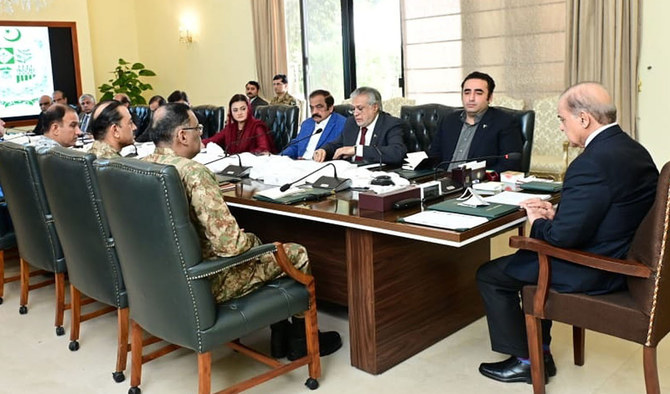

ISLAMABAD: The Pakistani government announced on Friday it would launch a fresh offensive to flush out militants from the country, amid months of political wrangling over elections in Punjab and Khyber Pakhtunkhwa (KP) provinces.
The development comes after an hours-long meeting of the National Security Committee (NSC), comprising senior civilian leaders and the military’s top brass, in Islamabad that was chaired by Prime Minister Shehbaz Sharif. During the meeting, top military leadership, including intelligence chiefs, briefed the participants about the security situation in the country.
The fresh military operation is expected to jeopardize the conduct of elections to the Punjab provincial assembly on May 14 in accordance with the Supreme Court of Pakistan's directives issued this week. The federal government has already informed the election regulator about a shortage of funds and unavailability of troops required to hold the polls.
The apex court, through its ruling, on Tuesday directed the federal government to extend all necessary assistance to the Election Commission of Pakistan (ECP), including the provision of Rs21 billion ($74 million) funds, by April 10 to hold the polls.
“The meeting approved launching of an all-out comprehensive operation with the [help] of the entire nation and the government,” a statement issued after the NSC meeting said, without specifying the operation area and its scale.
The forum said the operation would help “rid the country of the menace of terrorism” that would be launched with a renewed vigour and determination.
A high-powered committee has also been constituted to present its recommendations in two weeks about the limitations and implementation of the operation, according to the statement.
“All political, diplomatic, social and economic efforts will be part of the comprehensive operation to eliminate the menace of terrorism from Pakistan,” it said.
Friday's NSC meeting was held in continuation of the forum's deliberations following an attack on a police mosque in the northwestern city of Peshawar that killed more than 80 people, mostly policemen, on January 30.
The committee termed the recent spate of militant attacks an outcome of a "soft corner" for the Pakistani Taliban, or the Tehreek-e-Taliban Pakistan (TTP), and a policy devoid of rational thinking.
The TTP is a separate group but closely aligned with the Afghan Taliban and has claimed a number of attacks in the South Asian country, particularly after it called off a fragile ceasefire with the government in November. The Taliban takeover in Afghanistan has emboldened the Pakistani militants, whose top leaders and fighters are said to be hiding across the border.
“As a result, the terrorists were not only allowed to return without hindrance but dangerous TTP terrorists were also released from jails in the name of confidence building,” the statement mentioned.
“Peace and stability in the country was disrupted due to the return of these dangerous militants and assistance from numerous militant outfits present in Afghanistan,” it said, vowing to continue action till the elimination of militancy from the country.
The committee also condemned the "foreign-sponsored lethal propaganda" being spread on social media against the state institutions and their leadership, saying “it impacts the national security.”
Commenting on the meeting, Information Minister Marriyum Aurangzeb said militancy returned to the country in 2018 due to "flawed policies" of then prime minister Imran Khan.
“A complete briefing has been given [to the NSC participants] as to how the counter-terrorism department in KP was compromised,” she said, referring to Khan’s government in the province.
“It has been decided to revive the National Action Plan and mobilise all the law enforcement to get rid of terrorism.”
Pakistan announced the National Action Plan and setting up of military courts to tackle militancy following the massacre of nearly 150 people, mostly children, at a military-run school in Peshawar in December 2014.
Chaudhry Fawad Hussain, an aide to ex-PM Khan, said this attitude of the government was surprising that the security situation was so bad that the state was "at the mercy of terrorists," demanding PM Sharif admit his failure and step down from his post.
"According to Article 190 of the constitution, all institutions are bound by the decision of the Supreme Court regarding elections. Providing security and funds for elections is an important legal duty and government institutions should take steps in this regard," Hussain said on Twitter.
Hassan Khan, a senior journalist and security expert, said this fresh operation would largely be an intelligence-based operation unlike the past kinetic military operations in which heavy contingents of troops were moved and tens of thousands of people were displaced.
“We can assess from the NSC statement that police and other civil armed forces will be utilised along with the military in the intelligence-based operations to flush out militants,” Hassan told Arab News.
In the NSC communique, he noted, there was no hint about the Punjab and KP polls and the recent judgment of the Supreme Court about elections.
“But you can easily understand reading between the lines that civil and armed forces may not be available for elections due to their engagement in the operation,” he added.


