

British Muslim woman detained at UK airport ‘for having similar name to Daesh bride Shamima Begum’

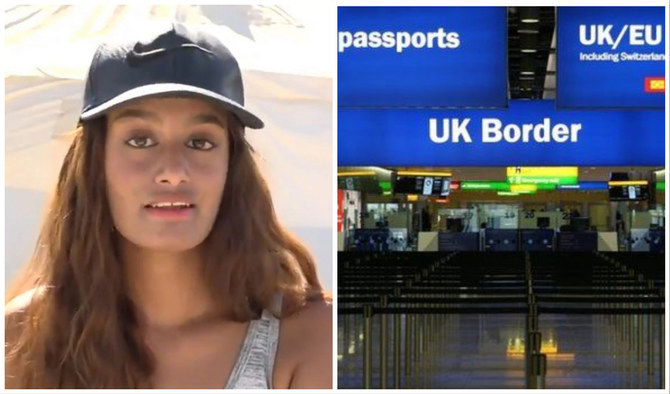
A British Muslim woman returning home to the UK from a holiday in Turkey claimed she was detained by police because she has a similar name as Daesh bride Shamima Begum, pictured left. (Reuters/File Photos)
Short Url
Updated 07 April 2023
Follow

British Muslim woman detained at UK airport ‘for having similar name to Daesh bride Shamima Begum’

  • Shamina Begum, who was returning to Manchester Airport, said she was asked if she “thinks bombing is okay”
  • Claimed she was also forced to go to an airport bathroom to relieve herself in an unlocked cubicle with a male officer present

LONDON: A British Muslim woman returning home to the UK from a holiday in Turkey claimed she was detained by police because she has a similar name as Daesh bride Shamima Begum.

Shamina Begum, who was returning to Manchester Airport, said she was asked if she “thinks bombing is okay,” and was told to seek assistance from UK Border Force staff because they said her name was the same as that belonging to “someone of interest.”

Begum, who had been traveling with her partner, alleged that five officers detained her under Schedule 7 of the Terrorism Act 2000. 

She also claimed her mobile phone and handbag were seized before having her DNA and fingerprints taken and being questioned for three hours over her name, her Muslim faith and even her mortgage.

In what Begum called a “humiliating” ordeal, she said she was also forced to go to an airport bathroom to relieve herself in an unlocked cubicle with a male officer present, all while being on her period. 

“I’m traumatized,” she told The Independent newspaper. “At first I was confused — I’ve travelled to many destinations previously and never had this problem,” she added.

Begum was eventually released with no further action taken against her.

“After I was let go, I cried all the way from the airport to my house and I couldn’t face the outside world for about four weeks,” she said. “In the immediate days after this happened, I’d wake up every day and wish I had not. I’m not a terrorist and didn’t deserve to be treated that way. It was a dark and difficult time which still impacts me, unfortunately.

“It was so humiliating and I could not say anything. It’s easy for the police to hand people a leaflet about what a Schedule 7 stop is...but what about aftercare? It’s taken me six months to talk about it properly.”

Begum complained to Greater Manchester Police about her treatment, who declined to comment on the case, and her complaint was not upheld by police staff who claimed the stop was justified and handled correctly.

She has now lodged an appeal against the decision, and added: “If it isn’t down to my race and religion, why aren’t police stopping every white person who walks through the airport? It’s always the brown and Black people who are targeted.

“It wasn’t just the fact that I was stopped; it was the kind of questions I was asked. Just because I am a Muslim with a Muslim name and background, it doesn’t make me a terrorist.”

Shamima Begum was 15 when she left her home in London, traveled through Turkey and into Daesh-held territory, before having her British citizenship revoked in February 2019.

She is currently in a Syrian camp for former Daesh brides and their families and is fighting a legal battle with the British government over the stripping of her citizenship.


France to vaccinate cattle for lumpy skin disease as farmers protest against cull

Updated 57 min 18 sec ago
Follow

France to vaccinate cattle for lumpy skin disease as farmers protest against cull

  • The announcement comes after several outbreaks of the highly contagious disease prompted authorities to order the culling of entire herds

PARIS: France will vaccinate 1 million head of cattle in the coming weeks against lumpy skin disease, Agriculture Minister Annie Genevard said on Saturday, as protesting farmers blocked roads in opposition to the government’s large-scale culling policy.
The announcement comes after several outbreaks of the highly contagious disease prompted authorities to order the culling of entire herds, sparking demonstrations by farmers who consider the measure excessive.
Lumpy skin disease is a virus spread by insects that affects cattle and buffalo, causing blisters and reducing milk production. While not harmful to humans, it often results in trade restrictions and severe economic losses.
“We will vaccinate nearly one million animals in the coming weeks and protect farmers. I want to reiterate that the state will stand by affected farmers, their losses will be compensated as well as their operating losses,” Genevard told local radio network ICI.
France says that total culling of infected herds, alongside vaccination and movement restrictions, is necessary to contain the disease and allow cattle exports. If the disease continues to spread in livestock farms, it could kill “at the very least, 1.5 million cattle,” Genevard told Le Parisien daily in a previous interview.
A portion of the A64 motorway south of Toulouse remained blocked since Friday afternoon, with about 400 farmers and some 60 tractors still in place on Saturday morning, according to local media.
The government, backed by the main FNSEA farming union, maintains that total culling of infected herds is necessary to prevent the disease from spreading and triggering export bans that would devastate the sector.
But the Coordination Rurale, a rival union, opposes the systematic culling approach, calling instead for targeted measures and quarantine protocols.
“Vaccination will be mandatory because vaccination is protection against the disease,” Genevard said, adding that complete culling remains necessary in some cases because the disease can be asymptomatic and undetectable.
France detected 110 outbreaks across nine departments and culled about 3,000 animals, according to the agriculture ministry. It has paid nearly six million euros to farmers since the first outbreak on June 29.