CAIRO: Egypt on Tuesday urged the international community to better support Lebanon’s armed forces as the country moves forward with a plan to disarm the militant group Hezbollah and bring all weapons under state control.
Speaking at a preparatory meeting in Cairo ahead of next month’s Paris conference in support of the Lebanese army, Egypt’s Foreign Minister Badr Abdelatty praised “the success of the Lebanese army in completing the first phase of the plan.”
“This achievement reflects the efficiency of the military institution and requires intensifying international support to complete the remaining phases of the plan,” Abdelatty said.
Lebanon’s government last year committed to disarming Hezbollah, which was badly weakened in a recent war with Israel, and tasked the army with drawing up a plan to do so.
Lebanon has since received promises of support, amid a shortage of equipment, personnel and technical capabilities needed to carry out the army’s mission.
Though its capabilities are limited, the military has worked to dismantle Hezbollah facilities and tunnels and confiscate weapons in the last few months.
It declared in January the completion of the first phase of its plan, which tackled the area south of the Litani river, located around 30 kilometers (20 miles) north of Israel.
Lebanon’s military now intends to tackle the area north of the river as the second phase of its plan, having said last week that it would need at least four months to finish the job.
Abdelatty said Tuesday’s meeting aimed “to enable the Lebanese state to ensure that all weapons are held exclusively by the state.”
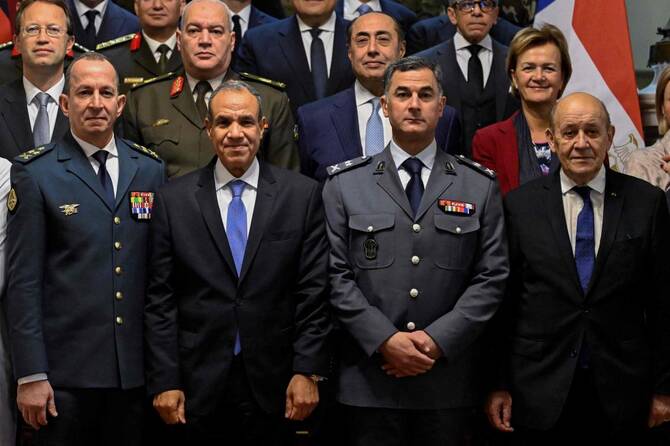
The meeting brought together Lebanon’s top security chiefs, including Army Commander General Rodolphe Haykal and Internal Security Forces Director-General Major General Raed Abdallah.
They were joined by representatives of the Quintet Committee on Lebanon, among them Qatar’s state minister for foreign affairs Mohammed bin Abdulaziz Al-Khulaifi, French envoy Jean-Yves Le Drian and Saudi Arabia’s envoy to Beirut Prince Yazid bin Farhan, along with senior officials from the United States.
At a separate meeting with Le Drian, Abdelatty stressed the need for what he described as a comprehensive international approach to the crisis in Lebanon.
“There is no path to restoring stability except by obliging Israel to immediately halt its aggression” and “fully withdraw from occupied Lebanese territories,” he said.
Israel, which accuses Hezbollah of rearming, has criticized the army’s progress as insufficient, and has kept up regular strikes on Lebanon despite a November 2024 ceasefire that sought to end more than a year of hostilities with the group.

Egypt urges support for Lebanese army as Hezbollah disarmed
https://arab.news/jehp3
Egypt urges support for Lebanese army as Hezbollah disarmed
- Abdelatty praised “the success of the Lebanese army in completing the first phase of the plan“
- “This achievement reflects the efficiency of the military institution and requires intensifying international support to complete the remaining phases of the plan”
What to know about the Strait of Hormuz, a key passageway essential for global energy supply
- The Strait of Hormuz is a bending waterway, about 33 kilometers (21 miles) wide at its narrowest point. It connects the Arabian Gulf to the Gulf of Oman
DUBAI, United Arab Emirates: The widening war in Iran has ground tanker traffic through the Strait of Hormuz to a halt and oil prices have been swinging sharply, highlighting the important role the narrow passageway plays in global energy supply.
The Strait of Hormuz is the narrow mouth of the Arabian Gulf through which about a fifth of the world’s oil passes. Tankers traveling through the strait, which is bordered in the north by Iran, carry oil and gas from Saudi Arabia, Kuwait, Iraq, Qatar, Bahrain, the UAE and Iran. Most of that oil goes to Asia.
Any disruption to traffic through the Strait of Hormuz is highly disruptive to the oil trade. Disruptions caused oil to spike Monday, only for it to swiftly fall back after President Donald Trump suggested the war could be near an end.
“The scale of what is at stake cannot be overstated,” said Hakan Kaya, senior portfolio manager at investment management firm Neuberger Berman. He said a partial slowdown lasting a week or two could be absorbed by oil companies. But a full or near full closure lasting a month or more would push crude oil prices “well into triple digits” and European natural gas prices “toward or above the crisis levels seen in 2022.”
Here’s what to know about the strait and the widening Iran war.
A key waterway for global shipping
The Strait of Hormuz is a bending waterway, about 33 kilometers (21 miles) wide at its narrowest point. It connects the Arabian Gulf to the Gulf of Oman. From there, ships can then travel to the rest of the world. While Iran and Oman have their territorial waters in the strait, it’s viewed as an international waterway all ships can ply. The United Arab Emirates, home to the skyscraper-studded city of Dubai, also sits near the waterway.
The strait long has been important for trade
The Strait of Hormuz through history has been important for trade, with ceramics, ivory, silk and textiles moving from China through the region. In the modern era, it is the route for supertankers carrying oil and gas from Saudi Arabia, Kuwait, Iraq, Qatar, Bahrain, the UAE and Iran. The vast majority of it goes to markets in Asia, including Iran’s only remaining oil customer, China.
While there are pipelines in Saudi Arabia and the UAE that can avoid the passage, the US Energy Information Administration says “most volumes that transit the strait have no alternative means of exiting the region.”
Threats to the route have spiked global energy prices in the past, including during the Israel-Iran war in June.
Is the strait closed?
Iran has attacked several ships in the Strait of Hormuz and threatened any ships that try to pass through, effectively but not officially closing it.
President Donald Trump said on social media that the US would dramatically increase attacks if Iran tried to close the Strait of Hormuz. Iran has been targeting energy infrastructure and traffic through the strait, which is a vital waterway for traded oil.
Previously, Iran temporarily shut down parts of the strait in mid-February for what it said was a military drill. In past times of tension and conflict, Iran has at times harassed shipping though the narrows, and during the 1980s’ Iran-Iraq war, both sides attacked tankers and other vessels, using naval mines to completely shut down traffic at points. But Iran had not carried out repeated threats to close the waterway altogether since the 1980s, even during last year’s 12-day war when Israel and the US bombarded Iran’s key nuclear and military sites.
The US is rolling out ship reinsurance in the region through the US International Development Finance Corp., a government agency that partners with the private sector to back global investment projects, in an effort to get ships moving through the Strait again.
Political risk insurance is a type of coverage intended to protect firms against financial losses caused by unstable political conditions, government actions, or violence. Marine insurers had been canceling or raising rates for insurance in the region.
The US reinsurance facility will insure losses up to approximately $20 billion on a rolling basis, according to the International Development Finance Corp., focusing on insuring cargo and physical damage to a ship’s structure and operating machinery to start.
Trump said that, if necessary, the US Navy would escort oil tankers through the Strait of Hormuz. The Navy has at least eight destroyers and three, smaller, littoral combat ships in the region. These ships have previously been used to escort merchant shipping in the region and in the Red Sea.
Meanwhile, French President Emmanuel Macron has pledged to dispatch additional warships to the Eastern Mediterranean. There is a French-led initiative in the works that will involve European and non-European nations helping to escort oil and gas tankers with the aim of gradually reopening the Strait of Hormuz off Iran “as soon as possible after the most intense phase of the conflict is over.”
Mine fears
On Tuesday, President Donald Trump said the US military “completely destroyed” 10 inactive Iranian mine-laying ships after reports of Iranian action in the Strait of Hormuz.
Trump in his social media post added that there would be “more to follow,” suggesting the US would target additional mine-laying vessels.
The announcement of the targeting of the ships came soon after two other social media posts by the US president in which he said he has no reports of Iran putting explosive mines in the strategic waterway, but also warned Tehran if mines were laid he wanted them immediately removed.
Global shippers suspend operations
Global shippers have issued service alerts saying they have suspended operations in the area. Danish shipping company Maersk, the world’s biggest shipping company, said Sunday it is suspending all vessel crossings in the Strait of Hormuz until further notice. Other ocean carriers including Hapag-Lloyd, CMA-CGM and MSC made similar announcements.
“Those ships that got stuck in the Gulf are not going anywhere,” said Tom Goldsby, logistics chairman in the Supply Chain Management Department at the University of Tennessee. “There’s also a whole host of ships that were heading into the Gulf to replace them, and of course they’re anchored or going elsewhere now.”
There are currently about 400 oil and product tankers idle in the Gulf, and one oil tanker passed through the Strait of Hormuz without incident on Monday, according to data from MarineTraffic, a project that tracks the movement of vessels around the globe using publicly available data.


