

Despite economic woes, Pakistan’s exports to Afghanistan increase by 17.2 percent

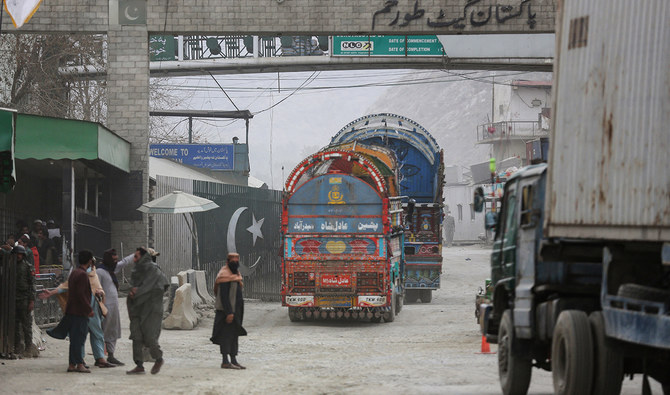
Goods carrier trucks cross into Pakistan at the zero point Torkham border crossing between Afghanistan and Pakistan, in Nangarhar province on February 25, 2023. (AFP/File)
Short Url
Updated 05 April 2023
Follow

Despite economic woes, Pakistan’s exports to Afghanistan increase by 17.2 percent

  • Overall exports to Afghanistan recorded at $346.522 million between July 2022 to February 2023
  • Pakistan’s exports to other countries declined by 9.65 percent over last eight months, says central bank

ISLAMABAD: Data by Pakistan’s central bank shows the country’s exports to Afghanistan have increased by 17.02 percent during the first eight months of the current fiscal year (2022-23), the state-run Associated Press of Pakistan (APP) said in a report on Wednesday. 

Hounded by dwindling foreign exchange reserves, soaring inflation and a looming balance of payments crisis, Pakistan’s exports to other countries declined by 9.65 percent over the last eight months, decreasing from $20.632 billion to $18.639 billion, the State Bank of Pakistan (SBP) said. 

Devastating floods in the country last year almost wiped out the entire cotton crop, the main raw material required for the country’s textile sector, in the southern province of Sindh while also partially damaging crops in Punjab. The devastation of cotton crops was a massive blow to the textile sector, Pakistan’s biggest foreign exchange earning sector.

Exports further suffered as Pakistan imposed restrictions on imports in its bid to prevent the outflow of US dollars. As a result, several industries, including steel, textiles, and pharmaceuticals, are struggling to function, forcing thousands of plants to shut operations. 

However, despite a decrease in exports to other countries, Pakistan sold more goods and services, predominately comprising rice, cement, medicines, surgical instruments, and fruit and vegetables, to neighboring Afghanistan.

“Pakistan’s export of goods and services to Afghanistan witnessed an increase of 17.02 percent during the first eight months of the current fiscal year (2022-23) as compared to the exports of the corresponding period of last year,” the APP report said, citing data from the SBP.

It said overall exports to Afghanistan were recorded at $346.522 million between July to February (2022-23) compared to the exports of $296.109 million during the same period in the last fiscal year (2021-22), thus reflecting a growth of 17.02 percent.

“On a year-to-year basis, the exports to Afghanistan also increased 60.49 percent from $38.222 million in February 2022, against the exports of US $61.345 million in the same month this year”, the report said.

Meanwhile, on a month-on-month basis, Pakistan’s exports to Afghanistan also surged by 82.58 percent during February 2023 as compared to the exports of $33.598 million in January 2022, the SBP data revealed.

On the other hand, the imports from Afghanistan into the country, during the period under review, were recorded at $13.540 million against $119.328 million last year, showing a decline of 88.65 percent in July-February (2022-23).

On a year-on-year basis, the import for Afghanistan also decreased by 98.89 percent from $13.723 million in February 2022, against the imports of $0.151 million in February 2023.

On a month-on-month basis, the imports from Afghanistan into the country increased by 11.02 percent during February 2023, as compared to the imports of US $0.136 million during January 2022, according to the data.

“The overall imports into the country witnessed a decrease of 21.02 percent, from US $47.336 billion to US $37.388 billion,” the report added.

Based on the figures, the trade of goods and services with Afghanistan witnessed an increase of 88.35 percent in surplus during July 2022 to February 2023 against the same period from the previous year.

“The surplus was recorded at $332.982 million against $176.781 million during last year, showing growth of 88.35 percent,” the report said.


Pakistan Air Force conducts successful test of air-launched cruise missile

Updated 03 January 2026
Follow

Pakistan Air Force conducts successful test of air-launched cruise missile

  • The indigenously developed ‘Taimoor’ missile has a range of 600 kilometers and carries a conventional warhead
  • The missile is designed to fly at low altitudes, which enables it to evade hostile air, missile defense systems

ISLAMABAD: The Pakistan Air Force (PAF) has successfully conducted a test of an air-launched cruise missile, ‘Taimoor,’ the Pakistani military said on Saturday, marking another significant milestone in advancement of national aerospace and defense capabilities.

The indigenously developed Taimoor weapon system is capable of engaging enemy land and sea targets with high precision. The missile has a range of 600 kilometers and carries a conventional warhead.

The missile test comes months after a brief but intense military conflict between Pakistan and India in which the nuclear-armed neighbors exchanged missile and artillery fire and deployed drones and fighter jets.

Equipped with state-of-the-art navigation and guidance system, Taimoor is designed to fly at very low altitudes, enabling it to effectively evade hostile air and missile defense systems.

“Its precision-strike capability significantly enhances the conventional deterrence and operational flexibility of Pakistan Air Force, further strengthening the country’s overall defense posture,” said the Inter-Services Public Relations (ISPR), the military’s media wing.

“The successful flight test underscores the technical maturity, innovation and self-reliance achieved by Pakistan’s defense industry.”

The missile’s launch was witnessed by senior officers of the armed forces along with distinguished scientists and engineers, who played a pivotal role in the development of this advanced weapon system.

PAF’s Air Chief Marshal Zaheer Ahmed Baber Sidhu congratulated the scientists, engineers and the entire PAF team on this remarkable achievement, lauding their professional excellence, dedication and unwavering commitment to strengthening Pakistan’s defense capabilities.

“The air chief reaffirmed that such accomplishments are a testament to the nation’s resolve to achieve technological self-sufficiency and maintain a credible conventional deterrent in the evolving regional security environment,” the ISPR said.

“The successful test of the Taimoor weapon system reflects Pakistan Air Force’s continued pursuit of operational readiness, technological superiority and national security objectives.”

Pakistan has placed greater emphasis on battle readiness in recent months. On Dec. 15, Pakistan Navy test-fired surface-to-air missile in the northern Arabian Sea.

Prior to that, Chief of Defense Forces Field Marshal Asim Munir visited frontline garrisons of Gujranwala and Sialkot to observe a field training exercise involving tanks and drones, where he had highlighted the importance of technological adaptability, saying modern warfare required agility, precision, situational awareness and rapid decision-making.