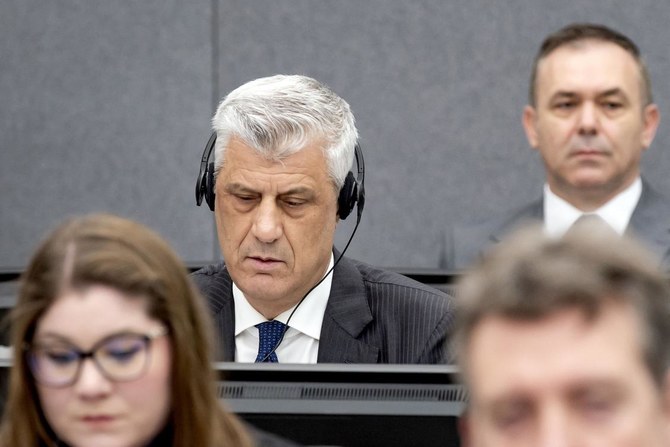
THE HAGUE, Netherlands: Former Kosovo president Hashim Thaci on Tuesday insisted he is an innocent man as he addressed a panel of international judges hearing his trial on 10 counts of war crimes and crimes against humanity.
At the end of his lawyers’ opening statement to the Kosovo Specialist Chambers, Thaci stood up, buttoned up his gray pinstripe suit jacket and told black-robed judges that he expects evidence to lead to his acquittal saying that “victims do not obtain justice when the innocent are pursued.”
Thaci was a student who came out of what he described as political exile in Switzerland to join Kosovo’s struggle for independence from Serbia. He was embraced by Western leaders who invited him to 1999 peace talks in France in his role as political director of the Kosovo Liberation Army and was seen as a leader who could guide the country toward independence.
Thaci said he regretted that late US Secretary of State Madeleine Albright and other international diplomats who have died in the nearly quarter of a century since the war could not speak on his behalf.
“They would have testified on my part about what I have said and what I did during that very important time in Kosovo’s history,” he said. “I’m happy that many others like them have come forward to testify about my innocence.”
But prosecutors paint a different picture, alleging Thaci and three other former senior leaders of the KLA on trial with him were responsible for murders and the illegal detention and abuse of people they considered traitors or collaborators with Serb forces.
“I’m innocent of all these allegations,” Thaci said. “However, I’m ready to face this new challenge and succeed for my family, my people and my country.”
Defense lawyer Gregory Kehoe told judges that Thaci had no “effective command and control” over the KLA at the time international prosecutors hold him responsible for war crimes and crimes against humanity allegedly committed by members of the guerilla force in Kosovo’s 1998-99 war for independence from Serbia.
The issue of how much control Thaci and three other former high-ranking KLA leaders on trial with him had over KLA fighters will be key in the trial that opened Monday and is expected to last many months.
Thaci and his fellow accused, Kadri Veseli, Rexhep Selimi and Jakup Krasniqi are each charged with offenses including murder, torture and persecution allegedly committed across Kosovo and northern Albania from 1998 to September 1999, during and after the war.
Kehoe’s opening statement aimed to counter prosecutors’ assertions on the trial’s opening day that Thaci and three-co-defendants who were all members of the KLA general staff who pursued a policy of targeting civilians perceived as collaborators and traitors.
Prosecution lawyer Matt Halling told judges Monday: “Each of the four accused wielded power, authority and influence” which enabled them enact the policy.
The trial is being held at the Kosovo Specialist Chambers, a branch of the Kosovo legal system that was established in The Hague in part due to fears about witness safety and security.
The court in The Hague and a linked prosecutor’s office were created after a 2011 report by the Council of Europe, a human rights body, that included allegations that KLA fighters trafficked human organs taken from prisoners and killed Serbs and fellow ethnic Albanians. The organ harvesting allegations weren’t included in the indictment against Thaci.
“We now know that both myself and the KLA, as well as the people of Kosovo, as well as all Albanians, have been vindicated of those allegations,” Thaci said, referring to the organ harvesting claims. “The truth has been told and the black clouds over Kosovo have been lifted.”
Most of the 13,000 people who died in the 1998-1999 war in Kosovo were ethnic Albanians. A 78-day campaign of NATO air strikes against Serbian forces ended the fighting. About 1 million ethnic Albanian Kosovars were driven from their homes.
The trial triggered a large demonstration in Kosovo on Sunday in support of the four defendants and another protest on Monday in The Hague by hundreds of Kosovars who waved flags and banners, including one that proclaimed: “KLA fought for freedom.”


![]()

Ex-Kosovo president tells international judges he’s innocent
Short Url
https://arab.news/jqb8u
Ex-Kosovo president tells international judges he’s innocent
- Thaci was a student who came out of what he described as political exile in Switzerland to join Kosovo's struggle for independence from Serbia
- "However, I’m ready to face this new challenge and succeed for my family, my people and my country,” Thaci said


Latest updates


Recommended


© 2026 SAUDI RESEARCH & PUBLISHING COMPANY, All Rights Reserved And subject to Terms of Use Agreement.