

Russia arrests young woman over death of top military blogger

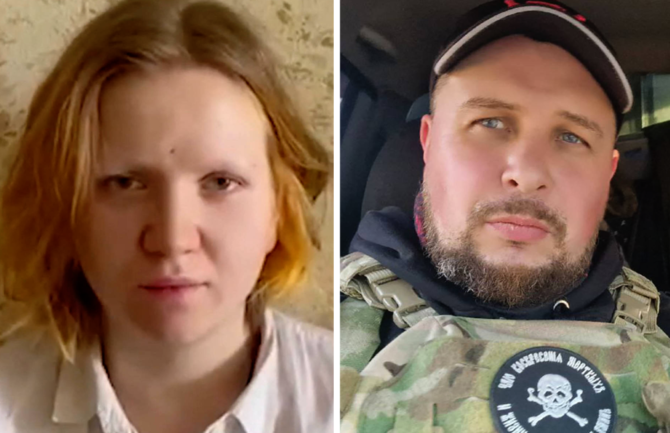
Darya Trepova (L) and Vladlen Tatarsky. (Agencies)
Short Url
Updated 04 April 2023
Follow

Russia arrests young woman over death of top military blogger

  • The 40-year-old, who hailed from the eastern Ukrainian region of Donetsk, fought alongside pro-Kremlin separatists and then became a popular military blogger with half a million followers on social media

MOSCOW: Russia on Monday detained a young woman after an explosion killed a top Russian military blogger and wounded dozens, claiming the bombing attack was orchestrated by Ukraine with the help of supporters of jailed Kremlin critic Alexei Navalny.
Ukraine has blamed Russia’s domestic infighting for the blast in a Saint Petersburg cafe that on Sunday wounded more than 30 people and killed Vladlen Tatarsky, a high-profile supporter of Moscow’s assault on Ukraine.
The attack came after Darya Dugina, the daughter of a prominent ultranationalist intellectual, was last August killed in a car bombing outside Moscow that Russia also blames on Ukraine.
Russia’s Investigative Committee and the National Anti-terrorism Committee both said pro-Navalny activists were behind the latest attack.
The Investigative Committee released a video of the arrest of 26-year-old Darya Trepova, who it said “holds opposition views and is a supporter of the Anti-Corruption Foundation,” referring to Navalny’s banned organization.
Political observers said the bombing attack could be used to justify a further crackdown on critics of Moscow’s offensive in Ukraine.
Navalny’s spokeswoman Kira Yarmysh said the attack could also be used to accuse the jailed opposition politician of new crimes.
“Alexei will soon be on trial for extremism,” Yarmysh wrote, adding that he faced 35 years in prison.
“The Kremlin thought: ‘It’s great to be able to add the terrorism charge’.”
The Kremlin condemned the “terrorist attack” and said “there is evidence... that the Ukrainian special services may be related to its organization.”
Ukrainian President Volodymyr Zelensky told journalists he was too busy focusing on his own country to pay attention to the attack in Saint Petersburg.
Tatarsky, whose real name is Maxim Fomin, was reportedly killed after receiving a statuette rigged with explosives during a talk at “Street Food Bar No. 1,” located along the Neva River not far from the historic city center.
The 40-year-old, who hailed from the eastern Ukrainian region of Donetsk, fought alongside pro-Kremlin separatists and then became a popular military blogger with half a million followers on social media.
At a Kremlin ceremony announcing the annexation of four Ukrainian regions last September Tatarsky recorded himself saying: “We will defeat everyone. We will kill everyone. We will rob everyone as necessary. Just as we like it.”

President Vladimir Putin posthumously bestowed a top award, the Order of Courage, on Tatarsky citing his “courage and bravery shown during professional duty,” said a Kremlin decree on Monday.
Russians placed flowers at a makeshift memorial in Saint Petersburg to honor the blogger, who served prison time before joining the pro-Kremlin separatists.
Igor Ivanov, an 18-year-old student, said he was shocked and added he closely followed Tatarsky. “This is a heavy loss,” he said.
Vladislav Andreev, 27, compared Tatarsky’s death to the bombing attack on Dugina.
“These people will stop at nothing,” he said.
The footage released by the Investigative Committee showed a young blond woman getting in an elevator with a suitcase and then cut to her being led into a room by men dressed in dark uniforms.
The Russian interior ministry also published a video of Trepova in which she was heard saying she had brought a statuette that exploded to the Saint Petersburg cafe.
Asked on camera who gave it to her, the Russian national said she would answer “later.”
“The terrorist attack was planned by Ukrainian security services with the help of agents working with the so-called Anti-Corruption Foundation,” said Russia’s National Anti-terrorism Committee.

At least 100 people reportedly attended the event when the bombing attack took place on Sunday.
Alisa Smotrova, who was at the cafe, told AFP:
“They put (the figurine) somewhere in the back without a second thought... and all of a sudden there was an explosion.
“There was blood and pieces of glass,” she added.
The head of the Wagner paramilitary group, Yevgeny Prigozhin, said the venue used to belong to him.
Prigozhin said on social media that he “gave the cafe to patriotic movement Cyber Front Z and they organized various seminars there.”
Cyber Front Z, which refers to itself on social media as “Russia’s information troops,” said it had hired out the venue for the evening.
Prigozhin said his forces hoisted the Russian flag with an inscription honoring the deceased blogger over the city administration of frontline hotspot of Bakhmut, which Wagner claimed to have seized.
On Sunday evening Ukrainian presidential aide Mykhaylo Podolyak suggested that the attack had taken place as a result of infighting in Russia.
“The question of when domestic terrorism would become an instrument of internal political fight was a matter of time,” he said on Twitter.
The Russian foreign ministry on Sunday paid homage to the blogger and his “service to the Fatherland, which aroused Kyiv’s hatred.”


House Republicans barely defeat Venezuela war powers resolution to check Trump’s military actions

Updated 5 sec ago
Follow

House Republicans barely defeat Venezuela war powers resolution to check Trump’s military actions

WASHINGTON: The House rejected a Democratic-backed resolution Thursday that would have prevented President Donald Trump from sending US military forces to Venezuela after a tied vote on the legislation fell just short of the majority needed for passage.
The tied vote was the latest sign of Republican House Speaker Mike Johnson’s tenuous hold on the majority, as well as some of the growing pushback in the GOP-controlled Congress to Trump’s aggressions in the Western Hemisphere. A Senate vote on a similar resolution was also tied last week until Vice President JD Vance broke the deadlock.
To defeat the resolution Thursday, Republican leaders had to hold the vote open for more than 20 minutes while Republican Rep. Wesley Hunt, who had been out of Washington all week campaigning for a Senate seat in Texas, rushed back to Capitol Hill to cast the decisive vote.
On the House floor, Democrats responded with shouts that Republican leaders were violating the chamber’s procedural rules. Two Republicans — Reps. Don Bacon of Nebraska and Thomas Massie of Kentucky — voted with all Democrats for the legislation.
The war powers resolution would have directed Trump to remove US troops from Venezuela. The Trump administration told senators last week that there are no US troops on the ground in the South American nation and committed to getting congressional approval before launching major military operations there.
But Democrats argued that the resolution is necessary after the US raid to capture Venezuelan leader Nicolás Maduro and since Trump has stated plans to control the country’s oil industry for years to come.
The response to Trump’s foreign policy
Thursday’s vote was the latest test in Congress of how much leeway Republicans will give a president who campaigned on removing the US from foreign entanglements but has increasingly reached for military options to impose his will in the Western Hemisphere. So far, almost all Republicans have declined to put checks on Trump through the war powers votes.
Rep. Brian Mast, the Republican chair of the House Armed Services Committee, accused Democrats of bringing the war powers resolution to a vote out of “spite” for Trump.
“It’s about the fact that you don’t want President Trump to arrest Maduro, and you will condemn him no matter what he does, even though he brought Maduro to justice with possibly the most successful law enforcement operation in history,” Mast added.
Still, Democrats stridently argued that Congress needs to assert its role in determining when the president can use wartime powers. They have been able to force a series of votes in both the House and Senate as Trump, in recent months, ramped up his campaign against Maduro and set his sights on other conflicts overseas.
“Donald Trump is reducing the United States to a regional bully with fewer allies and more enemies,” Rep. Gregory Meeks, the top Democrat on the House Foreign Affairs Committee, said during a floor debate. “This isn’t making America great again. It’s making us isolated and weak.”
Last week, Senate Republicans were only able to narrowly dismiss the Venezuela war powers resolution after the Trump administration persuaded two Republicans to back away from their earlier support. As part of that effort, Secretary of State Marco Rubio committed to a briefing next week before the Senate Foreign Relations Committee.
Yet Trump’s insistence that the US will possess Greenland over the objections of Denmark, a NATO ally, has alarmed some Republicans on Capitol Hill. They have mounted some of the most outspoken objections to almost anything the president has done since taking office.
Trump this week backed away from military and tariff threats against European allies as he announced that his administration was working with NATO on a “framework of a future deal” on Arctic security.
But Bacon still expressed frustration with Trump’s aggressive foreign policy and voted for the war powers resolution even though it only applies to Venezuela.
“I’m tired of all the threats,” he said.
Trump’s recent military actions — and threats to do more — have reignited a decades-old debate in Congress over the War Powers Act, a law passed in the early 1970s by lawmakers looking to claw back their authority over military actions.
The war powers debate
The War Powers Resolution was passed in the Vietnam War era as the US sent troops to conflicts throughout Asia. It attempted to force presidents to work with Congress to deploy troops if there hasn’t already been a formal declaration of war.
Under the legislation, lawmakers can also force votes on legislation that directs the president to remove US forces from hostilities.
Presidents have long tested the limits of those parameters, and Democrats argue that Trump in his second term has pushed those limits farther than ever.
The Trump administration left Congress in the dark ahead of the surprise raid to capture Maduro. It has also used an evolving set of legal justifications to blow up alleged drug boats and seize sanctioned oil tankers near Venezuela.
Democrats question who gets to benefit from Venezuelan oil licenses
As the Trump administration oversees the sale of Venezuela’s petroleum worldwide, Senate Democrats are also questioning who is benefiting from the contracts.
In one of the first transactions, the US granted Vitol, the world’s largest independent oil broker, a license worth roughly $250 million. A senior partner at Vitol, John Addison, gave roughly $6 million to Trump-aligned political action committees during the presidential election, according to donation records compiled by OpenSecrets.
“Congress and the American people deserve full transparency regarding any financial commitments, promises, deals, or other arrangements related to Venezuela that could favor donors to the President’s campaign and political operation,” 13 Democratic senators wrote to White House Chief of Staff Susie Wiles Thursday in a letter led by Democratic Sen. Adam Schiff of California.
The White House has said it is safeguarding the South American country’s oil for the benefit of both the people of Venezuela and the US