'My brain completely shut off': Kohli on World Cup masterclass that sunk Pakistan

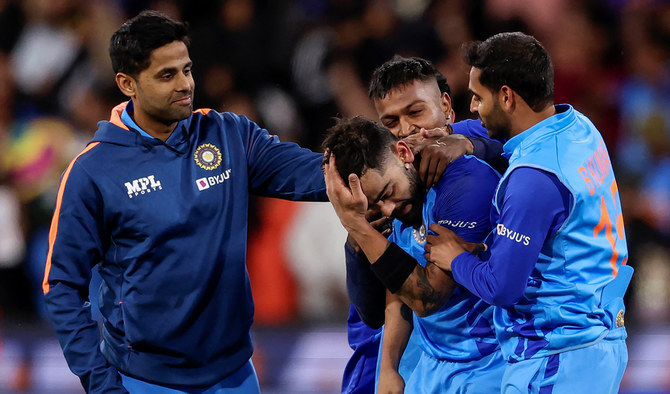
India's Virat Kohli (2nd R) celebrates with teammates after their win during the ICC men's Twenty20 World Cup 2022 cricket match between India and Pakistan at Melbourne Cricket Ground (MCG) in Melbourne on October 23, 2022. (AFP/File)
Short Url
Updated 03 April 2023
Follow

'My brain completely shut off': Kohli on World Cup masterclass that sunk Pakistan

  • Indian batter Virat Kohli scored a heroic 82 runs off 52 balls, which ultimately resulted in Pakistan's defeat
  • Kohli says when his "bran complete shut off", his instincts took over and guided his match-winning innings

ISLAMABAD: Former Indian cricket captain Virat Kohli said on Sunday that his brain had "completely shut off" while he delivered a batting masterclass against Pakistan in last year's T20 World Cup that helped India pull off a victory which is seen by cricket fans as nothing short of a miracle. 

The India-Pakistan cricket rivalry is one of the most passionate rivalries sports, with millions of fans waiting for years to catch the action when the Asian giants face each other at international events. Political tensions mean the two countries don't play bilateral series with each other but face off at international events.  

Pakistan last faced India at the massive MCG, with over 90,000 in attendance as the two sides battled during a World Cup fixture. Chasing a target of 160 runs, India were in serious trouble after Pakistan's pace battery took a flurry of quick wickets to dismiss batters Rohit Sharma, K.L.Rahul, Suryakumar Yadav and Axar Patel. 

Reeling at 31/4, Kohli steered his team out of trouble, building a solid partnership with all-rounder Hardik Pandya as the blue shirts managed to pull off a last-ball victory over Pakistan, driven mainly by Kohli's classic knock under pressure. He remained unbeaten on 82 from 52 balls, smashing six fours and four massive boundaries. 

At a recent corporate event, the former Indian captain was asked about his state of mind at the moment. In response, Kohli said he "still can’t make any sense of it."

"The fact of the matter is that I was so much under pressure that my mind had shut off completely by the 12th or 13th over," Kohli said, recalling that his earlier slump in 2021, which earned him a lot of flak from cricket fans and critics alike, was bearing heavily on his mind. 

Kohli said he was under so much stress when Pakistan had the upper hand that he still can't remember the advice Indian coach Rahul Dravid gave him during the drinks break. 

"I remember in the break, Rahul bhai came to me and I don't remember what he said. I swear and I even told him this as well. I told him, ‘I have no idea what you told me in that break because I was zoned out’," he said. 

Kohli said that when his mind "shut off", his instincts took over and guided his innings. 

"So, when I stopped thinking and planning, whatever God-given talent I have that came to the surface and then I felt like something higher was guiding me," he said. 

The former world number one batter said he learned the valuable lesson to not work his mind so much in such pressure situations, adding that "it actually pushes you away from real magic."

"What happened that night, I can never explain it and it won’t happen ever again," Kohli concluded. 


Pakistan to promote mineral sector at Saudi forum this month with 13 companies

Updated 02 January 2026
Follow

Pakistan to promote mineral sector at Saudi forum this month with 13 companies

  • Delegation will take part in the Future Minerals Forum in Riyadh from Jan. 13-15
  • Petroleum minister will lead Pakistan, participate in a 90-minute country session

ISLAMABAD: Around 13 Pakistani state-owned and private companies will attend the Future Minerals Forum (FMF) in Saudi Arabia from Jan. 13 to 15, an official statement said on Friday, as the country seeks to ramp up global engagement to develop its mineral resources.

The FMF is an international conference and investment platform for the mining sector, hosted by mineral-rich countries to attract global investors, companies and governments.

Petroleum Minister Ali Pervaiz Malik confirmed Pakistan’s participation in a meeting with the Saudi envoy, Nawaf bin Said Al-Malki.

Pakistan hosts one of the world’s largest copper-gold zones. The Reko Diq mine in southwestern Balochistan, with an estimated 5.9 billion tons of ore, is partly owned by Barrick Gold, which calls it one of the world’s largest underdeveloped copper-gold deposits. Its development is expected to boost Pakistan’s struggling economy.

“Upon an invitation of the Government of the Kingdom of Saudi Arabia, the Federal Minister informed the Ambassador that Pakistan will fully participate in the upcoming Future Minerals Forum (FMF), scheduled to be held in Riyadh later this month,” Pakistan’s Press Information Department (PID) said in an official statement.

The Pakistani minister will lead his country’s delegation at the FMF and take part in a 90-minute country showcase session titled “Unleashing Potential: Accelerating Pakistan’s Mineral Revolution” along with local and foreign investors.

Pakistan will also establish a dedicated pavilion to highlight the vast potential of its rich geological landscape to the global mineral community.

The Saudi envoy welcomed Pakistan’s decision to participate in the forum and discussed enhancing bilateral cooperation in the minerals and energy sectors during the meeting.

According to the statement, he highlighted the potential for cooperation between Saudi Arabia and Pakistan in the minerals and energy sectors, expressing confidence that the FMF would provide a platform to expand collaboration.
Pakistan’s mineral sector, despite its rich reserves of salt, copper, gold and coal, contributes only 3.2 percent to the country’s GDP and just 0.1 percent to global mineral exports.

However, many countries, including the United States, have shown interest in Pakistan’s underdeveloped mineral sector, particularly in copper, gold and other critical resources.

In October, Pakistan dispatched its first-ever shipment of rare earth and critical minerals to the United States, according to a Chicago-based US public relations firm’s report.