

Boom for Pakistani tent manufacturers after Turkiye-Syria quake, floods

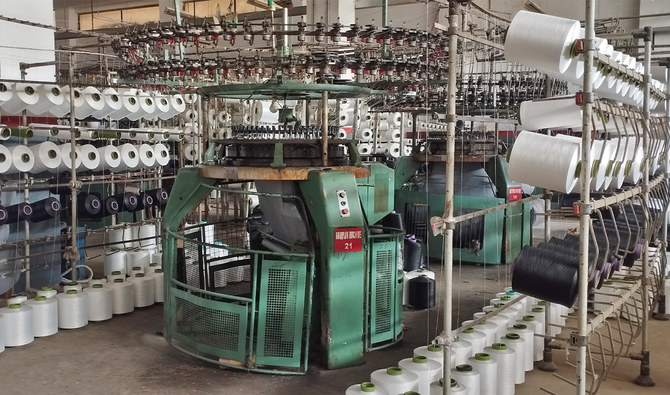
The picture taken on March 29, 2023, shows white yarn spools bobbin thread cones on automatic knitting machine in a factory in Karachi, Pakistan. (AN Photo)
Short Url
Updated 03 April 2023
Follow

Boom for Pakistani tent manufacturers after Turkiye-Syria quake, floods

  • A 7.8-magnitude earthquake jolted parts of Turkiye, Syria on February 6, killing over 50,000
  • The South Asian country is one of the leading producers and exporters of high-quality tents

KARACHI: Pakistani tent and blankets manufacturers say they are operating at “more than full capacity” as they cater to the demands of earthquake victims in Turkiye and Syria as well as millions displaced by last year’s cataclysmic floods in Pakistan. 

A 7.8-magnitude earthquake jolted parts of Turkiye and Syria on February 6, killing over 50,000 in the former while an estimated 6,000 in the latter. Pakistan is one of the leading countries that have sent food, winterized tents, blankets and other relief items for the two countries’ earthquake victims. 

The South Asian country is the leading producer and exporter of high-quality tents that include camping tents, relief tents, military tents, and event tents. The National Tent House (NTH), Pakistan’s largest tent manufacturing facility, is supplying aid products to global humanitarian agencies, which include the United Nations International Children’s Emergency Fund (UNICEF), United Nations High Commissioner for Refugees (UNHCR), International Committee of the Red Cross (ICRC), and the International Federation of Red Cross and Red Crescent (IFRC). 

Mohammad Ahmed, director of business development at NTH, told Arab News that the manufacturer has so far supplied over 15,000 tents and more than 200,000 blankets for the earthquake victims of Turkiye and Syria from manufacturing facilities in the Pakistani cities of Lahore and Karachi. He said NTH can produce up to 2,000 tents and an estimated 20,000 blankets per day. 

“Our annual tent production capacity is 600,000 tents and 6.2 million blankets and at present, we are operating at more than the full capacity because of the [Turkiye and Syria] earthquake and floods in Pakistan,” Ahmed told Arab News. 
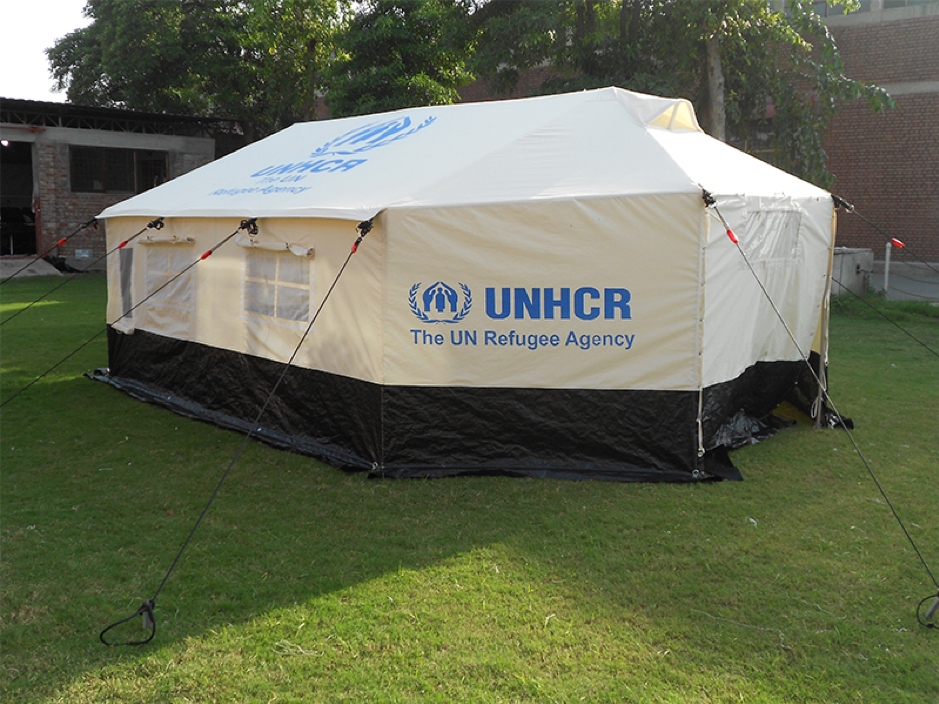


The undated photo shows a UNHCR tent in Lahore, Pakistan. (Photo courtesy: National Tent House)

Ahmed said the NTH is one of the only three suppliers of family tents for the UNHCR, adding that in 2009, it was also listed as the UN’s number one vendor in terms of “purchase order value.” 

Though water has receded in many parts of Pakistan, the floods displaced an estimated 33 million people and at one point, submerged one-third of the country in water. As flash floods swept away large swathes of land and damaged critical infrastructure across the country, Pakistan estimated losses from the floods to be over $30 billion. 

Shabab Ahmed, ex-chairman and current executive member of the Pakistan Canvas and Tents Manufacturers and Exporters Association (PCTMEA) told Arab News that during the floods, the association supplied 0.2 million tents in just 30 days. He said the association can produce up to 0.5 million tents and two million blankets on a monthly basis. 
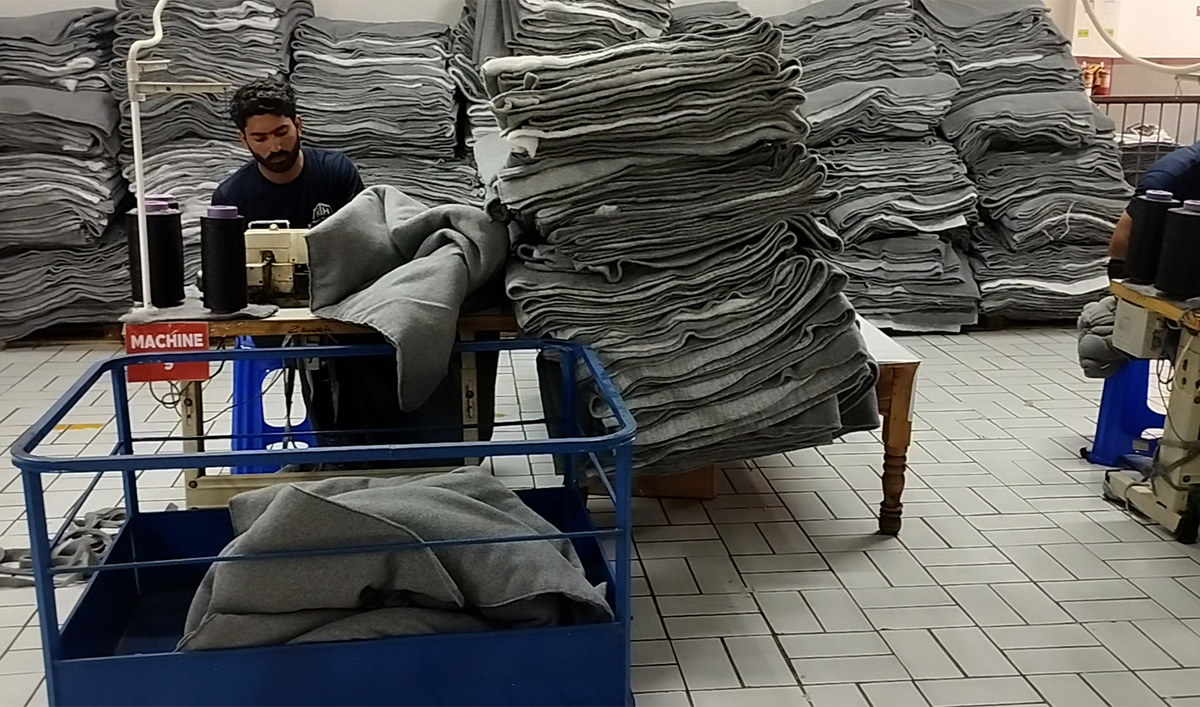


This photo taken on March 29, 2023, shows a worker sewing a blanket at National Tent House in Karachi, Pakistan. (AN photo)

However, Pakistan’s economic crisis has made it difficult to manufacture tents and blankets, Ahmed says. The South Asian country is struggling to revive a $6.5 billion loan program with the International Monetary Fund (IMF) as its forex reserves dip to an alarmingly low level. According to official data, Pakistan lacks enough reserves to provide import cover for over four weeks. 

To prevent the outflow of dollars, Pakistan has imposed restrictions on imports, causing a massive setback to manufacturers who rely on raw materials for production. The restrictions have forced commercial banks to stop issuing letters of credit to importers. 

“Our country is import-driven and even the tiniest part of raw material is imported,” Shabab said. “Hence, the non-issuance of letters of credit (LCs) is disturbing the supply chain of our industry, eventually having an impact on delivery timelines.” 

“It’s very tough these days because we as a country are going through an economic crisis and it’s very tough to arrange raw materials on time and then supplying to the humanitarian aid agencies is a risky task and a tough one,” Shabab said. 

“These humanitarian aid agencies don’t see if your country is going through an economic crisis or anything, because they purchase our products when any disaster or any emergency happens so they just want their products. So, it’s very tough for us to accommodate in these circumstances.” 
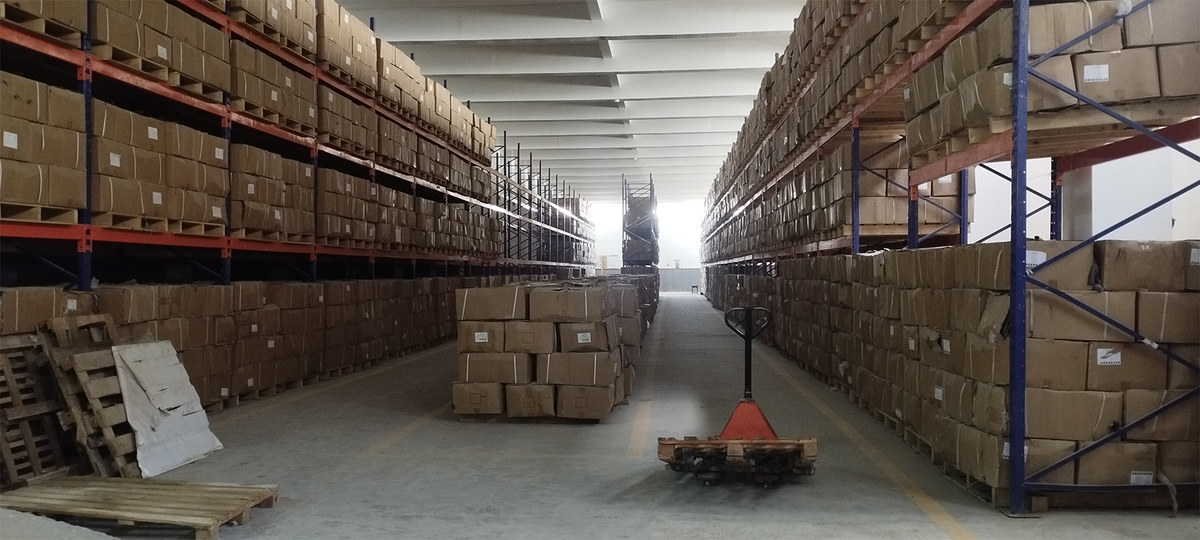


The image taken on March 29, 2023, shows a stock for shipment at the National Tent House's warehouse in Karachi, Pakistan. (Photo courtesy: AN photo)

Tent manufacturers say the economic crisis in Pakistan is also negatively impacting the export industry, including suppliers of relief products. 

The export of tents, canvas and tarpaulin from Pakistan has increased by 20 percent in terms of value to $86.3 million, but in terms of quantity, exports have declined by over 4 percent from July 2022 till January 2023, according to official data. 

Pakistani exporters say the fluctuation of exchange rate and energy crisis are also impacting the country’s exports. 

“This is adversely impacting cost of doing business as it is difficult to forecast and commit to buyers for long-term agreements,” Shabab added. 

In Pakistan’s Bannu, people start their day with a sugar rush

Updated 5 sec ago
Follow

In Pakistan’s Bannu, people start their day with a sugar rush

  • While much of Pakistan favors savory breakfasts, residents of Bannu prefer a sweet, caramelized halwa
  • People line up before sunrise at the decades-old Speen Sar restaurant to cherish its signature dish

BANNU, Pakistan: Before sunrise, the narrow lane outside Speen Sar, a modest restaurant, fills with customers waiting for halwa, a dense sweet made from wheat starch, sugar and clarified butter, that serves as breakfast for many people in this northwestern city.

Inside the restaurant’s kitchen, the morning air is thick with the scent of caramelized sugar and heated ghee. A chef leans over a large metal vat, dissolving sugar into the hot fat before adding a slurry of flour and water. With rhythmic, heavy strokes, he stirs the mixture until it thickens into a glossy halwa.

He pours the sweet onto a tray and rushes toward the counter, where a crowd of patrons has already gathered. Three cooks work in quick succession to keep pace with demand, turning out batch after batch during the breakfast rush in Bannu, a city in Pakistan’s Khyber Pakhtunkhwa province.

While halwa is widely eaten as a dessert or festival sweet across South and Central Asia and the Middle East, Bannu stands apart for turning it into a morning staple. Across most of Pakistan, breakfast tends to be savory, typically consisting of omelets, parathas or puris, and in some places nihari, a slow-cooked meat stew. Here, however, halwa is not a side dish but the meal itself, eaten plain or with bread before the workday begins.

“We open the shop at the time of morning prayer, and after prayer, we start preparing,” says Zahid Khan, whose grandfather Akbar Ghulam opened the restaurant over six decades ago.

The shop’s name, Speen Sar — Pashto for “white-haired man” — dates back to its earliest days. Khan said the business began as a small stall run by his grandfather. As he grew older and his hair turned white, customers began directing others to the “speen sar” shop, the place where the white-haired man sold halwa. The nickname endured, eventually becoming the shop’s official identity.

Speen Sar relies on a labor-intensive process of extracting starch from wheat flour.

“In our halwa, we use ghee, sugar, flour and other ingredients. From the flour, the starch that comes out is what we use to make the halwa,” Khan explained before examining the cooking process in his kitchen.

Bannu sits at the crossroads between Pakistan’s former tribal areas and the settled plains of the northwest, and the halwa shop serves as a rare social equalizer, drawing laborers, traders, students and travelers to the same counter each morning. For many passing through the city, stopping for halwa is not optional.

“Whenever I come from Waziristan ... the first thing I do is start with halwa,” says Irafullah Mehsud, an expatriate worker. “I eat the halwa first, and only then move on to other things.”

The popularity of the dish is partly due to its shelf life and to what the owners call good quality. At Rs500 ($1.80) per kilogram, it is an affordable luxury as well.

“Our halwa is widely consumed with breakfast, and it does not spoil quickly. If you want, that you will eat it tomorrow, you can even set some aside for the next day,” Khan said, pointing to a tray of nishasta halwa, a variety made by extracting wheat starch before cooking.

While the region offers variations including sohan halwa, milk-based recipes, and carrot-infused batches, this halwa offered by Speen Sar remains the undisputed king of the breakfast table in this city.

“This is a tradition of the people of Bannu. Early in the morning, everyone eats it and comes here,” says Razaullah Khan, a student at a local college. “Eating halwa is a common practice here ... but this one is the most popular. People eat it for breakfast.”

For the elders of the city, the habit is as much about routine as it is about flavor.

“This tradition has been going on for the past forty to fifty years ever since I can remember,” says Sakhi Marjan, a local elder in his late sixties. “We first come to the Azad Mandi market and then come here to eat halwa. We really enjoy this halwa. It is delicious.”

As the sun rises over Bannu, this ‘sweet’ trade shows no sign of slowing. For those like Gul Sher, a regular from Jani Khel, a town in a neighboring tribal district, a day without the local sweet is a day started wrong.

“As soon as I step into Bannu, I start my day with halwa. After that, the rest of the day goes well,” Sher said before finishing his plate of halwa.

“It is a sweet dish, and it makes the day better. It is a good thing.”