

Asia’s factory activity weakens as global demand falters

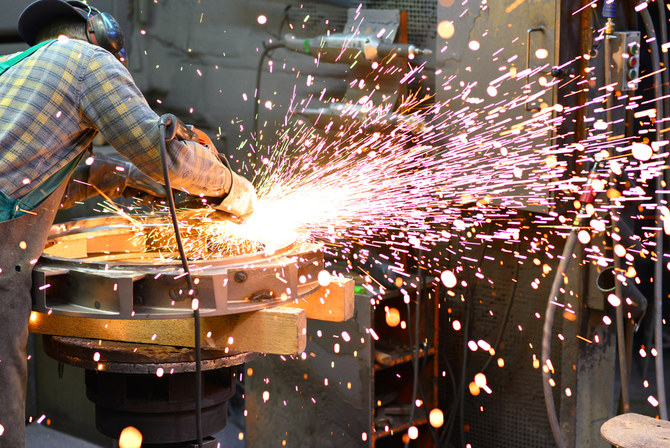
China's manufacturing sector was among those to stall in March (Shutterstock)
Short Url
Updated 03 April 2023
Follow

Asia’s factory activity weakens as global demand falters

TOKYO: Asia’s factory activity weakened in March as soft overseas demand hurt output, surveys showed on Monday, suggesting that a deteriorating global outlook will remain a drag on the region’s recovery and keep policymakers on their toes, according to Reuters.

Export-reliant Japan and South Korea both saw manufacturing activity contract in March while growth in China stalled, highlighting the challenge facing Asia as authorities try to keep inflation in check and fend off headwinds from slackening global economic momentum.

“With global growth set to remain weak in the coming quarters, we expect manufacturing output in Asia to remain under pressure,” said Shivaan Tandon, emerging Asia economist at Capital Economics.

China’s Caixin/S&P Global manufacturing purchasing managers’ index stood at 50.0 in March, much lower than market forecasts of 51.7 and below February’s 51.6.

The reading, which echoed slower growth in an official PMI released on Friday, put the index at the 50-point line that separates growth from contraction.

“The foundation for economic recovery is not yet solid. Looking forward, economic growth will still rely on a boost in domestic demand, especially an improvement in household consumption,” Wang Zhe, senior economist at Caixin Insight Group, said on China’s PMI.

South Korea’s PMI fell to 47.6 in March from 48.5 in February, contracting at the fastest pace in six months as export orders took a hit from weak global demand.

Japan’s final au Jibun Bank PMI stood at 49.2 in March, up from February’s 47.7 but remaining below the 50-threshold, as new orders contracted for a ninth consecutive month.

A separate central bank survey released on Monday showed Japanese big manufacturers’ sentiment soured in January-March to its worst level in more than two years, as weak external demand added to the struggle for firms already grappling with rising raw material costs.

India was a rare bright spot in the region, with its manufacturing sector expanding at its quickest pace in three months in March on improved output and new orders, suggesting its economy is better placed than most of its peers to weather a global slowdown.

Vietnam and Malaysia saw factory activity shrink in March, while that of the Philippines expanded at a slower pace than in February, surveys showed.

While supply disruptions caused by the COVID-19 pandemic have mostly run their course, weak chip demand and fresh signs of slowdown in global growth have emerged as risks to many Asian economies.

The collapse last month of two US banks and the take-over of Credit Suisse have added to uncertainty over the global outlook by causing market turbulence and shedding light on potential vulnerabilities in the world financial system.

While indications are that the US Federal Reserve will pause its tightening cycle soon, the outlook remains clouded by the banking-sector troubles, still-high inflation and slowing global growth.

The external pressures and uncertainty leave some of the major export-driven economies in Asia vulnerable at a time when businesses are looking to bounce back after a years-long COVID-induced downturn.

“Given much of the drag from higher interest rates is yet to feed through to advanced economies, we expect global growth and demand for Asia’s exports to remain weak in the coming quarters,” Capital Economics’ Tandon said.


EU investments in Saudi Arabia to prosper over next 5 years, says ambassador

Updated 8 sec ago
Follow

EU investments in Saudi Arabia to prosper over next 5 years, says ambassador

RIYADH: European investments in Saudi Arabia are set to see notable growth over the next five years, encompassing green energy, metals, critical raw materials, advanced industry, and the digital sector.

Christophe Farnaud, the EU Ambassador to Saudi Arabia, confirmed to Al-Eqtisadiah that an anticipated memorandum of understanding with the Kingdom in the energy field will provide an organized framework for cooperation in energy transition and sustainability, boosting investor confidence in the long-term partnership between the two sides.

The volume of trade in goods and services between Saudi Arabia and the EU amounts to €90 billion ($105.6 billion), according to the latest data from 2024, making the EU the Kingdom’s second-largest trading partner, according to Farnaud. 

Currently, 2,500 European companies operate within the Saudi market, highlighting the depth of economic relations between the two sides.

A qualitative development in relations

Farnaud affirmed that Saudi-European relations are witnessing qualitative development, especially since the EU’s adoption in 2022 of its strategy towards Gulf Cooperation Council countries, which is based on enhancing political, security, and economic cooperation, in addition to cultural and humanitarian exchange. 

He noted that Saudi Arabia’s Vision 2030 constitutes an attractive framework for strengthening this partnership.

The ambassador also pointed out that the launch of the European Chamber of Commerce in the Kingdom of Saudi Arabia during 2024 represented an important step to support cooperation between European and Saudi companies and enhance mutual investments, reflecting a positive outlook for the future of economic relations. 

Economic relations are no longer limited to traditional trade exchange but have transformed into a multi-sector partnership, including investment, services, manufacturing, energy, and sustainability, according to Farnaud.

Christophe Farnaud, the EU Ambassador to Saudi Arabia meeting Crown Prince Mohammed bin Salman in 2025. X/@EUAmbGCC

Relaunching Free Trade Agreement negotiations

The ambassador revealed ongoing discussions to relaunch negotiations for a Free Trade Agreement between the EU and GCC countries, which have been stalled since 2008, aiming to reach a modern agreement covering investment, services, intellectual property protection, technical standards, and government procurement.

He also indicated readiness to launch negotiations for a bilateral strategic partnership agreement with Saudi Arabia, including industrial cooperation, critical raw materials, energy, and sustainability, alongside working to sign a memorandum of understanding in the energy field in the coming period.

The EU, according to Farnaud, is the largest foreign investor in Saudi Arabia, holding 29 percent of the total foreign direct investment stock, which amounted to 30.7 billion euros in 2023. 

Investments are concentrated in the transport, energy, industry, tourism, education, and training sectors, with major European companies participating in strategic projects like the Riyadh Metro.

Sectors of common priority

The ambassador explained that the energy sector, especially renewable energy and green hydrogen, represents a common priority, amidst the global shift towards sustainability, in addition to significant opportunities in the high-tech manufacturing sector, industrial localization, and knowledge transfer.

He pointed to the growing interest of European investors in Saudi Arabia’s tourism sector, driven by Vision 2030’s targets to raise tourism’s contribution to the gross domestic product to 10 percent.

Wide opportunities stand out in areas of hospitality, tourist destination management, cultural tourism, transport, and sustainability, especially in major projects like NEOM, AlUla, the Red Sea Project, and Diriyah.

Farnaud cited existing partnerships with leading European companies such as Accor and Kempinski, in addition to French cooperation in developing AlUla as a global heritage and tourist site.