Pakistani police arrest eight after deadly Ramadan food stampede in Karachi

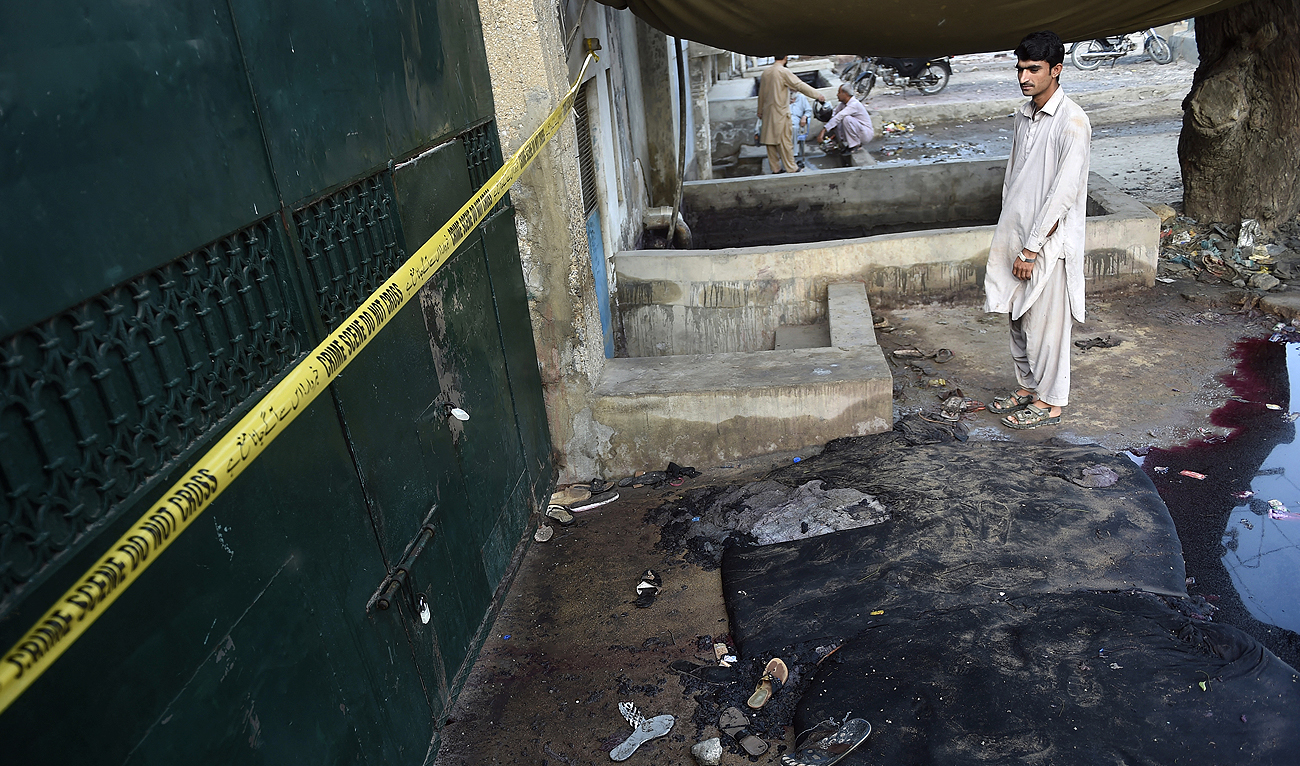
A bystander looks on at the site of a stampede in Karachi on April 1, 2023, a day after a crush during a Ramadan alms donation that has killed at least 11 people. (Photo courtesy: AFP)
Short Url
Updated 01 April 2023
Follow

Pakistani police arrest eight after deadly Ramadan food stampede in Karachi

  • At least 23 people have died in Ramadan food stampedes since the start of the holy month
  • Police recently fired tear gas at crowds in Peshawar who gathered to receive free flour bags

KARACHI: Pakistani police on Saturday arrested eight people in the southern port city of Karachi after a stampede killed 12 people at a Ramadan food and cash distribution point a day earlier.

Hundreds of women and children rushed to collect free food and cash outside a factory in an industrial area of the city on Friday. Business owners during the Islamic holy month often hand out cash and food, especially to the poor. An initial report from the police says nine women, aged between 40 and 80, and three children, aged between 10 and 15, died in the crush.

Police said the eight arrests include the factory manager, who did not tell local authorities about the Ramadan alms giving.

“Factory management did not open the inside gate of the factory and, due to the narrow street, the people at the tail of the line pushed elderly women and children,” Superintendent of Police Investigations Dr. Hafeez Bugti told the media during a visit to the site. “As a result, pressure increased enormously, and women and children became the victims of the stampede.”

Police say they issued and publicized an order saying that any person or organization planning to distribute food or other things to the poor must inform authorities in advance.

The chief minister of Sindh province, where Karachi is located, announced compensation for people injured in the stampede and relatives of the victims. Murad Ali Shah said each family who lost a loved one will receive 500,000 rupees, while everyone injured will receive 100,000 rupees.

Funerals were held Saturday for some of the deceased: Naseem Begum, 50, and Ma’afia Begum, 55, were buried in Karachi’s Orangi Town neighborhood. Shehzadi Umar, 60, was laid to rest in her hometown of Mirpur Mathelo, some eight hours from Karachi.

At least 23 people have died in Ramadan food stampedes since the start of the holy month. On Saturday, police fired tear gas at crowds who gathered to receive free flour bags in the northwestern city of Peshawar.

Cash-strapped Pakistan launched an initiative to distribute free flour among low-income families to ease the impact of record-breaking inflation and soaring poverty during the holy month.

While Friday’s stampede was not part of that government program, crowds have swelled at the distribution centers in recent days. The free flour distribution initiative was launched by Pakistan’s Prime Minister Shahbaz Sharif. His coalition government is facing the country’s worst economic crisis amid a delay in getting a key $1.1 billion tranche of a $6 billion bailout package originally signed in 2019 with the International Monetary Fund.

Weekly inflation is 45%, unseen since Pakistan got its independence from British colonial rule in 1947. Rising food costs and soaring fuel bills have raised fears of public unrest.

Neither Sharif nor Pakistani President Arif Alvi have commented on Friday’s stampede.

World Bank approves $400 million to expand water, sanitation services in Pakistan’s Punjab

Updated 12 December 2025
Follow

World Bank approves $400 million to expand water, sanitation services in Pakistan’s Punjab

  • Project aims to improve access for 4.5 million people and curb waterborne diseases
  • Program to prioritize women’s participation and climate-resilient urban infrastructure

ISLAMABAD: The World Bank this week approved $400 million for a new project to expand access to safe water, sanitation and hygiene services for around 4.5 million people in Pakistan’s most populous Punjab province, aiming to curb waterborne diseases and reduce long-term public health costs.

The project, known as the Punjab Inclusive Cities Program (PICP), is the second phase of the World Bank-supported Pakistan Urban Water, Sanitation and Hygiene Services Multiphase Programmatic Approach. It will focus on rehabilitating water supply networks, sewerage systems and wastewater treatment plants, while expanding stormwater drainage infrastructure across 16 secondary cities in Punjab.

Punjab faces persistent challenges in providing safe drinking water and adequate sanitation, with many urban households relying on contaminated sources. Weak infrastructure and limited hygiene services contribute to high rates of waterborne diseases such as diarrhea, typhoid and hepatitis, which disproportionately affect children and low-income communities.

“Reducing child stunting is essential for Pakistan’s future. Through the Punjab Inclusive Cities Program, we are investing in safe water, sanitation, and hygiene services to break the cycle of malnutrition and disease that holds back so many children from reaching their full potential,” the World Bank quoted its Country Director for Pakistan, Bolormaa Amgaabazar, as saying in a statement.

“In collaboration with the Punjab Government, the program represents a significant step forward in improving urban infrastructure and strengthening local institutions, thereby laying the foundation for healthier communities and a more prosperous Pakistan.”

Child stunting, a form of chronic malnutrition that leaves children too short for their age, is often linked to repeated infections, poor sanitation and unsafe drinking water, and remains a major public health concern in Pakistan.

Beyond water and sanitation, the project will also support solid waste management systems to improve sanitary waste disposal, extending services to an additional two million people in Punjab’s urban areas. The program will strengthen the capacity of local governments, including efforts to improve revenue generation and long-term service sustainability.

“The program complements infrastructure investments with capacity building and revenue generation, helping to ensure that service delivery is well sustained,” the statement quoted Amena Raja, Senior Urban Specialist at the World Bank, as saying.

“It will also help Punjab’s cities better withstand floods and droughts, ensuring urban development is both environmentally responsible and resilient to climate change.”

The program includes a gender-focused component, prioritizing the hiring of women in decision-making roles, establishing gender-compliant service desks and supporting skills development. It also aims to mobilize private capital to support water and sanitation services in Punjab’s secondary cities.

Pakistan has been a member of the World Bank since 1950 and has received more than $48 billion in assistance since. The Bank’s current portfolio in the country comprises 54 projects with total commitments of $15.7 billion, while its private-sector arm, the International Finance Corporation, has invested about $13 billion since 1956.

Earlier this year, Pakistan and the World Bank signed a first-of-its-kind agreement for a plan to focus $20 billion in lending to the cash-strapped nation over the coming decade on development issues like the impact of climate change as well as boosting private-sector growth.