

Sikh, Christian die in targeted killings in Pakistan’s northwest

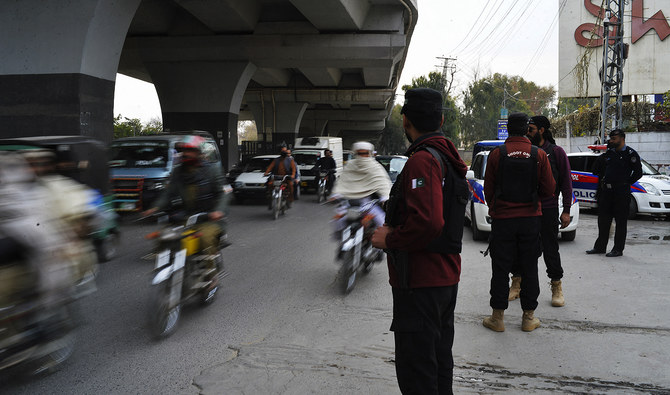
In this picture taken on February 1, 2023, policemen stand guard along a street in Peshawar. (Photo courtesy: AFP/File)
Short Url
Updated 01 April 2023
Follow

Sikh, Christian die in targeted killings in Pakistan’s northwest

  • Officials say they have found evidence from surveillance camera footage and will soon identify the gunmen
  • Religious minorities often face violence in Pakistan, though the country’s constitution guarantees them equal rights

PESHAWAR: A Pakistani Sikh businessman and a Christian cleaner were shot dead by unknown assailants in separate incidents in the northwestern city of Peshawar, police said Saturday.

Gunmen on a motorbike opened fire on Sikh shop owner Dayal Singh when he was in his grocery store and fled the scene, said police officer Haroon Rasheed. He said an investigation was underway.

Rasheed said police have found evidence from surveillance camera footage and will soon be able to identify the gunmen.

Ranveer Singh, a representative of Pakistan’s minority Sikh community, said the businessman had no problems with anyone. He said Sikhs are feeling insecure as 11 members of their community have been killed in recent years.

The minister for information and religious minorities in Khyber Pakhtunkhwa province, where Peshawar is located, assured Sikhs the culprits will be arrested and there will be steps to protect minorities. Feroze Jamal Shah Kakakhel also announced compensation of 500,000 rupees for Singh’s family.

A Christian man, Kashif Maseeh, was shot dead by unknown attackers on Saturday. He was attacked while returning from his job as a cleaner for local authorities.

It was the third targeted killing in two days. Prominent Hindu doctor and eye surgeon Birbal Genani was gunned down in Karachi on Thursday. Police superintendent Zubair Tanoli said Genani received a fatal gunshot to the head.

Religious minorities often face violence in Pakistan, even though the country’s Constitution guarantees them equal rights and the freedom to practice their faith.


Pakistan terms climate change, demographic pressures as ‘pressing existential risks’

Updated 06 December 2025
Follow

Pakistan terms climate change, demographic pressures as ‘pressing existential risks’

  • Pakistan has suffered frequent climate change-induced disasters, including floods this year that killed over 1,000
  • Pakistan finmin highlights stabilization measures at Doha Forum, discusses economic cooperation with Qatar 

ISLAMABAD: Pakistan’s Finance Minister Muhammad Aurangzeb on Saturday described climate change and demographic pressures as “pressing existential risks” facing the country, calling for urgent climate financing. 

The finance minister was speaking as a member of a high-level panel at the 23rd edition of the Doha Forum, which is being held from Dec. 6–7 in the Qatari capital. Aurangzeb was invited as a speaker on the discussion titled: ‘Global Trade Tensions: Economic Impact and Policy Responses in MENA.’

“He reaffirmed that while Pakistan remained vigilant in the face of geopolitical uncertainty, the more pressing existential risks were climate change and demographic pressures,” the Finance Division said. 

Pakistan has suffered repeated climate disasters in recent years, most notably the 2022 super-floods that submerged one-third of the country, displaced millions and caused an estimated $30 billion in losses. 

This year’s floods killed over 1,000 people and caused at least $2.9 billion in damages to agriculture and infrastructure. Scientists say Pakistan remains among the world’s most climate-vulnerable nations despite contributing less than 1 percent of global greenhouse-gas emissions.

Aurangzeb has previously said climate change and Pakistan’s fast-rising population are the only two factors that can hinder the South Asian country’s efforts to become a $3 trillion economy in the future. 

The finance minister noted that this year’s floods in Pakistan had shaved at least 0.5 percent off GDP growth, calling for urgent climate financing and investment in resilient infrastructure. 

When asked about Pakistan’s fiscal resilience and capability to absorb external shocks, Aurangzeb said Islamabad had rebuilt fiscal buffers. He pointed out that both the primary fiscal balance and current account had returned to surplus, supported significantly by strong remittance inflows of $18–20 billion annually from the Middle East and North Africa (MENA) and Gulf Cooperation Council (GCC) regions. 

Separately, Aurangzeb met his Qatari counterpart Ali Bin Ahmed Al Kuwari to discuss bilateral cooperation. 

“Both sides reaffirmed their commitment to strengthening economic ties, particularly by maximizing opportunities created through the newly concluded GCC–Pakistan Free Trade Agreement, expanding trade flows, and deepening energy cooperation, including long-term LNG collaboration,” the finance ministry said. 

The two also discussed collaboration on digital infrastructure, skills development and regulatory reform. They agreed to establish structured mechanisms to continue joint work in trade diversification, technology, climate resilience, and investment facilitation, the finance ministry said.