

Pakistan posts highest-ever annual inflation as stampedes for food kill 16 

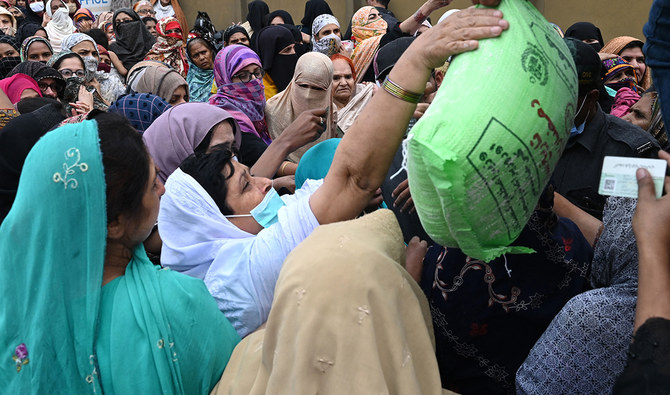
People gather to receive the free bags of flour from a delivery truck at a distribution point ahead of the Muslim holy fasting month of Ramadan, in Lahore on March 20, 2023, following an announcement from Pakistan’s Prime Minister Shehbaz Sharif to provide free flour to the needy people during the Ramadan in the wake of country's soaring inflation. (AFP/File)
Short Url
Updated 01 April 2023
Follow

Pakistan posts highest-ever annual inflation as stampedes for food kill 16 

  • March inflation numbers eclipse Feb's 31.5%, with food, beverage and transport prices surged up to 50 year-on-year
  • Thousands have gathered at flour distribution centers, some as part of a government-backed program to ease impact 

ISLAMABAD: Consumer price inflation in Pakistan jumped to a record 35.37 percent in March from a year earlier, the statistics bureau said on Saturday, as at least 16 people were killed in stampedes for food aid. 

The March inflation number eclipsed February’s 31.5 percent, the bureau said, as food, beverage and transport prices surged up to 50 percent year-on-year. 

Thousands of people have gathered at flour distribution centers set up across the country, some as part of a government-backed program to ease the impact of inflation. 

At least 16 people, including five women and three children, have been killed in stampedes at such centers in recent days, police and officials have said. Thousands of bags of flour have also been looted from trucks and distribution points, according to official records. 

A spokesman at the statistics bureau said the inflation number was the highest ever year-on-year increase recorded by the bureau since monthly records began in the 1970s. 

“This is the highest ever inflation recorded in the data we have,” he said. 

The consumer price index was up 3.72 percent in March from the previous month, the bureau said. 

Higher prices of food, cooking oil and electricity pushed up the index, it said. 

Annual food inflation in March was at 47.1 percent and 50.2 percent for urban and rural areas respectively, the bureau said. Core inflation, which strips out food and energy, stood at 18.6 percent in urban areas and 23.1 percent in rural areas. 

The South Asian nation has been in economic turmoil for months with an acute balance of payments crisis while talks with the IMF to secure $1.1 billion funding as part of $6.5 billion bailout agreed in 2019 have not yet yielded fruit. 

Pakistan’s foreign exchange reserves have fallen to cover barely four weeks of imports. 

A monthly economic outlook report issued by the finance ministry on Friday projected inflation would remain elevated. 

The report cited market frictions caused by relative demand and supply gaps of essential items, exchange rate depreciation, and the recent upward adjustment in fuel prices as reasons behind higher inflation expectations. 


Pakistan president in Bahrain to boost trade, defense and security ties

Updated 14 sec ago
Follow

Pakistan president in Bahrain to boost trade, defense and security ties

  • Asif Ali Zardari will meet Bahrain’s king and crown prince, discuss regional issues of mutual interest
  • Trade volume between Pakistan and Bahrain has increased from $500 million to $1 billion in recent years

ISLAMABAD: Pakistan President Asif Ali Zardari arrived in Bahrain late Tuesday on a four-day visit to enhance bilateral cooperation in trade, defense and security, Pakistani state media reported.

Pakistan and Bahrain have maintained close diplomatic, trade, investment and defense relations and have lately been focusing on strengthening their cooperation in key economic sectors.

The Pakistan president’s visit will be focused on bilateral, regional and international issues of mutual interest for both nations, according to the foreign office in Islamabad.

He will hold talks with King Hamad bin Isa Al-Khalifa and Crown Prince Salman bin Hamad, and address a reception held at the headquarters of the Economic Development Board in Manama.

“The visit seeks to reinforce Pakistan’s longstanding cooperation with the brotherly Gulf nation while expanding opportunities for collaboration in trade and economic partnership, defense and security and people-to-people ties,” the Radio Pakistan broadcaster said.

Islamabad and Manama established diplomatic ties in 1971. In recent years, the bilateral trade volume between the two countries has ranged between $500 million to around $1 billion, according to Pakistan’s foreign ministry.

Major exports from Pakistan to Bahrain include meat, vegetables, rice, tobacco and textile. Imports from Bahrain, on the other hand, include petroleum products, ferrous wastes and scrape and aluminum.

Both have established a Joint Ministerial Commission (JMC) at the level of foreign ministers to discuss trade and economic ties, take decisions mutually and supervise the implementation of these decisions. So far, only two sessions of the JMC have been held and the last one was held in Bahrain in July 2021.

Zardari’s visit takes place amid increasing economic engagement between the two nations following the Pakistan-Bahrain Investment Summit in May 2025. Both sides signed contracts worth $13 million during the summit.