Japanese PM hails ties with Islamic countries at Ramadan dinner

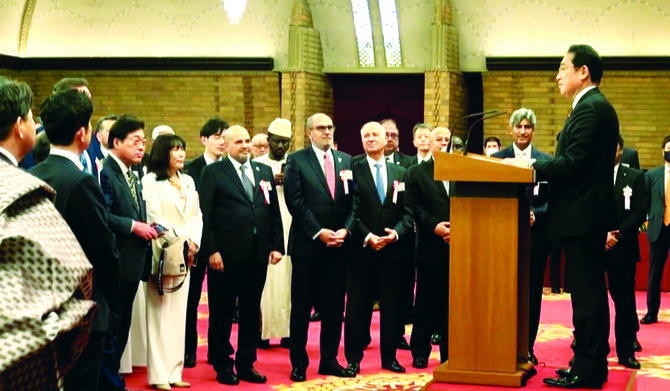
Japanese Prime Minister Kishida Fumio speaks during the event. The event was attended by the heads of Islamic diplomatic missions in Japan, top Foreign Ministry officials and others. (AN photo)
Short Url
Updated 01 April 2023
Follow

Japanese PM hails ties with Islamic countries at Ramadan dinner

  • Ambassador of Palestine and dean of the Arab diplomatic missions, Waleed Siam, told Arab News Japan: “Hosting the Ramadan iftar dinner has been a tradition of Japanese prime ministers, and we highly appreciate it”

TOKYO: Japanese Prime Minister Kishida Fumio hosted a dinner at his office in Tokyo on Thursday to mark the holy month of Ramadan and spoke of the tolerance of Islam needed to combat conflicts in the world.
The event was attended by the heads of Islamic diplomatic missions in Japan, Foreign Minister Hayashi Yoshimasa, top Foreign Ministry officials, parliamentarians and representatives of Islamic organizations.

“After experiencing the pandemic, the international community stands at a historic turning point,” Kishida said in his address. “Now, more than ever, we must lead the international community toward cooperation instead of division and conflict. I feel that the ‘wifaq’ or harmony and ‘tassmoh’ or tolerance that both Japan and Islamic countries embrace are becoming more important.

Now, more than ever, we must lead the international community toward cooperation instead of division and conflict.

Kishida Fumio, Japanese prime minister

“In that connection, the plan of a free and open Indo-Pacific, or FOIP, which I announced recently, is an important tool. The vision of FOIP honors inclusivity and diversity. Under this plan, we have launched four pillars to make clear our intention to expand cooperation with regions and countries. We would also like to upgrade our relationships with Islamic countries as we continue to advance such efforts.”
Kishida said he had worked hard through meetings, phone calls and events such as TICAD8 to “deepen the bonds of trust and friendship” with the Islamic world.
“Since I was the foreign minister, I have long embraced our ties with the Islamic World, which stretches from Southeast Asia through the Middle East, Central Asia, Africa and Europe.”
Kishida concluded his remarks by wishing, “tonight’s occasion, where we share our moments with friends from Muslim communities, will be a great opportunity to deepen the friendship between Japan and your countries.”
Ambassador of Palestine and dean of the Arab diplomatic missions, Waleed Siam, told Arab News Japan: “Hosting the Ramadan iftar dinner has been a tradition of Japanese prime ministers, and we highly appreciate it.”


Ethiopia’s prime minister accuses Eritrea of mass killings during Tigray war

Updated 6 sec ago
Follow

Ethiopia’s prime minister accuses Eritrea of mass killings during Tigray war

  • Landlocked Ethiopia says that Eritrea is arming rebel groups, while Eritrea says Ethiopia’s aspiration is to gain access to a seaport
  • Ethiopia lost sovereign access to the Red Sea when Eritrea seceded in 1993 after decades of guerrilla warfare

ADDIS ABABA: Ethiopia’s government Tuesday for the first time acknowledged the involvement of troops from neighboring Eritrea in the war in the Tigray region that ended in 2022, accusing them of mass killings, amid reports of renewed fighting in the region.
Ethiopian Prime Minister Abiy Ahmed, while addressing parliament Tuesday, accused Eritrean troops fighting alongside Ethiopian forces of mass killings in the war, during which more than 400,000 people are estimated to have died.
Eritrean and Ethiopian troops fought against regional forces in the northern Tigray region in a war that ended in 2022 with the signing of a peace agreement.
Eritrea’s Information Minister Yemane Gebremeskel told The Associated Press that Ahmed’s comments were “cheap and despicable lies” and did not merit a response.
Both nations have been accusing each other of provoking a potential civil war, with landlocked Ethiopia saying that Eritrea is arming and funding rebel groups, while Eritrea says Ethiopia’s aspiration is to gain access to a seaport.
“The rift did not begin with the Red Sea issue, as many people think,” Ahmed told parliamentarians. “It started in the first round of the war in Tigray, when the Eritrean army followed us into Shire and began demolishing houses, massacred our youth in Axum, looted factories in Adwa, and uprooted our factories.”
“The Red Sea and Ethiopia cannot remain separated forever,” he added.
Ethiopia lost sovereign access to the Red Sea when Eritrea seceded in 1993 after decades of guerrilla warfare.
Gebremeskel said the prime minister has only recently changed his tune in his push for access to the Red Sea.
Ahmed “and his top military brass were profusely showering praises and State Medals on the Eritrea army and its senior officers. … But when he later developed the delusional malaise of ‘sovereignty access to the sea’ and an agenda of war against Eritrea, he began to sing to a different chorus,” he said.
Eritrea and Ethiopia initially made peace after Abiy came to power in 2018, with Abiy winning a Nobel Peace Prize for his efforts toward reconciliation.
In June, Eritrea accused Ethiopia of having a “long-brewing war agenda” aimed at seizing its Red Sea ports. Ethiopia recently said that Eritrea was “actively preparing to wage war against it.”
Analysts say an alliance between Eritrea and regional forces in the troubled Tigray region may be forming, as fighting has been reported in recent weeks. Flights by the national carrier to the region were canceled last week over the renewed clashes.